Many English learners get confused between “didn’t” and “doesn’t.” They look similar, and both are negative words, so people often mix them up. Even native speakers sometimes make small mistakes in fast speech or writing.
The confusion happens because both words are used to show something did not happen. But they are used in different time situations. One is for the past, and the other is for the present.
In this article, you will learn the difference in a very simple way. After reading, you will know exactly when to use didn’t and when to use doesn’t without guessing.
Quick Answer
Here is the simplest way to understand the difference:
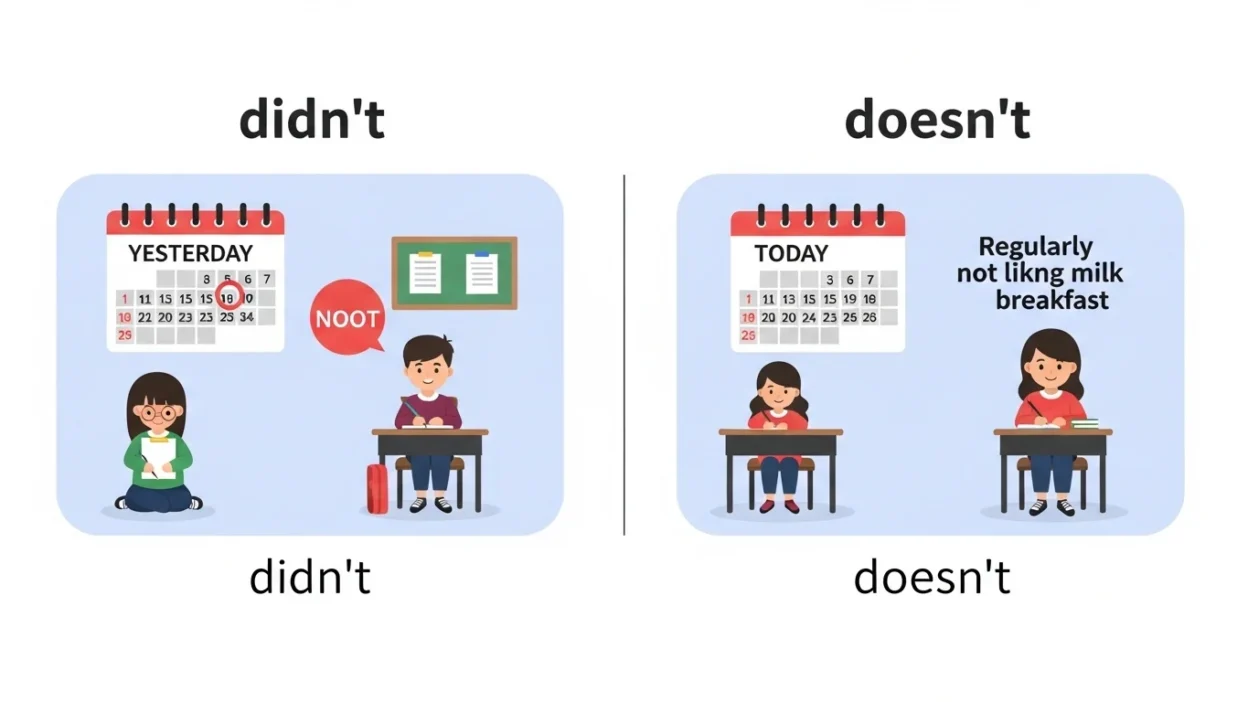
- Didn’t = past time (yesterday, last week, before now)
- Doesn’t = present time (today, now, always)
More simple points:
- Use didn’t when something did NOT happen in the past
- Use doesn’t when something does NOT happen in the present
- Didn’t works with all subjects (I, you, he, she, they)
- Doesn’t usually works with he, she, it (third person singular)
Simple Background Explanation
Both “didn’t” and “doesn’t” come from helping verbs in English.
- “Didn’t” comes from “did not”
- “Doesn’t” comes from “does not”
These are called negative forms because they show that something is not true or did not happen.
English uses different forms depending on time. This is why we need two different words instead of just one.
Think of it like this:
- Past actions use “did”
- Present actions use “does”
When we add “not,” they become “did not” and “does not,” which shorten into “didn’t” and “doesn’t.”
Clear Explanation of the Difference
Let’s understand both words in detail.
Didn’t (Past Negative)
We use didn’t when talking about something that did NOT happen before now.
Examples:
- I didn’t go to school yesterday.
- She didn’t eat breakfast this morning.
- They didn’t watch the movie last night.
In all these sentences, the action is already finished. We are talking about the past.
Important point:
After “didn’t,” the main verb is always in its basic form.
Example:
- Correct: I didn’t play football.
- Incorrect: I didn’t played football.
Doesn’t (Present Negative)
We use doesn’t when something does NOT happen in the present time or regularly.
Examples:
- He doesn’t like milk.
- She doesn’t go to gym every day.
- It doesn’t work properly.
In these sentences, we are talking about habits, facts, or current situations.
Important point:
After “doesn’t,” the main verb is also in basic form.
Example:
- Correct: She doesn’t like tea.
- Incorrect: She doesn’t likes tea.
Comparison
| Feature | Didn’t | Doesn’t |
| Time | Past | Present |
| Full form | Did not | Does not |
| Usage | Finished actions | Current actions or habits |
| Example | I didn’t sleep well | He doesn’t sleep well |
| Verb form after it | Base verb | Base verb |
| Common with | All subjects | He, she, it |
Which One to Use and When
To choose the correct word, ask yourself one simple question:
Is it past or present?
If it happened before now:
- Use didn’t
If it is happening now or usually happens:
- Use doesn’t
Easy trick:
- Think “yesterday” → use didn’t
- Think “today” → use doesn’t
Another helpful idea:
- Didn’t = finished story
- Doesn’t = current story
Common Mistakes People Make
Many learners make similar mistakes. Here are the most common ones:
Using past tense after didn’t
Wrong: I didn’t went home
Correct: I didn’t go home
Using wrong subject with doesn’t
Wrong: They doesn’t like it
Correct: They don’t like it
Mixing past and present
Wrong: She doesn’t went there yesterday
Correct: She didn’t go there yesterday
Forgetting base verb rule
After both didn’t and doesn’t, always use the simple form of the verb.
Everyday Real Life Examples
Let’s see how people use these words in daily life.
Talking with friends
- I didn’t see your message last night.
- He doesn’t answer my calls.
School or study life
- I didn’t understand the lesson yesterday.
- She doesn’t like mathematics.
Social media posts
- I didn’t expect this result!
- He doesn’t use social media much.
News or information style
- The company didn’t announce any changes.
- The system doesn’t support older phones.
At home
- I didn’t clean my room yesterday.
- My brother doesn’t wake up early.
These examples show how both words are part of daily communication.
Learning Section for Beginners
Here is a small practice guide for you.
Try completing these sentences:
- I ___ go to school yesterday. (didn’t / doesn’t)
- She ___ like spicy food. (didn’t / doesn’t)
- They ___ finish their homework. (didn’t / doesn’t)
- He ___ watch the match today. (didn’t / doesn’t)
Answers:
- didn’t
- doesn’t
- didn’t
- doesn’t
Simple memory trick:
- If the sentence is about yesterday, last week, or before, use didn’t
- If the sentence is about today, every day, or now, use doesn’t
FAQ Section
What is the main difference between didn’t and doesn’t?
Didn’t is used for past actions, and doesn’t is used for present actions.
Can I use didn’t for present time?
No, didn’t is only for past situations.
Can I use doesn’t with I or you?
No, we usually use “don’t” with I and you, not doesn’t.
Why do we use base verb after didn’t and doesn’t?
Because both already show negative meaning, so the main verb stays simple.
Is doesn’t only for he, she, and it?
Mostly yes, but also for singular subjects in present tense.
What is the full form of didn’t?
The full form is “did not.”
What is the full form of doesn’t?
The full form is “does not.”
How can I remember the difference easily?
Think: didn’t = past, doesn’t = present.
Conclusion
Understanding didn’t and doesn’t is not difficult once you know the simple rule: time matters.
- Use didn’t for actions that happened in the past and did not occur
- Use doesn’t for actions that are happening now or usually happen
Both words are very common in English speaking and writing. If you remember the time difference and use the base verb after them, you will rarely make mistakes.
With a little practice, choosing between didn’t and doesn’t will become natural and easy.

Steven Mark is a writer, researcher, and contributor at Meanefy.com, a platform dedicated to exploring word meanings, language nuances, and everyday linguistic curiosities. With a passion for words and clear communication, Steven focuses on making language simple, engaging, and accessible to all readers.