Many English learners get confused between “mean” and “meant.” They look similar, and both come from the same idea of “meaning something.” But they are used in different situations.
This confusion is very common for students, learners and even native speakers when they write quickly. If you mix them up, your sentence can sound wrong or unclear.
The good news is: the difference is actually very simple. Once you understand it, you will never forget it.
Quick Answer
Here is the easiest way to understand the difference:
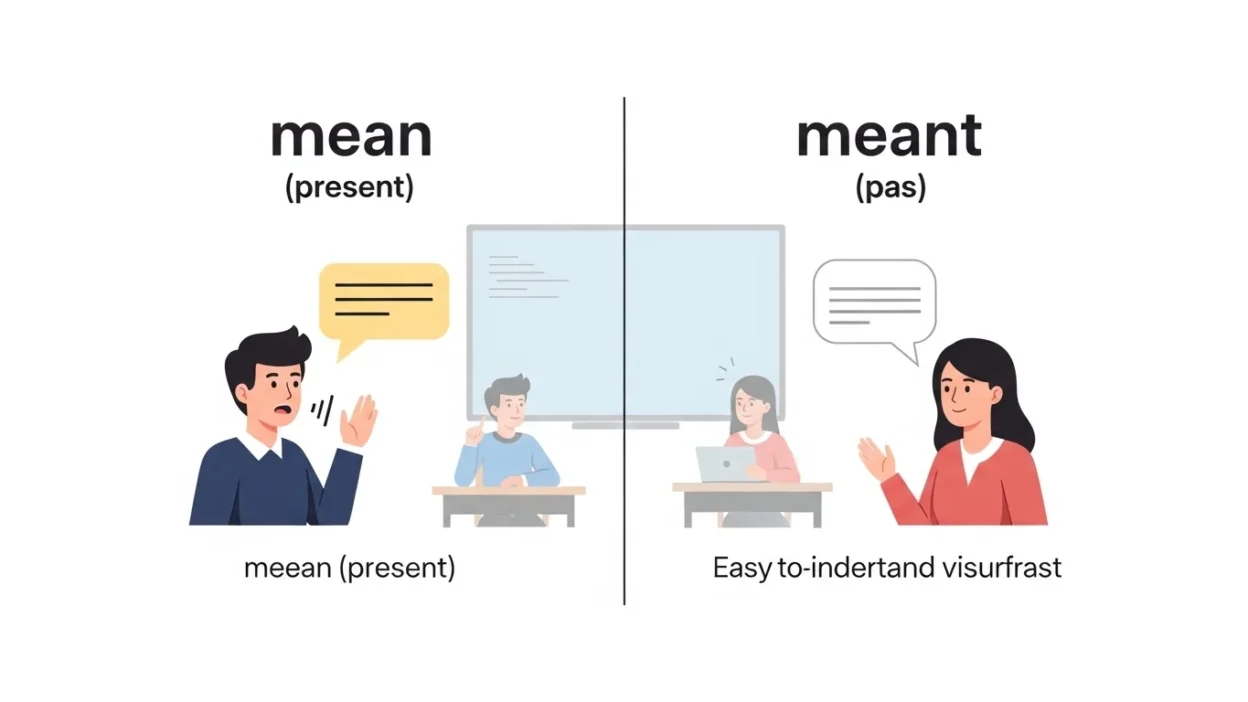
- Mean is present tense (now or general time)
- Example: I mean what I say.
- Example: What do you mean?
- Meant is past tense (before now)
- Example: I meant to call you yesterday.
- Example: She meant no harm.
- Mean = now
- Meant = before / past
That’s it. The whole confusion comes from time.
Simple Origin and Background
The words “mean” and “meant” come from the old idea of “to have a purpose or idea in your mind.”
In simple English:
- “Mean” means you are expressing something now.
- “Meant” means you expressed something in the past.
English verbs often change form to show time. This is why “mean” becomes “meant” when we talk about the past.
Many learners confuse them because:
- They sound similar
- They are used in many everyday sentences
- The meaning changes slightly depending on time
But the base idea stays the same: communication or intention.
Clear Explanation of the Difference
Let’s break it down in a very simple way.
Mean (Present or General Use)
We use mean when:
- Talking about now
- Asking about meaning
- Talking about facts or general truth
Examples:
- What do you mean?
- I mean this sentence clearly.
- This word means “happy.”
- He means business.
So, “mean” is active and happening now.
Meant (Past Use)
We use meant when:
- Talking about something already done
- Talking about past intention
- Explaining something you said before
Examples:
- I meant to text you yesterday.
- She meant what she said last night.
- We meant no disrespect.
- He meant to help, not hurt.
So, “meant” is always about the past.
Easy Comparison
| Feature | Mean | Meant |
| Time | Present | Past |
| Use | Now or general | Before now |
| Type | Base form | Past form |
| Example | I mean it | I meant it |
| Action | Happening | Already happened |
| Feeling | Current intention | Past intention |
Which One to Use and When
To choose correctly, ask yourself one simple question:
Is it happening now?
- If YES → use mean
- If NO (it already happened) → use meant
Let’s make it even easier:
Use “mean” when:
- You are explaining something now
- You are asking someone about a word or sentence
- You are talking about general meaning
Use “meant” when:
- You talk about something you said before
- You explain past intention
- You correct a past situation
A quick trick:
- mean = now
- meant = memory (past)
Common Mistakes People Make
Many learners mix these words in similar situations. Here are the most common mistakes:
Mistake: Using “mean” for past actions
Wrong:
- I mean to call you yesterday.
Correct:
- I meant to call you yesterday.
Mistake: Using “meant” for present meaning
Wrong:
- What did you meant?
Correct:
- What do you mean?
Mistake: Forgetting time completely
Some learners do not think about time at all and choose randomly.
Fix:
- Always check if the action is past or present.
Mistake: Mixing questions
Wrong:
- What you meant?
Correct:
- What do you mean?
- What did you mean?
Everyday Real Life Examples
Let’s see how people use these words in daily life.
Conversations
- “I don’t understand what you mean.”
- “Oh, I meant something else.”
Messages or Chats
- “Sorry, I meant to reply earlier.”
- “Do you mean you are coming today?”
Social Media
- “I meant no offense in my comment.”
- “What do you mean by that post?”
Emails
- “I meant to send this file yesterday.”
- “Could you explain what you mean in your report?”
Daily Life
- Someone says something confusing:
- “What do you mean?”
- You correct yourself:
- “Sorry, I meant the other place.”
These examples show how common these words are in real communication.
Short Learning Section for Students
Here is a simple way to remember:
Step one: Think about time
- Now → mean
- Before → meant
Step two: Practice small sentences
Try changing sentences like:
- I mean it → I meant it
- What do you mean? → What did you mean?
Step three: Speak aloud
Reading aloud helps your brain remember the difference faster.
Easy memory trick:
- “mean = present moment”
- “meant = memory time”
If you practice this for a few days, you will stop mixing them.
FAQ
Why do “mean” and “meant” look so similar?
They are from the same verb family. One is present form, and one is past form.
Can I use “meant” in questions?
Yes, but only in past questions:
- What did you mean?
Is “mean” only for meaning words?
No. It can also show intention:
- I mean to help you.
What is the easiest way to remember the difference?
Think about time:
- mean = now
- meant = before
Can “mean” be used in past tense sentences?
No. For past, you must use “meant.”
Why do people confuse these words so much?
Because they are short, similar, and used in fast speech and writing.
Are “mean” and “meant” important in English?
Yes. They are very common in daily communication.
Conclusion
The difference between mean and meant is simple once you understand time.
- Mean is used for present or general situations.
- Meant is used for past situations.
If you remember just one idea mean is now, meant is before you will almost never make mistakes again.
With a little practice in speaking and writing, using these words correctly will become natural and easy.

Daniel Matthew is a language enthusiast, writer, and contributor at Meanefy.com, where he explores the meanings, origins, and nuances of words and phrases. With a deep passion for language, Daniel aims to make complex concepts simple, engaging, and easy to understand for readers of all ages.