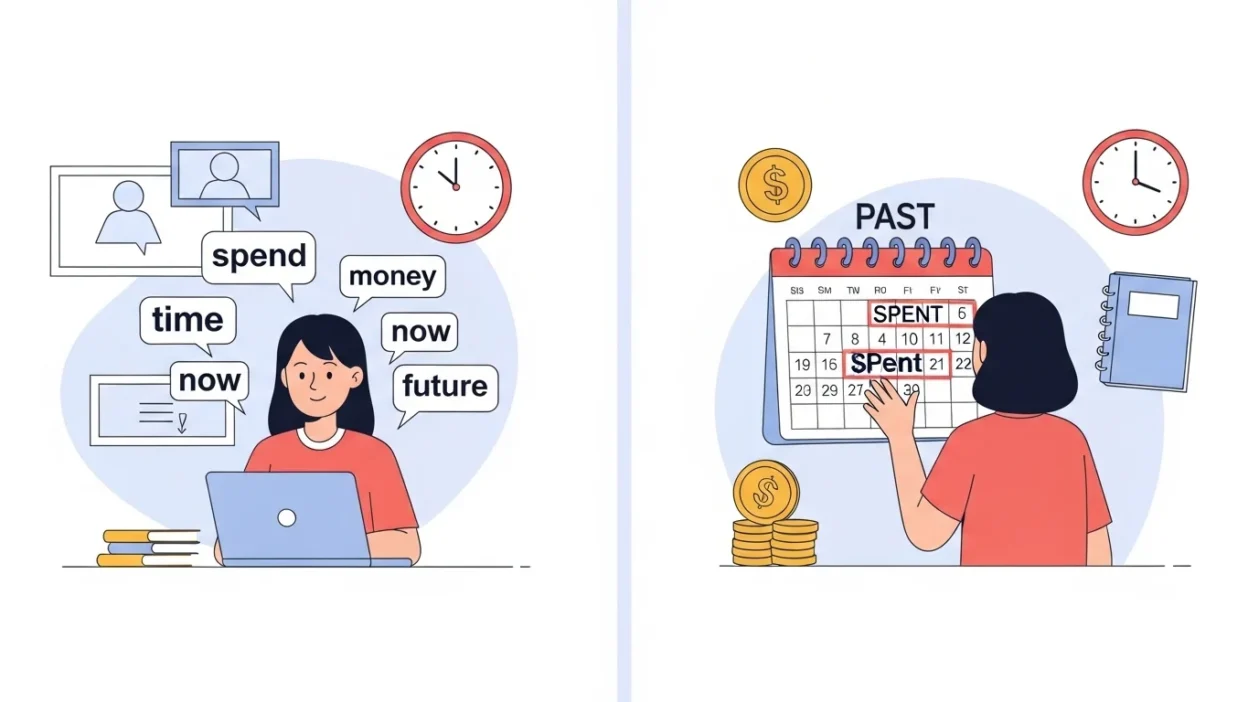
Many English learners feel confused when they see the words “spend” and “spent.” They look similar, and they are related to money, time, and energy. But they are not used in the same way.
If you ever say a sentence like “I spend money yesterday” and feel unsure, you are not alone. This confusion is very common for students and ESL learners because English verbs change form depending on time.
In this article, you will learn the difference between spend or spent in the easiest way possible. By the end, you will feel confident using both words correctly in real life.
Quick Answer
Here is the simplest way to understand it:
- Spend → used for present or future actions
- I spend money every day.
- I will spend time with my family.
- Spent → used for past actions
- I spent money yesterday.
- She spent two hours studying.
Easy trick to remember:
- Spend = Now or later
- Spent = Already happened
Origin or Background
The word “spend” comes from old English. Long ago, it meant “to use something up,” like money, time, or energy.
Over time, English developed different forms of the same word to show time:
- present form: spend
- past form: spent
This is normal in English. Many verbs change like this:
- go → went
- eat → ate
- spend → spent
So, “spend” and “spent” are just different time forms of the same idea.
Difference Explained
Let’s make it very clear and simple.
Spend (Present or Future)
We use spend when:
- talking about habits
- talking about things happening now
- talking about future plans
Examples:
- I spend a lot of time on my phone.
- They spend money wisely.
- We will spend the weekend together.
Spent (Past)
We use spent when:
- the action is finished
- it already happened
Examples:
- I spent all my money yesterday.
- She spent three hours cleaning the house.
- We spent a great day at the park.
Simple idea:
- If the action is not finished → spend
- If the action is finished → spent
Comparison
| Feature | Spend | Spent |
| Time | Present or future | Past |
| Meaning | Ongoing or planned action | Completed action |
| Example | I spend money daily | I spent money yesterday |
| Verb form | Base form | Past form |
| Use | habits, routines, plans | finished events |
When to Use Each
Understanding when to use each word is very important.
Use “spend” when:
- You talk about daily habits
- I spend time reading books.
- You talk about general truth
- People spend too much time on social media.
- You talk about future plans
- I will spend my vacation in Lahore.
Use “spent” when:
- You talk about past events
- I spent the whole day at school.
- You describe completed actions
- He spent his salary in one week.
- You tell stories
- We spent a wonderful evening together.
Common Mistakes People Make
Many learners make simple mistakes with this verb pair. Let’s fix them.
Mistake using past time with “spend”
❌ I spend all my money yesterday.
✔ I spent all my money yesterday.
Mistake using past action with “spend”
❌ She spend two hours studying last night.
✔ She spent two hours studying last night.
Mistake forgetting time clue
Sometimes learners forget to match the verb with time words like:
- yesterday
- last night
- ago
- in 2020
If you see these words, you almost always need spent.
Everyday Real Life Examples
Let’s see how native speakers use these words in daily life.
Talking about money
- I spend my pocket money on snacks.
- I spent all my savings on a new phone.
Talking about time
- Students spend many hours studying.
- I spent two hours watching a movie.
Emails or messages
- I spent the whole day working on the project.
- I spend most of my time in meetings.
Social media posts
- “I spent an amazing weekend with friends!”
- “I spend too much time scrolling at night.”
News style sentences
- The government spends money on education.
- The company spent millions on new technology.
These examples show that both words are very common in real life.
Learning Section for Students and Beginners
Here is a very simple way to practice.
Step one: Understand time
Ask yourself:
- Is it happening now or often? → use spend
- Did it already happen? → use spent
Step two: Practice switching
Try changing sentences:
- I spend money → I spent money yesterday
- She spends time reading → She spent time reading
Step three: Make your own sentences
Try writing 5 sentences with “spend” and 5 with “spent.”
Step four: Say it aloud
Speaking helps your brain remember faster.
FAQ
What is the main difference between spend and spent?
“Spend” is for present or future, and “spent” is for past actions.
Is spent the past tense of spend?
Yes, “spent” is the past form of “spend.”
Can I use spend for yesterday?
No, if the action is in the past, use “spent.”
Can spent be used for future?
No, “spent” is only for the past.
Is spend only about money?
No, it can also mean time, energy, or effort.
Why do we change spend to spent?
English verbs change form to show time (past, present, future).
Which one is more common?
Both are common, but “spent” is very common in storytelling and past events.
Can I say “I am spend money”?
No, correct form is “I am spending money” (present continuous).
Conclusion
The difference between spend or spent is actually very simple once you understand time.
- Use spend for present habits and future plans.
- Use spent for completed actions in the past.
Think of it like this:
- Spend = not finished yet
- Spent = already finished
If you practice a few sentences every day, you will quickly stop making mistakes. English grammar becomes easy when you understand the pattern behind it, and this one is a very important and common one.
Keep practicing, and soon you will use “spend” and “spent” naturally without even thinking about it.

Anthony Charles is the founder and lead content creator at Meanefy.com, a platform dedicated to exploring word meanings, language nuances, and everyday curiosities. With a passion for language and a keen eye for detail, Anthony aims to make complex words and concepts simple and accessible for readers around the world.