Many English learners get confused when they see or hear words like “sweeped” and “swept.” They look similar, and both seem like they could be correct. Because of this, people often mix them up in writing and speaking.
If you have ever felt unsure about which one to use, you are not alone. This is a very common mistake, even for people who have studied English for a long time. The good news is that the answer is actually very simple. Once you understand it, you will never feel confused again.
In this article, you will learn the correct form, why the confusion happens, and how to use the word correctly in daily life.
Quick Answer
Here is the simple truth:
- Swept is correct
- Sweeped is not correct in modern English
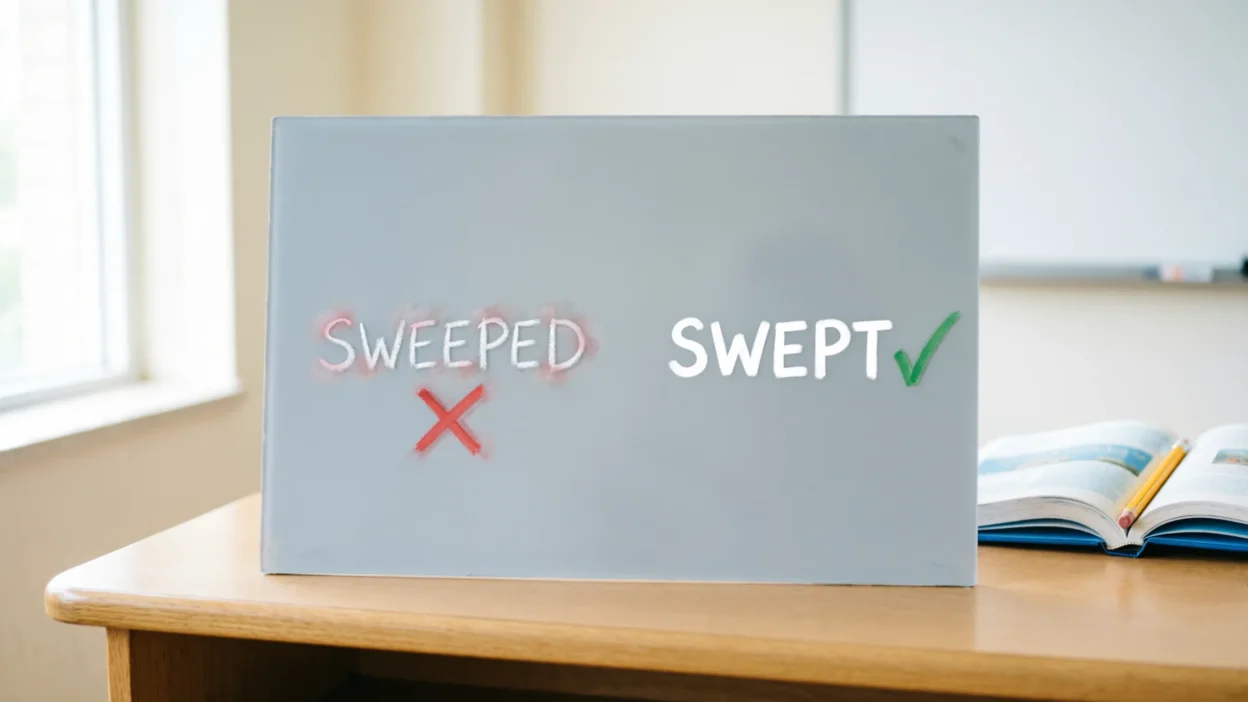
- The past form of “sweep” is swept
- “Swept” is used for both past tense and past participle
- “Sweeped” is a common mistake made by learners
So, if you want to speak or write correctly, always use swept.
Simple Origin and Background
To understand this better, let’s look at how English verbs work.
English has two main types of verbs:
- Regular verbs (add “ed” in past form)
- Irregular verbs (change form completely)
For example:
- Walk → Walked (regular)
- Play → Played (regular)
- Go → Went (irregular)
The verb “sweep” is an irregular verb.
Its correct forms are:
- Present: sweep
- Past: swept
- Past participle: swept
Long ago, some people may have tried saying “sweeped” because it follows the normal rule of adding “ed.” But over time, English did not accept this form. The language settled on “swept” as the correct version.
That is why today, “sweeped” is considered incorrect.
Clear Explanation of the Difference
The difference is very simple:
Swept
- Correct word
- Past tense of “sweep”
- Past participle of “sweep”
- Used in normal speaking and writing
Example:
- She swept the floor yesterday.
Sweeped
- Incorrect form
- Not used in standard English
- Considered a grammar mistake
Example:
- ❌ She sweeped the floor yesterday. (wrong)
So the main point is:
Only “swept” is correct in all situations.
Comparison
| Form | Correct or Incorrect | Usage | Example Sentence |
| Sweep | Correct | Present tense | I sweep the room daily. |
| Swept | Correct | Past tense and past participle | I swept the room yesterday. |
| Sweeped | Incorrect | Not used in English | Not correct to use |
Which One to Use and When
Now let’s make it even easier.
Use swept when:
- Talking about something that already happened
- Writing stories, essays, or messages in past tense
- Describing completed cleaning actions
Examples:
- I swept the kitchen this morning.
- They swept the street after the storm.
- She has swept the whole house.
You should NEVER use “sweeped” in any situation.
Even if it sounds natural in your head, it is still wrong in English.
Common Mistakes People Make
Many learners make the same mistakes with this word. Here are the most common ones:
Adding “ed” automatically
People think all verbs become past tense by adding “ed.” This is not always true.
- Wrong: sweeped
- Correct: swept
Mixing regular and irregular verbs
Learners sometimes treat all verbs the same, which causes errors.
Overthinking the rule
Some students think “sweeped” sounds more logical, so they use it. But English is not always logical.
Writing what they hear
Sometimes people hear incorrect speech and repeat it in writing.
Everyday Real Life Examples
Let’s look at how “swept” is used in real life.
In daily home life
- I swept my room before going to school.
- My mother swept the kitchen floor.
In school or writing
- The students swept the classroom after the activity.
- He swept the floor as part of cleaning duty.
In social media posts
- “Cleaned my whole house today. I finally swept everything!”
- “Weekend cleaning done. Floors are swept and neat.”
In news or reports
- The workers swept the street after the festival.
- Volunteers swept the area to remove trash.
These examples show that “swept” is used in both casual and formal situations.
Learning Section for Students and Beginners
If you are learning English, here is a simple way to remember this rule:
Easy memory trick
Think like this:
- “Sweep” is a strong irregular verb
- It does NOT follow normal “ed” rules
- Its past form is special: swept
Practice tip
Try making your own sentences:
- I sweep…
- I swept…
- I have swept…
Repeat them daily to remember the correct form.
Quick learning rule
If you are unsure, just remember:
Sweep → Swept (never sweeped)
FAQ
Is “sweeped” ever correct?
No, “sweeped” is never correct in standard English.
Why do people say “sweeped”?
People often add “ed” to verbs because it is a common rule, but “sweep” is irregular.
What is the past tense of sweep?
The past tense is “swept.”
What is the past participle of sweep?
It is also “swept.”
Can I use “swept” in formal writing?
Yes, “swept” is correct in both formal and informal writing.
Is “swept” used in speaking too?
Yes, native speakers use “swept” in everyday conversation.
How can I stop making this mistake?
Practice sentences and remember that “sweep” is an irregular verb.
Are there other verbs like this?
Yes, many verbs are irregular, such as “keep → kept” and “sleep → slept.”
Conclusion
The confusion between “sweeped” and “swept” is very common, especially for English learners. But the rule is actually very simple.
Only “swept” is correct in English. It is the past tense and past participle of “sweep.” The word “sweeped” is not correct and should not be used in writing or speaking.
Once you remember this, you will avoid a very common mistake and speak more confidently.
Just keep this simple idea in mind:
Sweep becomes swept, never sweeped.

Daniel Matthew is a language enthusiast, writer, and contributor at Meanefy.com, where he explores the meanings, origins, and nuances of words and phrases. With a deep passion for language, Daniel aims to make complex concepts simple, engaging, and easy to understand for readers of all ages.