Many learners feel confused when they see the words threw and thrown. They look similar, they come from the same verb, and both talk about the action of throwing something. So it is easy to mix them up.
But the truth is simple: these two words are used in different sentence structures. Once you understand the pattern, you will not be confused again.
This guide will explain everything in very easy English so you can understand it quickly and use both words correctly in your daily life.
Quick Answer
Here is the simple difference:
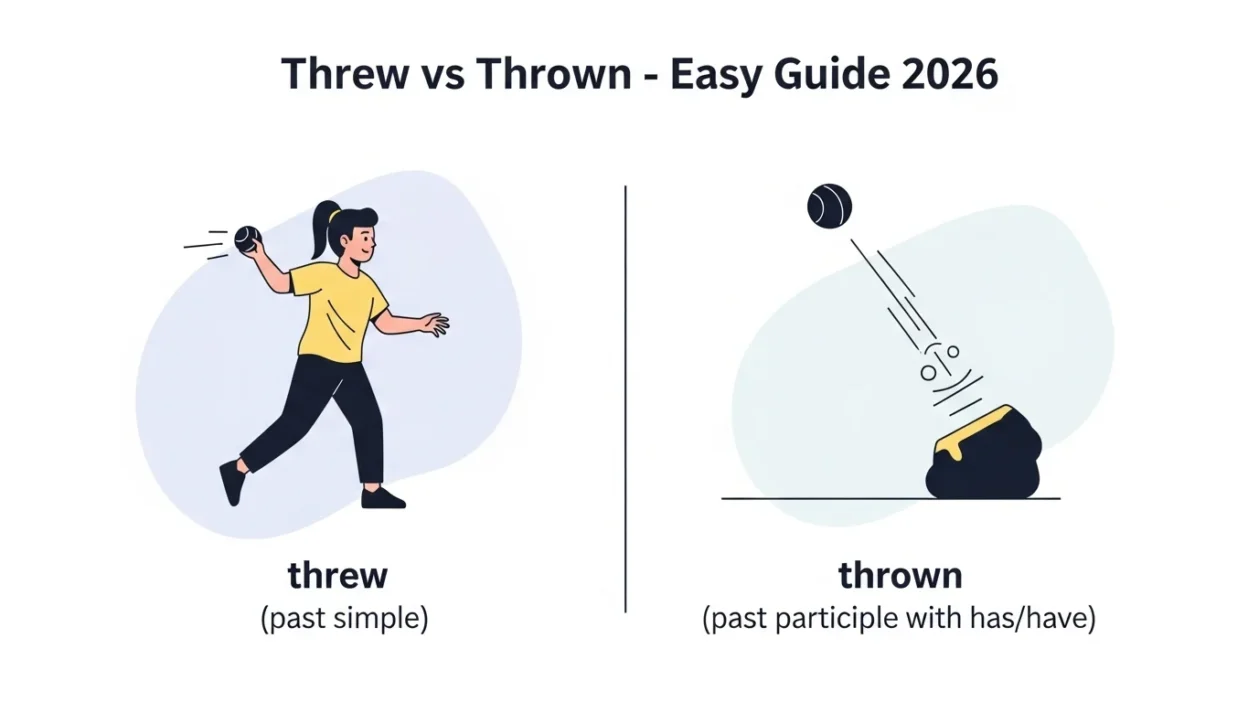
- Threw = past simple (used alone)
- Thrown = past participle (used with helping verbs)
Examples:
- I threw the ball. ✅
- I have thrown the ball. ✅
Wrong:
- I have threw the ball. ❌
Simple Background
The base verb is throw.
It is an irregular verb, which means it does not follow the normal “ ed” rule.
Here are its forms:
- Present: throw
- Past: threw
- Past participle: thrown
You need to remember these forms because they do not follow a simple pattern like “walk → walked”.
Clear Explanation of the Difference
Let’s make this very easy.
Threw
Use threw when:
- You are talking about the past
- You do NOT use a helping verb
Structure:
- Subject + threw + object
Example:
- She threw the keys on the table.
Thrown
Use thrown when:
- You use a helping verb like has, have, had, is, was, were
Structure:
- Subject + helping verb + thrown
Examples:
- She has thrown the keys.
- The keys were thrown on the table.
Comparison
| Feature | Threw | Thrown |
| Verb type | Past simple | Past participle |
| Used alone? | Yes | No |
| Needs helping verb? | No | Yes |
| Example | I threw a stone | I have thrown a stone |
| Common helpers | None | has, have, had, was, were |
Which One to Use and When
Use threw when you are talking about a completed action in the past.
- I threw the paper away.
- He threw the ball yesterday.
Use thrown when your sentence has a helper verb.
- I have thrown the paper away.
- The ball was thrown by him.
Easy Tip
If you see:
- has / have / had / is / was / were
→ Use thrown
If there is no helper verb
→ Use threw
Common Mistakes People Make
Here are mistakes many learners make:
Using “threw” with helping verbs
❌ I have threw the ball
✅ I have thrown the ball
Using “thrown” without a helper
❌ I thrown the ball
✅ I threw the ball
Mixing past and present forms
❌ She has threw it yesterday
✅ She threw it yesterday
✅ She has thrown it
Forgetting the structure
Many learners remember the word but forget the sentence pattern. Always check:
- Is there a helper verb?
- If yes → use thrown
Everyday Real Life Examples
In Emails
- I threw away the old files yesterday.
- I have thrown away the old files already.
In News
- The protester threw a bottle.
- A bottle was thrown during the protest.
On Social Media
- Someone threw food at the stage!
- Someone has thrown food again!
In Daily Conversation
- He threw his phone on the bed.
- He has thrown his phone many times before.
At School
- The student threw a paper ball.
- The paper ball was thrown during class.
Learning Section for Students and Beginners
Here is a simple way to practice:
Step One: Learn the Forms
- throw → threw → thrown
Say them aloud a few times.
Step Two: Practice Sentences
Fill in the blanks:
- I ______ the ball.
- I have ______ the ball.
Answers:
- threw
- thrown
Step Three: Make Your Own Sentences
Try to create your own examples:
- One sentence with threw
- One sentence with thrown
Step Four: Check for Helping Verbs
Before choosing the word, ask:
- Do I see “has”, “have”, “was”, etc.?
This small check will help you avoid mistakes.
FAQ Section
What is the main difference between threw and thrown?
Threw is used alone in past sentences.
Thrown is used with helping verbs.
Can I say “I have threw”?
No. This is incorrect.
You must say: I have thrown.
Is “thrown” always used with a helper?
Yes. It needs a helping verb like has, have, had, is, was.
Is “threw” present or past?
Threw is past tense.
Why is it not “throwed”?
Because “throw” is an irregular verb. It does not follow the “ ed” rule.
Can both words be used in the same sentence?
Yes.
Example:
- He threw the ball that I had thrown earlier.
Which one is more common in speaking?
Both are common. It depends on the sentence structure.
How can I remember the difference easily?
Remember this rule:
- No helper → threw
- With helper → thrown
Conclusion
The difference between threw and thrown is not difficult once you understand the pattern.
- Threw is simple past and works alone
- Thrown needs a helping verb
That’s it.
Focus on the sentence structure, not just the word. When you see a helper verb, your answer becomes clear.
With a little practice, you will start using both words correctly without even thinking about it.

Daniel Matthew is a language enthusiast, writer, and contributor at Meanefy.com, where he explores the meanings, origins, and nuances of words and phrases. With a deep passion for language, Daniel aims to make complex concepts simple, engaging, and easy to understand for readers of all ages.