Many English learners get confused between “mistook” and “mistaken.” These two words look similar, and both come from the same verb “mistake.” Because of this, people often mix them up in speaking and writing.
The confusion happens because English uses different forms of verbs for past actions, and also uses special forms when helping verbs like is, are, has, have are added. At first glance, both “mistook” and “mistaken” seem like they could mean the same thing, but they are used in different situations.
This article will explain everything in very simple English so you never get confused again.
Quick Answer
Here is the simplest way to understand the difference:
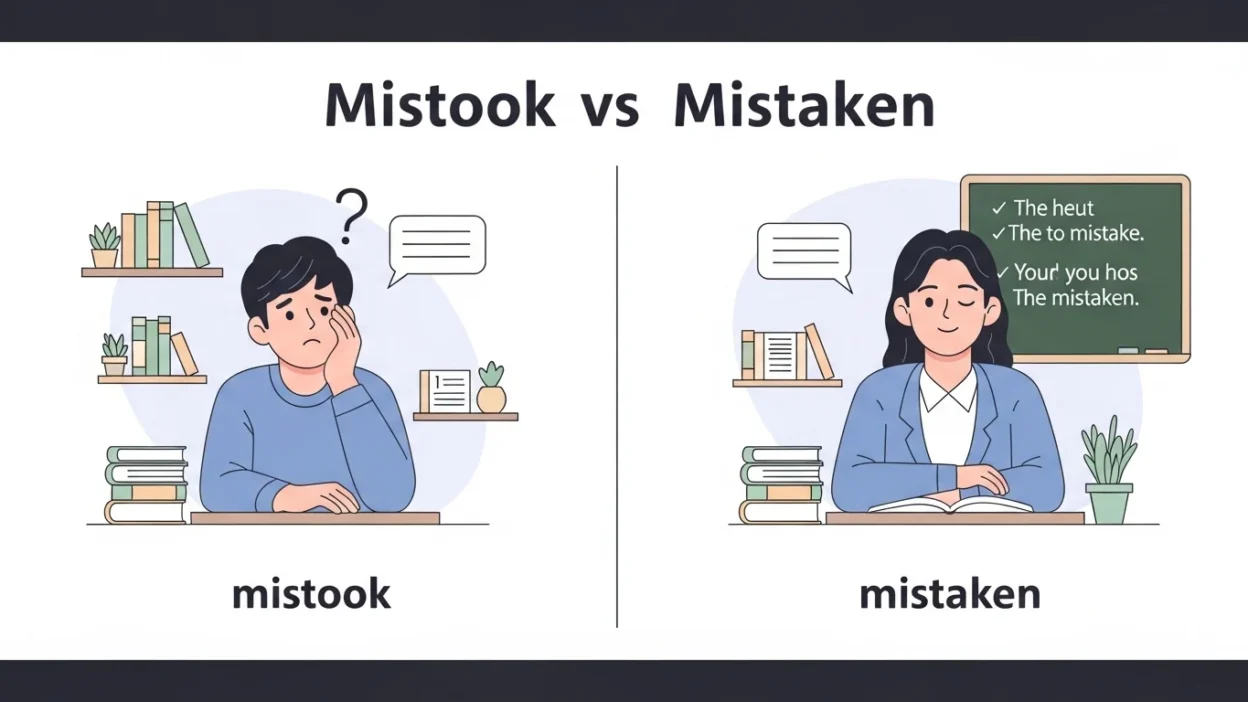
- Mistook is the simple past form of “mistake”
- Mistaken is the past participle form of “mistake”
- Mistook is used alone (no helping verb)
- Mistaken is used with helping verbs like is, are, was, were, has, have
Examples:
- I mistook him for his brother.
- I have mistaken him for his brother.
Simple Origin and Background
The verb “mistake” means to understand something in the wrong way or to identify something incorrectly.
Like many English verbs, it has three main forms:
- Base form: mistake
- Past simple: mistook
- Past participle: mistaken
These forms come from older English patterns where verbs changed their shape depending on time and grammar rules.
Over time, English kept both “mistook” and “mistaken” because they are used in different sentence structures.
Clear Explanation of the Difference
Mistook
“Mistook” is used when we talk about a finished action in the past.
It does not need helping verbs.
Structure:
- Subject + mistook + object
Examples:
- I mistook the salt for sugar.
- She mistook his silence as anger.
- They mistook the time of the meeting.
Think of “mistook” as a simple story in the past.
Mistaken
“Mistaken” is not used alone in most cases. It needs helping verbs like:
- is / are / was / were
- has / have / had
Structure:
- Subject + helping verb + mistaken
Examples:
- I was mistaken about the address.
- You are mistaken.
- He has mistaken my words.
Think of “mistaken” as a describing word or completed state.
Easy Comparison
| Feature | Mistook | Mistaken |
| Type | Verb (past simple) | Past participle / adjective form |
| Used alone | Yes | No |
| Needs helping verb | No | Yes |
| Time reference | Finished past action | Past action or state |
| Example | I mistook him for a stranger | I was mistaken about him |
| Sentence style | Simple past story | Perfect or passive structure |
When to Use Mistook or Mistaken
Use Mistook When
- You are talking about something that happened in the past
- You are describing a simple action
- There is no helping verb in the sentence
Examples:
- I mistook her voice in the crowd.
- He mistook the instructions.
- We mistook the date of the exam.
Use Mistaken When
- You are using “is, are, was, were, has, have, had”
- You are showing a state of being wrong
- You are forming perfect tense or passive voice
Examples:
- I was mistaken about the result.
- They are mistaken.
- She has mistaken my intention.
Common Mistakes People Make
Many learners mix these two words. Here are the most common mistakes:
Using Mistaken Alone
Wrong:
- I mistaken him for a teacher.
Correct:
- I mistook him for a teacher.
Using Mistook with Helping Verbs
Wrong:
- I have mistook him.
Correct:
- I have mistaken him.
Confusing Meaning
Some learners think both words mean different things, but actually:
- Both mean “to understand something wrongly”
- The only difference is grammar structure
Everyday Real Life Examples
Daily Conversation
- I mistook your message and replied late.
- I was mistaken about your birthday.
School Life
- I mistook the exam date and came one day early.
- The teacher said I was mistaken about the answer.
Social Media
- I mistook that post as real news.
- Many users are mistaken about the update.
Email Example
- I mistook your email for spam.
- I was mistaken about the meeting time mentioned in your email.
News Example
- I mistook the headline and misunderstood the story.
- The report shows people were mistaken about the event details.
Learning Section for Students and Beginners
Here is a very simple trick to remember:
- If you can say the sentence in simple past, use mistook
- If you need is, are, was, were, has, have, use mistaken
Easy memory rule:
- “I did it wrong” → mistook
- “I am wrong” → mistaken
Practice these sentences:
- I mistook the road.
- I was mistaken about the road.
- She mistook his name.
- She is mistaken.
Try reading them aloud. It helps your brain remember the pattern faster.
FAQ Section
What is the main difference between mistook and mistaken?
“Mistook” is used for simple past actions, while “mistaken” is used with helping verbs like is, was, has, or have.
Can I use mistaken without a helping verb?
No, in normal grammar “mistaken” needs a helping verb. Without it, the sentence is incorrect.
Is mistook still commonly used in English?
Yes, it is still used in daily speaking and writing when talking about past mistakes.
Is mistaken an adjective or a verb?
It can act like both, but mostly it behaves like a past participle or adjective.
Which one is more formal?
Both are correct. “Mistaken” is often used in more formal or descriptive sentences.
Can I say “I have mistook”?
No, that is incorrect. The correct form is “I have mistaken.”
Why do both words exist?
English verbs change form depending on grammar rules. “Mistook” is for simple past, and “mistaken” is for perfect or passive structures.
What is the easiest way to remember them?
Think like this:
- Mistook = past action
- Mistaken = state or description with helping verb
Conclusion
The difference between mistook and mistaken is simple once you understand the rule.
- Use mistook for simple past actions without helping verbs.
- Use mistaken when the sentence includes helping verbs like is, was, has, have.
Both words come from the same root verb “mistake,” but they follow different grammar patterns. The key is not meaning, but sentence structure.
If you remember the simple rule mistook for action, mistaken for state you will never mix them up again.