Many English learners feel confused when they want to talk about resting or going to bed. They often ask: should I say “laid down” or “lied down”?
This confusion happens because English has two similar verbs: “lie” and “lay.” They look almost the same, but their meanings and past forms are different. Even native speakers sometimes make mistakes with them in casual speaking.
If you have ever stopped while writing a sentence like “I ___ down on the bed,” you are not alone. This is one of the most common grammar doubts in English.
In this article, you will learn the difference in a very simple way. By the end, you will never mix them up again.
Quick Answer
Here is the easiest way to understand it:
- Lie down → lied down (❌ NOT correct for resting)
- Lie down → lay down → lain down (correct pattern for resting, but “lay down” is the common past form)
- Lay down → laid down (used when you put something down, not yourself)
Simple rule:
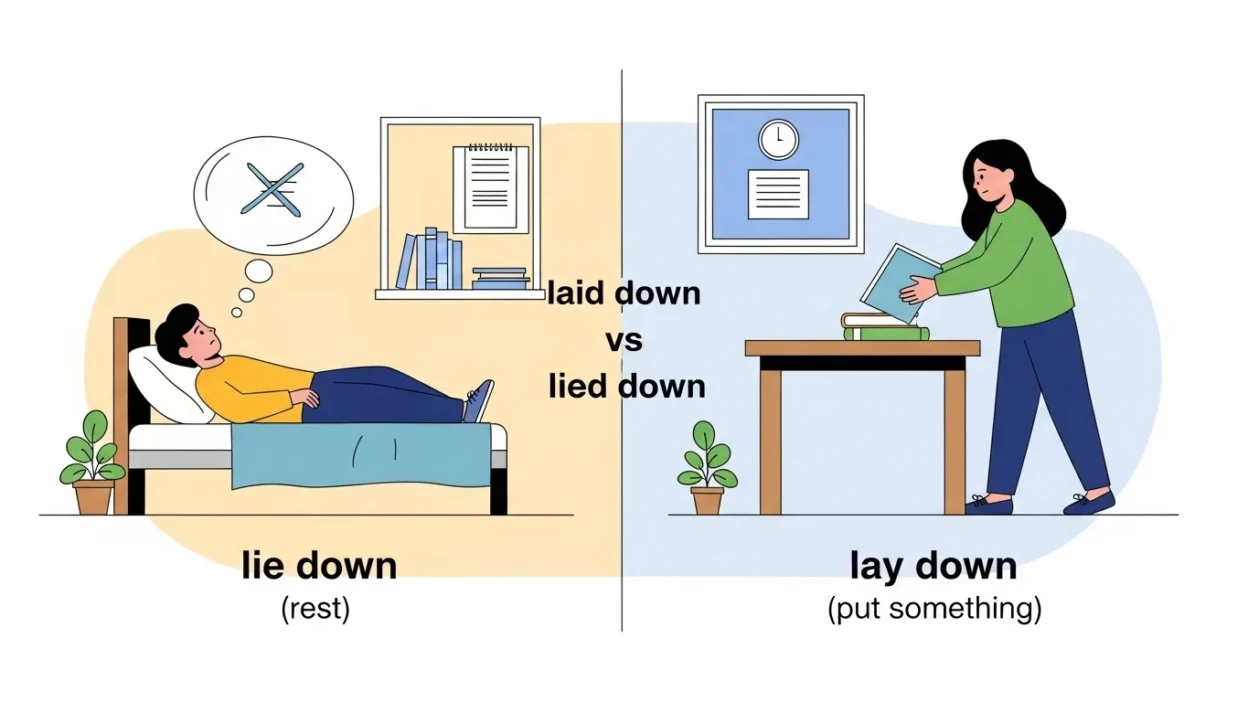
- Use “lie down” when a person or animal rests.
- Use “laid down” when someone puts something on a surface.
- “Lied down” is wrong in normal daily English.
Simple Origin or Background
English comes from older Germanic languages. In those old forms, verbs changed depending on the subject and time. Over time, English kept some of these changes, which created confusing verb forms.
The verbs lie and lay became especially confusing because:
- “Lie” means to rest or be in a flat position.
- “Lay” means to put something down.
But their past forms do not follow simple patterns like many modern verbs.
That is why learners often mix them up today. The problem is not your learning—it is the structure of English itself.
Clear Explanation of the Difference
Let’s break it into very simple ideas.
Lie down (resting action)
We use lie down when a person or animal puts their own body in a flat position.
Examples:
- I lie down on the bed.
- She lies down after school.
Past form:
- I lay down on the bed yesterday.
Past participle:
- I have lain down many times today.
Yes, “lay” is also the past form of “lie,” which is why confusion happens.
Lay down (putting something)
We use lay down when someone puts an object somewhere.
Examples:
- I lay down the book on the table.
- He lays down his bag every morning.
Past form:
- I laid down the book yesterday.
Past participle:
- I have laid down my phone.
Lied down (common mistake)
“Lied down” is usually incorrect when talking about resting.
Why?
Because “lied” is the past of “lie” meaning to not tell the truth, not to rest.
Example of correct “lied”:
- He lied to me yesterday. (He did not tell the truth)
So:
- ❌ I lied down on the bed (wrong)
- ✅ I lay down on the bed (correct)
Comparison
Here is a simple table to make everything clear:
| Verb | Meaning | Present | Past | Past Participle | Example |
| Lie down | to rest | lie | lay | lain | I lie down every day |
| Lay down | to place something | lay | laid | laid | I lay down the book |
| Lie (tell truth) | to not tell truth | lie | lied | lied | He lied yesterday |
This table is the easiest way to remember the difference.
Which One to Use and When
Here is a very simple guide:
Use “lie down” when:
- You are talking about resting
- Someone is sleeping or relaxing
- A body is going flat on a bed, sofa, or floor
Example:
- I want to lie down after work.
Use “lay down” when:
- You are placing an object
- You are putting something on a surface
Example:
- Please lay down your phone on the table.
Avoid “lied down” for resting
Do not use it when talking about sleep or rest.
- I lay down and slept.
Common Mistakes People Make
Many learners make the same mistakes. Let’s look at them:
Mixing lie and lay
People often think they are the same verb, but they are not.
Wrong:
- I lay down on the bed (present tense confusion)
Correct:
- I lie down on the bed
Using “lied down” for resting
Wrong:
- I lied down after school
Correct:
- I lay down after school
Forgetting past forms
Wrong:
- Yesterday I lie down early
Correct:
- Yesterday I lay down early
Overthinking the rule
Many learners try to memorize too much grammar. This makes it more confusing.
Simple idea:
- People “lie down”
- Objects are “laid down”
Everyday Real Life Examples
Let’s see how these words are used in real life.
Email example
- “I felt tired, so I lay down for a short rest.”
Social media post
- “After a long day, I just want to lie down and sleep.”
Daily conversation
- Friend 1: What did you do yesterday?
- Friend 2: I came home and lay down for an hour.
News style sentence
- “The injured player lay down on the field before medical help arrived.”
School example
- “The teacher asked students to lay down their books on the desk.”
These examples show how natural these words are in daily life.
Short Learning Section for Beginners
Here is a very easy way to remember:
Think like this:
- Lie = you rest yourself
- Lay = you place something
Memory trick:
- If there is a person resting → lie
- If there is an object being placed → lay
Practice sentences:
Try filling in the blanks:
- I ___ down on the sofa.
- She ___ down her bag.
- Yesterday, he ___ down early.
Answers:
- lie
- laid
- lay
Practice this a few times, and it will become natural.
FAQ (Frequently Asked Questions)
1. Is “lied down” correct English?
No. It is incorrect when talking about resting. Use “lay down” instead.
2. What is the past tense of lie down?
The past tense is “lay down.”
3. Can I say “I am laying down”?
Yes, but it usually means you are putting something down, not resting.
4. Why is English so confusing with lie and lay?
Because English kept old verb forms from older languages, which did not follow simple rules.
5. What is the easiest way to remember the difference?
Remember: people lie down, objects are laid down.
6. Is “I lay down on the bed” correct?
Yes. That is the correct past form of “lie down.”
7. What is the past participle of lie down?
It is “lain down,” but it is not used often in daily speech.
8. Do native speakers also make mistakes?
Yes. Even native speakers sometimes confuse “lie” and “lay” in casual speech.
Conclusion
The confusion between “laid down” and “lied down” is very common, but it becomes easy once you understand the basic idea.
Remember this simple rule:
- Use lie down when a person is resting.
- Use laid down when something is being placed.
- Never use lied down for resting.
English grammar can feel tricky at first, but small rules like this become easy with practice. Once you start noticing these words in reading and speaking, you will naturally use them correctly.
Keep practicing with daily sentences, and soon you will never feel confused again.

Steven Mark is a writer, researcher, and contributor at Meanefy.com, a platform dedicated to exploring word meanings, language nuances, and everyday linguistic curiosities. With a passion for words and clear communication, Steven focuses on making language simple, engaging, and accessible to all readers.