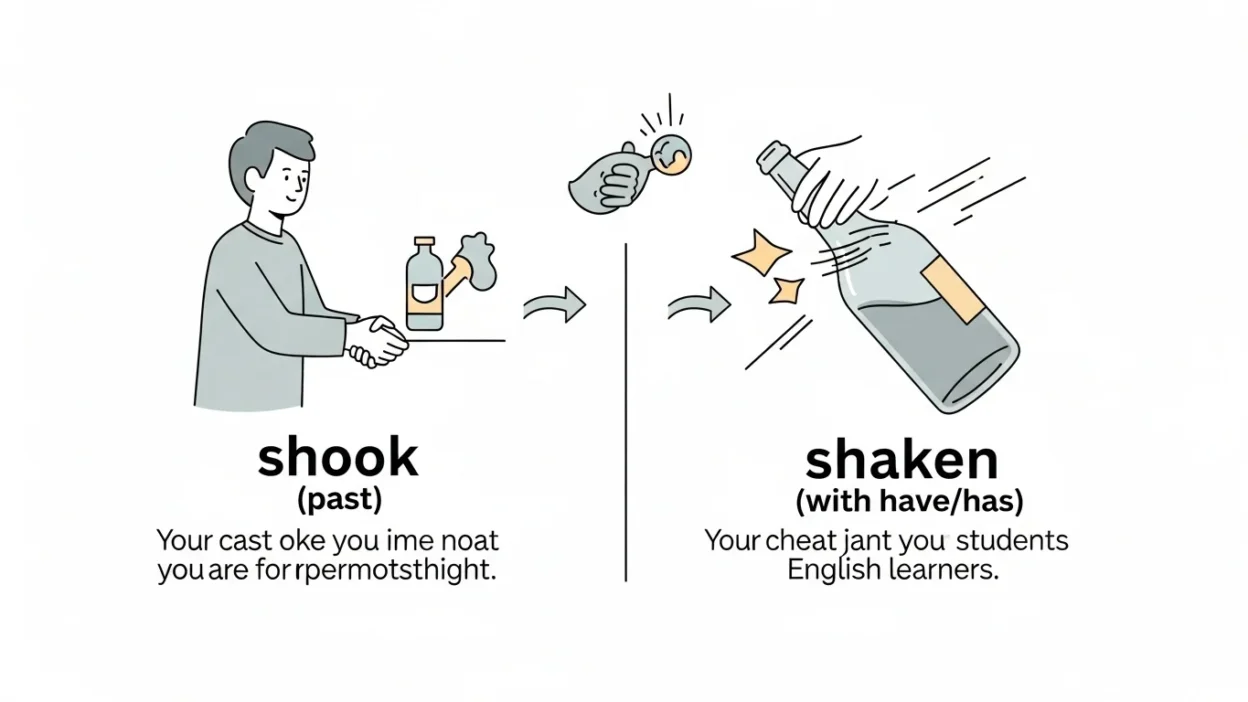
Many English learners feel confused when they see the words “shook” and “shaken.” They look similar, and both come from the same verb “shake.” But their use is different, and using the wrong one can change the meaning of a sentence.
This confusion is very common because English has irregular verbs. Some verbs change in simple ways, but others change in unexpected ways. “Shake” is one of those tricky verbs.
In this article, you will learn the difference in a very simple way. After reading, you will know exactly when to use “shook” and when to use “shaken” without stress.
Quick Answer
Here is the simplest explanation:
- Shook → used for the past tense (yesterday, past time)
- Shaken → used for the past participle (with “have,” “has,” “had,” or passive sentences)
Easy examples:
- I shook his hand yesterday.
- The ground has shaken during the earthquake.
- She was shaken after the accident.
Simple rule:
- If it is a simple past action → shook
- If it is with helping verbs or passive voice → shaken
Simple Origin or Background
The verb “shake” is an irregular verb in English.
Its three main forms are:
- Present: shake
- Past: shook
- Past participle: shaken
Old English had many verbs that changed completely in different tenses. Over time, these forms stayed in modern English.
That is why we do not say:
- “I shaked” ❌
We say: - “I shook” ✔
And we do not always use “shook” in perfect tenses. Instead, we use:
- “has shaken,” “have shaken,” “had shaken”
This system is what creates confusion for learners.
Clear Explanation of the Difference
“Shook” (Simple Past)
We use shook when talking about something that happened in the past and is finished.
It does not need helping verbs like “has” or “have.”
Structure:
- Subject + shook + object
Examples:
- The boy shook the bottle.
- She shook her head.
- We shook hands after the meeting.
👉 Think of “shook” as a finished action in the past.
“Shaken” (Past Participle)
We use shaken in two main situations:
With helping verbs:
- has shaken
- have shaken
- had shaken
In passive sentences:
- is shaken
- was shaken
Examples:
- I have shaken the bottle well.
- The tree has shaken in the wind.
- She was shaken by the bad news.
👉 Think of “shaken” as a form used when the action is connected to another verb or when something is happening to the subject.
Comparison
| Feature | Shook | Shaken |
| Verb form | Past tense | Past participle |
| Usage | Simple past actions | Perfect tenses + passive voice |
| Helping verbs | Not needed | Needed (have, has, had, is, was) |
| Example | I shook his hand | I have shaken his hand |
| Meaning | Finished action in past | Completed or passive action |
Which One to Use and When
Choosing between “shook” and “shaken” becomes easy when you follow simple rules.
Use “shook” when:
- You are talking about a past event
- There is no helping verb
- The action is simply finished
Example situations:
- Yesterday’s events
- Storytelling in past tense
- Short past actions
Example:
- I shook the box before opening it.
Use “shaken” when:
- You use “have,” “has,” or “had”
- You use passive voice (was/is/are)
- You want to show a result or effect
Example situations:
- Experiences
- Emotional reactions
- Completed actions with connection to present
Examples:
- I have shaken the bottle already.
- She was shaken after hearing the news.
Common Mistakes People Make
Many learners make similar mistakes with these two words.
Using “shaked” instead of “shook”
- ❌ I shaked his hand
- ✔ I shook his hand
Using “shaken” in simple past
- ❌ I shaken the bottle yesterday
- ✔ I shook the bottle yesterday
Forgetting helping verbs
- ❌ I have shake the bottle
- ✔ I have shaken the bottle
Mixing passive and active forms
- ❌ The news shook her very badly (when meaning emotional state)
- ✔ She was shaken by the news
Everyday Real Life Examples
Let’s see how these words are used in daily life.
In conversations:
- I shook hands with my teacher today.
- He has shaken the bottle already.
In emails:
- We shook hands after finalizing the deal.
- The manager was shaken by the report.
In social media:
- “I just shook hands with my favorite actor!”
- “She was deeply shaken by what happened today.”
In news reports:
- The building shook during the earthquake.
- The residents were shaken but safe.
In storytelling:
- He shook the door again and again.
- The hero has shaken the fear from his mind.
Learning Section for Students and Beginners
If you are a student, here is a simple way to remember:
Think like this:
- Shook = one time past action
- Shaken = action connected with “have/has/had” or passive voice
Memory trick:
- “oo” in shook looks like something short and quick (past action)
- “en” in shaken looks like something complete or finished result
Practice tip:
Try making your own sentences:
- I shook…
- I have shaken…
- She was shaken…
Practicing like this will make the difference very clear in your mind.
FAQ
What is the main difference between shook and shaken?
“Shook” is simple past, and “shaken” is past participle used with helping verbs or passive voice.
Can I say “I have shook”?
No. The correct form is “I have shaken.”
Is “shook” formal or informal?
It is neutral and can be used in both spoken and written English.
When do I use “shaken” in a sentence?
Use it with “have,” “has,” “had,” or in passive voice sentences like “was shaken.”
Why is “shake” irregular?
It comes from old English, where verbs changed forms in different tenses.
Which one is more common?
Both are common, but “shook” is used in simple past conversations, while “shaken” is common in perfect tenses and news.
Can “shaken” describe emotions?
Yes. Example: “She was shaken after the accident” means emotionally disturbed.
What is the base verb?
The base form is “shake.”
Conclusion
The difference between shook and shaken is simple once you understand the rule.
- Use shook for finished actions in the past.
- Use shaken with helping verbs or passive sentences.
At first, they may feel confusing, but with practice, they become easy.
Remember that both words come from the same verb “shake,” but they serve different roles in English grammar.
If you practice a few sentences every day, you will soon use them naturally without thinking.

Anthony Charles is the founder and lead content creator at Meanefy.com, a platform dedicated to exploring word meanings, language nuances, and everyday curiosities. With a passion for language and a keen eye for detail, Anthony aims to make complex words and concepts simple and accessible for readers around the world.