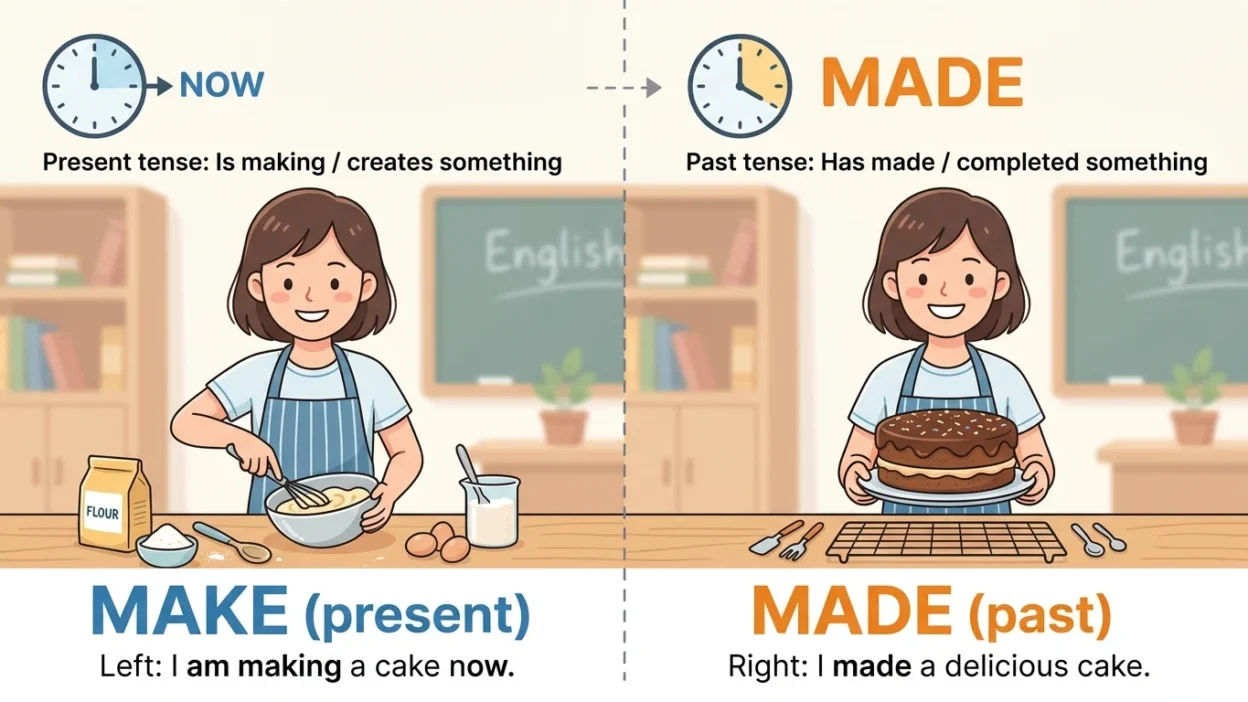
Many learners feel confused about “make” and “made.” They look similar, and they both come from the same word. But they are used in different ways. If you use the wrong one, your sentence can sound strange or incorrect.
The good news: the difference is very simple. Once you understand it, you will not feel confused again.
Quick Answer
Here is the easy idea:
- Make = present (now, general, or future)
- Made = past (already finished)
Examples:
- I make dinner every day.
- I made dinner yesterday.
That’s the core difference.
Simple Background
The word “make” is a verb. A verb is an action word.
“Make” means:
- to create something
- to build something
- to produce something
Examples:
- make food
- make a plan
- make a mistake
“Made” is just the past form of “make.”
So:
- make → present
- made → past
This is like:
- go → went
- eat → ate
Clear Explanation of the Difference
Let’s understand this in a very simple way.
Make (Present)
We use make when:
- we talk about now
- we talk about habits
- we talk about general facts
- we talk about the future (with helping words)
Examples:
- I make tea every morning.
- They make toys in this factory.
- We will make a new plan.
Made (Past)
We use made when:
- something already happened
- the action is finished
Examples:
- I made tea this morning.
- They made a big mistake.
- She made a cake yesterday.
Easy Tip
Ask yourself:
- Is it happening now or usually? → make
- Did it already happen? → made
Comparison
| Feature | Make | Made |
| Time | Present / Future | Past |
| Action | Not finished or general | Finished |
| Example | I make lunch | I made lunch |
| Daily use | Habits, routines | Past events |
| Helping verbs | will, can, do | did, was, have (with made) |
Which One to Use and When
Here is a simple guide to help you choose.
Use “Make” When:
- You talk about daily habits
- I make coffee every day.
- You talk about general truth
- People make mistakes.
- You talk about the future
- I will make a call later.
- You use “do/does”
- Do you make your own food?
Use “Made” When:
- You talk about yesterday
- I made dinner yesterday.
- You talk about something finished
- She made a dress.
- You use “did”
- Did you make this? (notice: after “did,” use “make”)
- You use present perfect
- I have made a decision.
Common Mistakes People Make
Let’s fix the most common problems.
Using “Made” for Present
❌ I made coffee every day.
✔ I make coffee every day.
Why? Because it is a habit, not past.
Using “Make” for Past
❌ I make dinner yesterday.
✔ I made dinner yesterday.
Why? Yesterday = past.
After “Did,” Using “Made”
❌ Did you made this?
✔ Did you make this?
Rule:
After did, always use the base form (make).
Mixing Time Words
❌ I make this last night.
✔ I made this last night.
“Last night” = past → use “made.”
Everyday Real Life Examples
Let’s see how people use these words in real life.
In Emails
- I will make the report tomorrow.
- I made the changes you asked for.
In Social Media
- I make videos every week.
- I made this painting today!
In News
- The company makes cars.
- The company made a big profit last year.
In Daily Conversation
- I make my bed every morning.
- I made my bed already.
- Can you make tea?
- I made tea for everyone.
Learning Section for Students and Beginners
Here is a simple way to practice.
Step One: Think About Time
Ask:
- Now or usual? → make
- Finished? → made
Step Two: Practice Simple Sentences
Try saying:
- I make ___ every day.
- I made ___ yesterday.
Example:
- I make breakfast every day.
- I made breakfast yesterday.
Step Three: Speak Out Loud
Speaking helps you remember faster.
Say:
- make → now
- made → past
Step Four: Write Your Own Examples
Write 5 sentences with “make”
Write 5 sentences with “made”
This will help your brain understand clearly.
FAQ
What is the main difference between make and made?
“Make” is present. “Made” is past.
That’s the biggest difference.
Is “made” always past?
Yes, “made” is always used for past actions.
Can I use “make” for future?
Yes.
Example: I will make dinner.
Why do we say “Did you make,” not “Did you made”?
Because after “did,” we always use the base verb (make).
Is “made” a different word?
No. It is just the past form of “make.”
Can “make” and “made” mean the same thing?
They have the same meaning, but different time.
Only the time changes.
Which one is easier to learn?
Both are easy once you remember:
make = now
made = past
How can I remember the difference?
Use this simple idea:
“Made already happened.”
Conclusion
The difference between make and made is very simple when you focus on time.
- Use make for now, habits, and future
- Use made for past, finished actions
If you remember just this one rule, you will avoid most mistakes.
Practice a little every day. Try using both words in your speaking and writing. Soon, it will feel natural, and you will not feel confused anymore.