When I first started paying attention to Through and Thru, I noticed how often people mix them in modern English. The truth is, both words have the same meaning, but their use depends on formality, context, and acceptability in writing. In academic writing, business writing, and even legal writing, only the standard spelling Through is treated as correct, especially in professional writing, like essays, resumes, contracts, and business emails. It shows professional communication, improves readability, and avoids grammar mistakes, punctuation mistakes, and the need for error correction through tools like Grammarly, a popular spelling checker and writing tool used for proofreading polished text.
On the other hand, Thru is a phonetic abbreviation, a nonstandard and informal version used mostly in text messages, WhatsApp, Slack, and other forms of informal communication. It appears in signage, advertisements, fast food menus, billboards, and road signs, especially in the common use case of drive thru or drive through services. You might even see it in walk thru guide notes, coding shorthand, or short personal notes where space is limited.
I have seen it used in American English, especially in North American English contexts like fast food industry, drive thru prayer, or even event references like Rock ’n’ Roll Las Vegas Marathon, Pittsburgh Post Gazette, WRIC, and New York Daily News. However, in formal writing, such as news writing, academic papers, or business reports, using Thru can create confusion, reduce communication clarity, and lead to professional writing issues, especially when readers expect standard spelling and correct usage rule for clear English usage.
Quick Answer: Simple points to understand
- Through is the correct and standard English spelling.
- Thru is an informal or shortened spelling of “through.”
- Both words usually mean the same thing: going from one side to another or finishing something.
- “Through” is used in formal writing like exams, essays, and books.
- “Thru” is used in casual writing like signs, text messages, and advertisements.
- In most school and professional situations, always use through.
Origin and background of the words
The word “through” has been used in English for hundreds of years. It comes from Old English, where spelling rules were not fixed like today.
Over time, English spelling became more standard. “Through” became the official form used in dictionaries, books, and education.
The word “thru” is a much newer, simplified form. It started appearing in:
- Street signs
- Fast food advertisements
- Text messages
- Short notes where space or time is limited
People created “thru” to write faster and save space, not because it changed the meaning.
Clear explanation of the difference
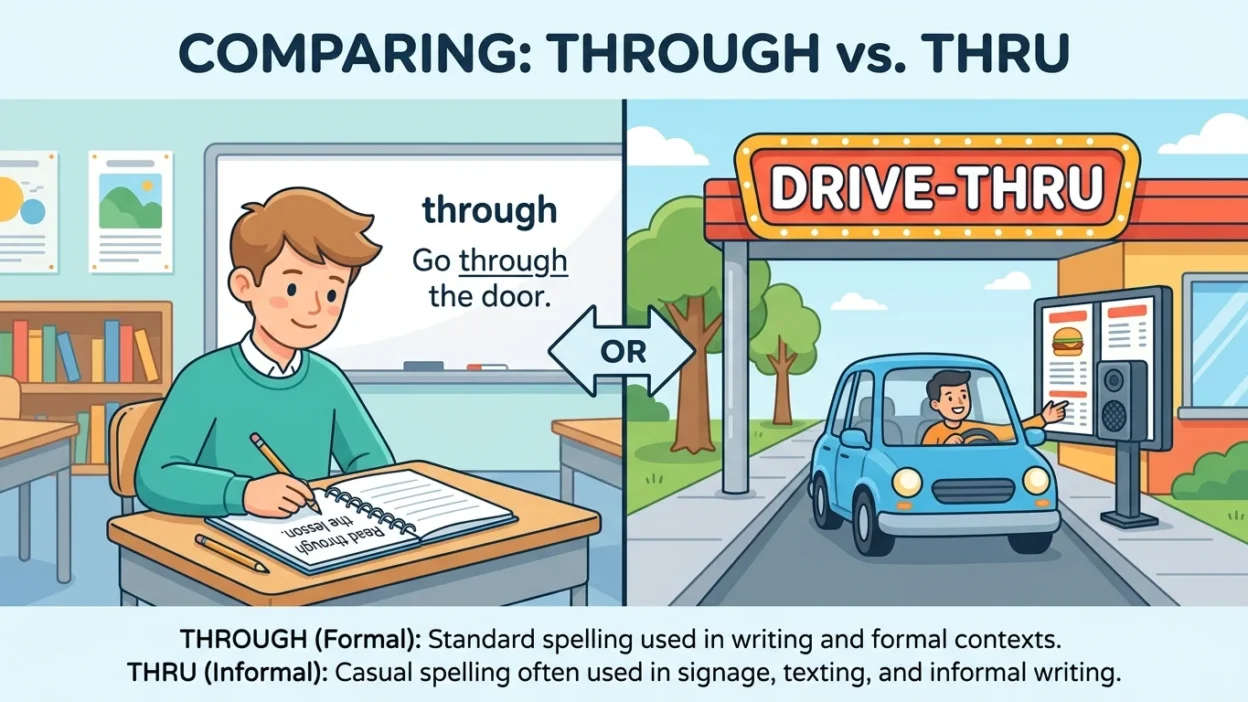
The difference between through and thru is not about meaning. It is about formality and usage.
Meaning (same for both)
Both words can mean:
- Moving from one side to another
- Completing a process
- Passing something completely
- Continuing without stopping
Style (different use)
- Through → formal, correct, standard English
- Thru → informal, casual, simplified English
Think of it like this:
- “Through” is like wearing school uniform (formal and correct)
- “Thru” is like wearing casual clothes (relaxed and informal)
Comparison table
| Feature | Through | Thru |
| Spelling style | Standard English | Shortened form |
| Formal writing | Yes | No |
| Informal use | Sometimes | Yes |
| Used in exams | Yes | No |
| Used in signs | Rare | Very common |
| Meaning | Same | Same |
| Acceptability in school | Correct | Usually incorrect |
Which one to use and when
Choosing between through and thru depends on the situation.
Use “through” when:
- Writing essays or assignments
- Taking exams
- Writing emails to teachers or employers
- Reading or writing books
- Doing official work
Use “thru” when:
- Sending quick text messages to friends
- Reading road signs like “Drive Thru”
- Seeing restaurant signs like “Drive Thru Service”
- Writing informal notes or social media posts
Simple rule to remember:
If you are unsure, always choose through. It is safe in every situation.
Common mistakes people make
Many learners mix these words incorrectly. Here are some common mistakes:
- ❌ Using “thru” in school essays
- ❌ Thinking “thru” is a different word with a different meaning
- ❌ Using both spellings in one paragraph
- ❌ Believing “thru” is modern English grammar rule (it is not official grammar)
- ❌ Overusing “thru” in professional emails
How to avoid mistakes
- Remember: “through” is always correct
- Think of “thru” as only casual slang
- Check your writing before submitting school work
Everyday Real Life Examples
Emails and formal writing
- Correct: I will go through your report carefully.
- Incorrect: I will go thru your report carefully.
In professional emails, always use through because it looks respectful and correct.
Social media and chatting
- Casual: I’m going thru old photos.
- Formal version: I’m going through old photos.
Both are understood, but “thru” is more relaxed and friendly.
Street signs and public places
- Drive Thru (fast food restaurants)
- Thru traffic (road signs in some countries)
These are designed to be short and easy to read quickly.
Daily conversation
- We walked through the tunnel.
- The light shines through the window.
- She read through the entire book.
In spoken English, people always say “through,” not “thru.”
Short learning section for students and beginners
If you are a student learning English, here is a simple way to remember:
Think of two levels:
- Through = School level English (formal and correct)
- Thru = Street level English (short and informal)
Practice tip:
Try rewriting these sentences:
- I went ___ the tunnel.
- She looked ___ the window.
- We are driving ___ the city.
Answers:
- through
- through
- through
This shows that “through” is almost always the correct choice in learning English.
FAQ: Simple questions and answers
Is “thru” correct English?
“Thru” is not considered standard English. It is informal and used in casual writing only.
Can I use “thru” in exams?
No. In exams, you should always use “through” because it is the correct spelling.
Do “through” and “thru” mean the same thing?
Yes, both words have the same meaning. The difference is only in spelling style.
Why do restaurants use “drive thru”?
Restaurants use “drive thru” because it is shorter and easier to read quickly on signs.
Is “thru” becoming more popular?
It is common in texting and advertising, but it is still not accepted in formal writing.
Which one should I learn first?
You should always learn “through” first because it is the standard English form.
Can I mix both words in writing?
It is better not to mix them. Choose one style based on the situation.
What is the safest choice?
The safest and most correct choice in all situations is through.
Conclusion
The confusion between through and thru is very common, but the idea is actually simple. Both words mean the same thing, but they are used in different situations.
- Through is the correct, standard, and formal spelling.
- Thru is a casual, shortened version used in signs and informal writing.
If you are a student, learner, or professional, using through will always keep your English correct and clear. You can think of “thru” as a shortcut used in fast writing, but not in serious or formal communication.
Once you remember this simple rule, you will never get confused again.

Anthony Charles is the founder and lead content creator at Meanefy.com, a platform dedicated to exploring word meanings, language nuances, and everyday curiosities. With a passion for language and a keen eye for detail, Anthony aims to make complex words and concepts simple and accessible for readers around the world.