The words Girly and Girlie often look almost the same, but in real usage they carry different weight in English. Girly is an Adjective, commonly used for describing things suitable for typical girls, like a dress, movies, or even a soft aesthetic. It feels more modern, widely accepted in formal writing, and works in everyday communication when talking about feminine characteristics, patterns, or connotations. I’ve often seen learners confuse it in conversations, especially when they try to describe something “cute” or traditionally feminine but end up using the wrong form, which can subtly change the intended message or affect professional communication in certain settings.
On the other hand, Girlie is a Noun, usually more casual, affectionate, and slightly old fashioned in certain contexts like magazines or among a little group of friends. It can carry a softer or sometimes diminutive tone, referring to a girl or young woman, and may appear colloquial with stronger emotional or familiarity undertones. However, it can also feel patronizing or dismissal depending on speaker intent and relationship dynamics, especially in cross cultural communication. In social interaction, like saying “Hey girlie, grab coffee”, it feels friendly, but in professional environments, it may reduce neutrality and create confusion. That’s why choosing between them depends on contextual usage, audience expectations, and careful linguistic consideration.
Quick Answer: Simple Meaning in Short Points
Girly
- Modern and commonly used word
- Means something is feminine or has “girl-like” style
- Often used in a neutral or friendly way
- Common in daily speech today
Girlie
- Older or more informal version
- Can sound playful or sometimes slightly childish
- Less common in modern formal English
- Sometimes used in a teasing or casual way
Simple Origin and Background
Both girly and girlie come from the word “girl.” Over time, English speakers added endings like “-y” and “-ie” to create adjectives. These endings help describe something that has a quality of being like a girl or having feminine style.
How “girly” developed
“Girly” became the more standard and widely accepted form in modern English. It is used in schools, magazines, conversations, and social media.
How “girlie” developed
“Girlie” is an older style of spelling. It was more common in earlier informal English. Today, it still exists, but it is less common and often feels more playful or old fashioned.
So, both words started from the same idea, but their popularity changed over time.
Clear Explanation of the Difference
Even though both words are similar, the difference is mostly about tone, usage, and modern style.
Girly in modern English
“Girly” is used when something has a feminine style or personality. It is the normal and preferred word today.
Examples:
- Girly clothes (pink dresses, floral designs)
- Girly style (soft, cute, feminine look)
- Girly things (makeup, accessories, etc.)
It is not negative. It is simply descriptive.
Girlie in everyday English
“Girlie” is less common today. It may sound:
- playful
- Old fashioned
- slightly childish
Sometimes people use it in a joking way, for example:
- “girlie magazines” (older usage)
- “girlie night out” (casual, fun tone among friends)
However, in modern writing, many people prefer “girly” instead.
Key idea
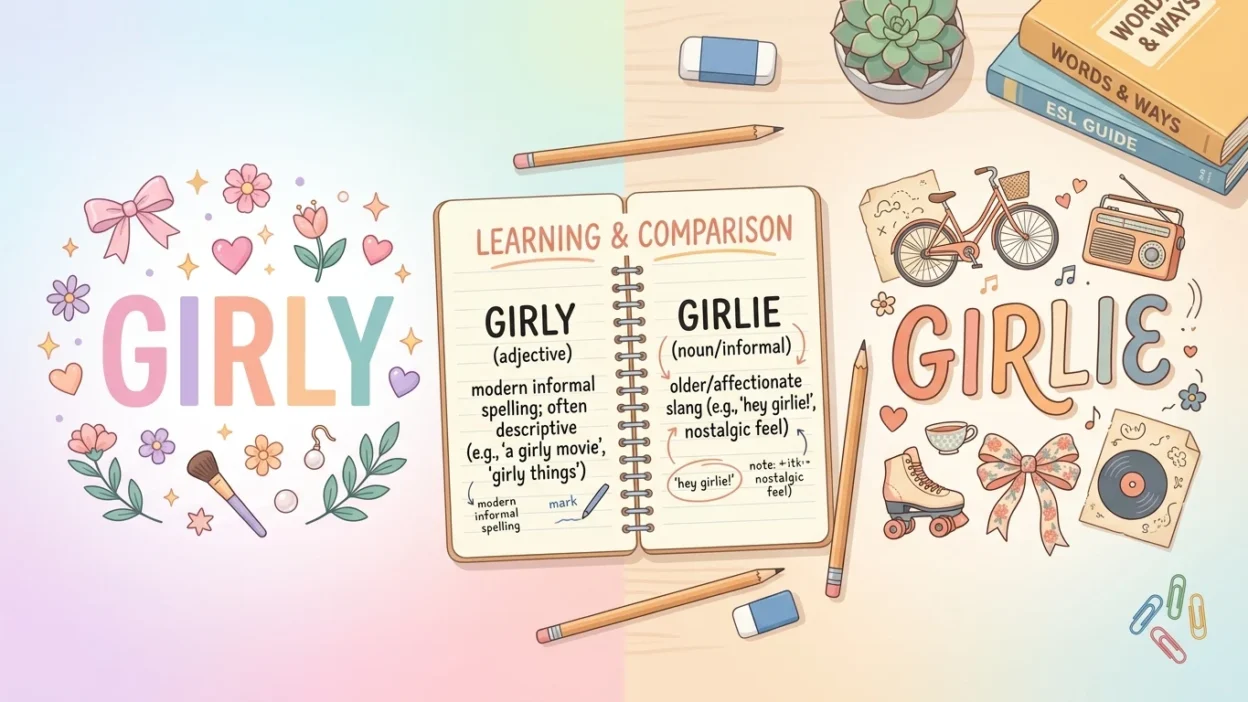
Both words mean something similar, but:
- Girly = modern, standard
- Girlie = older, informal, playful
Comparison Table: Girly vs Girlie
| Feature | Girly | Girlie |
| Spelling style | Modern | Older style |
| Common use today | Very common | Less common |
| Tone | Neutral, simple | Playful or childish |
| Formal writing | Acceptable in casual writing | Rare in formal writing |
| Meaning | Feminine style or behavior | Same meaning but softer or informal |
| Popularity | High | Low |
Which One to Use and When
Choosing between these two words is easy once you understand the situation.
Use “girly” when:
- You are speaking or writing in modern English
- You want a normal, clear word
- You are describing feminine style or interests
- You are unsure which one to choose
Example:
- She likes girly dresses.
- My room has a girly decoration style.
Use “girlie” when:
- You want a playful or fun tone
- You are copying an old style or casual speech
- You are writing something informal with friends
Example:
- We had a girlie movie night.
- It was a girlie chat about fashion and fun.
Simple rule to remember
If you are confused, always choose “girly.” It works in almost every situation.
Common Mistakes People Make
Many learners mix these words or use them incorrectly. Here are common mistakes:
Thinking both are completely different
Some people think “girly” and “girlie” have totally different meanings. This is not true. They are very similar.
Using “girlie” in formal writing
“Girlie” can sound outdated in formal English. It is better to avoid it in essays or professional writing.
Overusing the words
Sometimes learners use “girly” too much when other words are better, like:
- feminine
- soft style
- cute design
Confusing tone
Using “girlie” in serious situations can sound strange or childish.
Everyday Real Life Examples
Emails and messages
- “I want a girly theme for the event decorations.”
- “Let’s plan a girlie night this weekend.”
Social media captions
- “Feeling very girly today 💕”
- “Girly vibes only ✨”
Daily conversation
- “She has a very girly style.”
- “We had a girlie talk about school and friends.”
Fashion and lifestyle
- “This dress is very girly and soft.”
- “We planned a girlie shopping trip.”
These examples show how both words appear in real life, especially in casual situations.
Short Learning Section for Students and Beginners
If you are learning English, here is a simple way to remember:
Think of “girly” as modern English
- Used today
- Easy and natural
- Safe for all situations
Think of “girlie” as old style English
- Less common now
- More playful
- Used mostly in casual talk
Easy memory trick
- Girly = Normal today
- Girlie = Old and playful
If you remember this, you will not confuse them again.
FAQ: Simple Questions and Answers
Are “girly” and “girlie” the same?
They have almost the same meaning, but “girly” is more modern and common.
Is “girlie” wrong English?
No, it is not wrong. It is just less common today and sounds informal.
Which word should I use in exams?
Use “girly” because it is more standard and widely accepted.
Can I use “girly” in formal writing?
Yes, in simple descriptions. But in very formal writing, better use “feminine.”
Why do both words exist?
Because English changes over time. One version became more popular (“girly”), and the other stayed older (“girlie”).
Is “girly” only for girls?
Not always. It describes style or things, not only people.
Does “girly” have a negative meaning?
No, it is neutral. It simply describes feminine style.
Can boys use “girly”?
Yes. Anyone can use the word to describe something feminine or cute.
Conclusion
The words “girly” and “girlie” are very similar, and both come from the idea of something related to girls or feminine style. The main difference is simple: “girly” is modern and commonly used, while “girlie” is older and more playful or informal.
If you are learning English and feel confused, just remember one easy rule: use “girly” in most situations. It is clear, natural, and widely understood.
With this understanding, you can now confidently use both words in the right way without mixing them up.

Daniel Matthew is a language enthusiast, writer, and contributor at Meanefy.com, where he explores the meanings, origins, and nuances of words and phrases. With a deep passion for language, Daniel aims to make complex concepts simple, engaging, and easy to understand for readers of all ages.