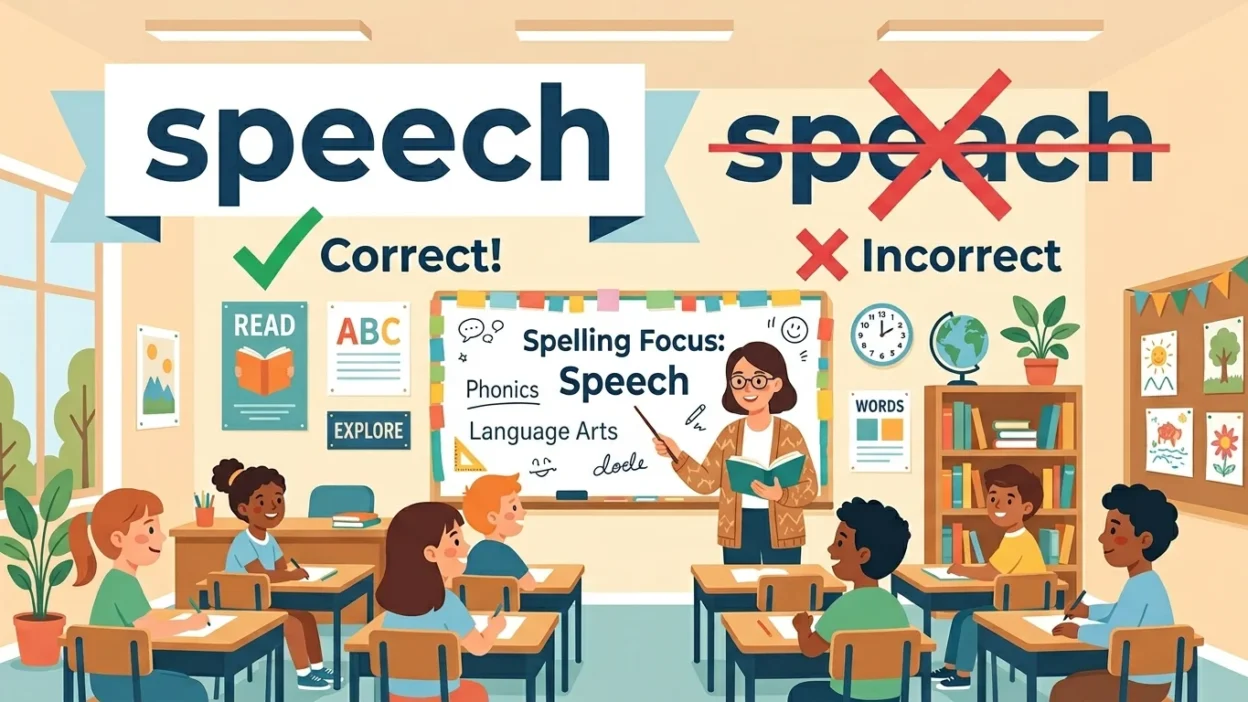
The confusion between speech and speach is a very common misspelling in english language writing, especially for learners, students, and even professionals. I still remember checking my first school assignments and noticing how often this mistake appeared in emails and online posts because of search intent on google and other trending topics. The correct spelling is always speech, while speach is incorrect and has no valid form in standard english usage. This is important for clarity, accuracy, and strong communication in every article, whether for education, seo, or global usage.
The reason behind this confusion is the pronunciation, where spoken words, phonetic sound, and syllables make the word feel like it should use “ea” instead of “ee.” Many students try to follow a wrong spelling pattern, leading to a repeated error pattern in writing skills. However, English grammar rule, structure, and language evolution show that speech comes from old english roots like spræc, later shaped by middle english and proto germanic linguistic history. Understanding this improves confidence, credibility, and helps in better speech writing, speech delivery, and even public speaking in school, conference, or graduation ceremony settings where communication system and oral communication matter most.
Quick Answer: What Is Correct?
Here is the simple answer:
- ✔ Speech = correct word
- ✘ Speach = incorrect spelling (mistake)
Easy meaning of “speech”:
- A spoken talk given by a person
- Words spoken in front of people
- A formal or informal talking act
Example:
- The teacher gave a speech in school.
So remember:
👉 Always use speech, never “speach.”
Simple Origin and Background of the Word
The word speech comes from old English language roots. It is connected to the idea of “speaking” or “talking.”
Over time, English spelling became more fixed, and the correct form became speech.
The mistake “speach” likely appears because:
- People try to spell it the way it sounds
- “ea” is common in many English words (like “teach” or “reach”)
- Fast typing leads to wrong letters
But historically and grammatically, “speech” is the only correct spelling.
Clear Explanation of the Difference
There is actually no real “difference in meaning” between speach and speech because:
So the difference is only:
- Speech → correct, meaningful word
- Speach → spelling error
What “speech” means in simple English:
A speech is when someone talks in front of other people to share ideas, feelings, or information.
It can be:
- A school speech
- A political speech
- A wedding speech
- A motivational speech
Comparison Table (Easy to Understand)
| Feature | Speech | Speach |
| Correct spelling | Yes | No |
| Meaning | Talking in front of people | No meaning |
| Used in English | Always used | Never used |
| Dictionary word | Yes | No |
| Example | She gave a speech | ❌ incorrect |
Which One to Use and When
You should always use speech in every situation.
Use “speech” when talking about:
- School presentations
- Public talks
- Formal speaking events
- Recorded talks or messages
- Inspirational talks
Example situations:
- A student giving a speech in class
- A leader giving a speech on TV
- A wedding speech by a friend
👉 If you are unsure, just remember:
If it is about talking in front of people, use “speech.”
There is no situation where “speach” is correct.
Common Mistakes People Make
Many learners make spelling mistakes with this word. Here are the most common ones:
Mistake 1: Writing “speach” instead of “speech”
- This happens because of pronunciation confusion.
Mistake 2: Thinking both words are correct
- Only “speech” is accepted in English.
Mistake 3: Typing quickly on mobile
- Auto correct may not always fix it.
Mistake 4: Mixing with similar words
- Words like “teach,” “reach,” “beach” confuse learners.
How to avoid mistakes:
- Remember: “speech” has ee, not “ea”
- Practice writing it 5–10 times
- Read it in real sentences often
Everyday Real Life Examples
Here are simple real life examples to help you understand how “speech” is used.
School life examples
- The principal gave a speech in the morning assembly.
- I prepared a speech for my English class.
News examples
- The leader delivered a long speech on television.
- The public listened carefully to the speech.
Social media examples
- “Watch my motivational speech on YouTube.”
- “Her graduation speech was very emotional.”
Daily life examples
- My friend gave a short speech at the party.
- I forgot my speech notes before the presentation.
Learning Section for Students and Beginners
If you are a student or English learner, here is a simple way to remember:
Memory trick:
👉 Think: “You SPEAK a SPEECH.”
- SPEAK → action of talking
- SPEECH → result of speaking
Easy spelling tip:
- Correct: speech = s + p + e + e + c + h
- Wrong: speach = incorrect “ea”
Practice idea:
Try making 3 sentences every day using the word “speech.”
Example:
- I gave a speech today.
- Her speech was clear.
- The speech was short.
FAQ: Common Questions
Is “speach” a real English word?
No, “speach” is not a real word. It is only a spelling mistake.
Why do people write “speach”?
Because it sounds similar and people often spell it the way they hear it.
What is the correct spelling?
The correct spelling is speech.
What does “speech” mean?
It means a spoken talk given in front of people.
Can “speach” ever be correct in any situation?
No, it is never correct in standard English.
Is “speech” used in formal English?
Yes, it is used in schools, offices, news, and formal events.
How can I stop making this mistake?
Practice spelling “speech” often and remember the “ee” rule.
Is pronunciation the same for both?
Yes, they sound similar, which is why the mistake happens.
Conclusion
The confusion between “speach” and “speech” is very common, but the answer is simple and clear.
Only “speech” is the correct English word. It refers to a spoken talk given in front of people, whether in school, public events, or daily life situations. The word “speach” does not exist in proper English and should always be avoided.
If you remember just one thing, it should be this:
👉 Speak + ee = Speech
With practice, you will never make this mistake again, and your English writing will become more accurate and confident.