Many English learners and even native speakers mix up cue and queue because they sound exactly the same. Both words are pronounced like “kyoo”, but they have very different meanings.
The confusion becomes even greater because both words are commonly used in daily life. You may hear them in conversations, see them in emails, read them in news articles, or notice them on social media.
The good news is that the difference is simple once you understand what each word means.
This guide will help you clearly understand when to use cue and when to use queue, with easy explanations and real life examples.
Quick Answer
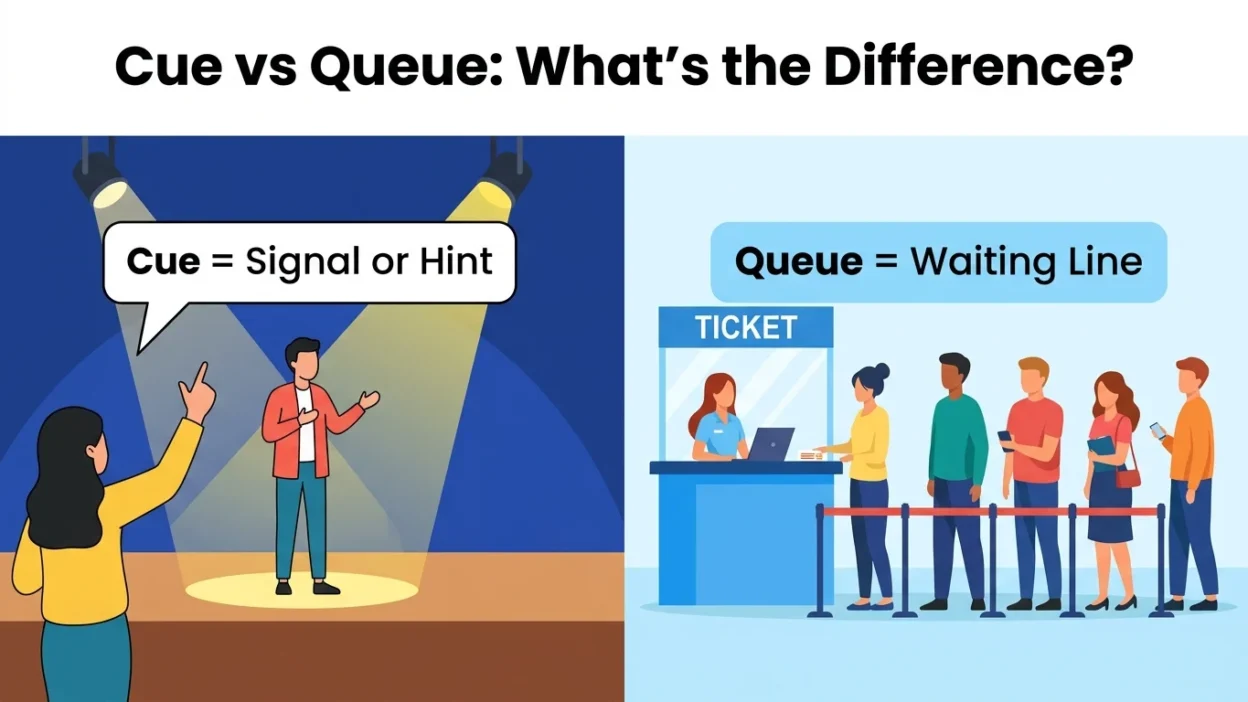
- Cue means a signal, hint, reminder, or instruction to do something.
- Queue means a line of people, vehicles, or items waiting for something.
- Cue is connected to action or timing.
- Queue is connected to waiting.
Easy Memory Trick
- Cue = Clue or Signal
- Queue = Waiting Line
Example:
- The teacher gave me a cue to start speaking.
- We stood in a queue to buy tickets.
Origin and Background
Understanding where these words came from can make them easier to remember.
Cue
The word cue became popular in theater and acting. Actors needed a signal that told them when to speak or move on stage.
For example:
- When one actor finished a sentence, that sentence became the next actor’s cue.
Over time, the meaning expanded to include any signal, hint, or reminder.
Queue
The word queue comes from a word that originally meant a tail or something that follows behind.
This makes sense because people standing in a line follow one another, almost like a tail.
Today, queue is used for any line of people, vehicles, calls, or digital tasks waiting their turn.
The Difference Between Cue and Queue
Although they sound the same, their meanings are completely different.
What Is a Cue?
A cue tells someone when to act, speak, move, or pay attention.
Think of it as a signal.
Examples:
- The coach gave the runners a cue to start.
- Her smile was a cue that everything was okay.
- The music was my cue to enter the stage.
In all these examples, the cue is a sign that triggers an action.
What Is a Queue?
A queue is a line of people or things waiting for their turn.
Think of it as waiting in line.
Examples:
- There was a long queue outside the store.
- We joined the queue for the bus.
- Your request is in the queue.
In all these examples, people or items are waiting.
The Simple Rule
Ask yourself:
Is it a signal?
- Use cue.
Is it a line or waiting list?
- Use queue.
Comparison Table
| Feature | Cue | Queue |
| Meaning | Signal or hint | Line of people or things |
| Purpose | Tells someone to act | Shows waiting order |
| Related Idea | Action | Waiting |
| Common Places | Theater, sports, conversations | Stores, airports, websites |
| Part of Speech | Noun or verb | Noun or verb |
| Pronunciation | Kyoo | Kyoo |
| Example | That’s my cue to leave. | We waited in a queue. |
Which One to Use and When
Use “Cue” When Talking About Signals
Choose cue when something tells a person what to do next.
Examples:
- The bell was a cue to enter the classroom.
- His expression gave me a cue.
- The green light was the cue to start.
Use “Queue” When Talking About Waiting
Choose queue when people or things are waiting for their turn.
Examples:
- The queue moved slowly.
- Hundreds of people joined the queue.
- The computer placed the task in a queue.
Using Them as Verbs
Both words can also be verbs.
Cue as a Verb
It means to signal or prepare something.
Examples:
- Please cue the music.
- The manager cued the presentation.
Queue as a Verb
It means to form a line or wait in order.
Examples:
- People queued outside the stadium.
- Customers queued for hours.
Common Mistakes People Make
Writing “Queue” Instead of “Cue”
Incorrect:
- That was my queue to speak.
Correct:
- That was my cue to speak.
Why?
Because speaking starts after a signal, not after a line.
Writing “Cue” Instead of “Queue”
Incorrect:
- We stood in a cue for tickets.
Correct:
- We stood in a queue for tickets.
Why?
Because people are waiting in a line.
Assuming They Have Similar Meanings
Many learners think the words are related because they sound alike.
They are not.
Remember:
- Cue = signal
- Queue = line
Forgetting the Extra Letters
Many people misspell queue because it contains several vowels.
A helpful trick:
Queue looks long because a line can be long.
Everyday Real Life Examples
Emails
Cue
- Your message was the cue I needed to begin the project.
- The manager’s email gave us a cue about the next step.
Queue
- Your support request is in the queue.
- Emails are processed in the order they enter the queue.
News
Cue
- The announcement was a cue for celebrations.
- The speech gave investors a cue about future plans.
Queue
- A long queue formed outside the event.
- Travelers waited in a queue at the airport.
Social Media
Cue
- Her post was a cue for people to join the discussion.
- The video gave viewers a cue to subscribe.
Queue
- New posts are placed in a queue before publishing.
- Users waited in a queue to access the service.
Daily Conversations
Cue
- That’s my cue to go home.
- His laugh was a cue that he was joking.
Queue
- Let’s join the queue.
- The queue is getting shorter.
Learning Tips for Students and Beginners
Remember the First Letter
- C in Cue can remind you of Clue.
- Q in Queue can remind you of a Queue of people.
Think About the Situation
Ask:
“Am I talking about a signal?”
If yes, use cue.
Ask:
“Am I talking about people waiting?”
If yes, use queue.
Practice With Simple Sentences
Try these:
- The teacher’s nod was my cue.
- We waited in a queue.
- The music was the cue to dance.
- A long queue formed at the entrance.
Create Your Own Examples
Making your own sentences is one of the fastest ways to remember the difference.
For example:
- The whistle was my cue to run.
- We joined the queue for lunch.
FAQ
Is cue the same as queue?
No. They sound the same but have different meanings.
- Cue = signal
- Queue = line of waiting people or things
How do you pronounce cue and queue?
Both are pronounced the same way:
Which word means a signal?
Cue means a signal, hint, or reminder.
Example:
- The bell was a cue to begin.
Which word means a line?
Queue means a line of people or things waiting.
Example:
- We stood in a queue for tickets.
Can cue be used as a verb?
Yes.
Example:
- Please cue the music.
It means to prepare or signal something.
Can queue be used as a verb?
Yes.
Example:
- People queued outside the building.
It means to stand in line.
Why does queue have so many letters?
English spelling developed over time, and some words kept older spellings. Even though queue has five letters, it is still pronounced like “kyoo.”
What is an easy way to remember the difference?
Remember:
- Cue = Clue or Signal
- Queue = Waiting Line
Conclusion
Cue and queue may sound exactly the same, but their meanings are very different.
A cue is a signal, hint, or instruction that tells someone when to act. A queue is a line of people, vehicles, or items waiting for their turn.
The easiest way to remember them is:
- Cue = signal
- Queue = waiting line
Once you connect cue with action and queue with waiting, choosing the correct word becomes much easier in everyday writing and conversation.

Daniel Matthew is a language enthusiast, writer, and contributor at Meanefy.com, where he explores the meanings, origins, and nuances of words and phrases. With a deep passion for language, Daniel aims to make complex concepts simple, engaging, and easy to understand for readers of all ages.