
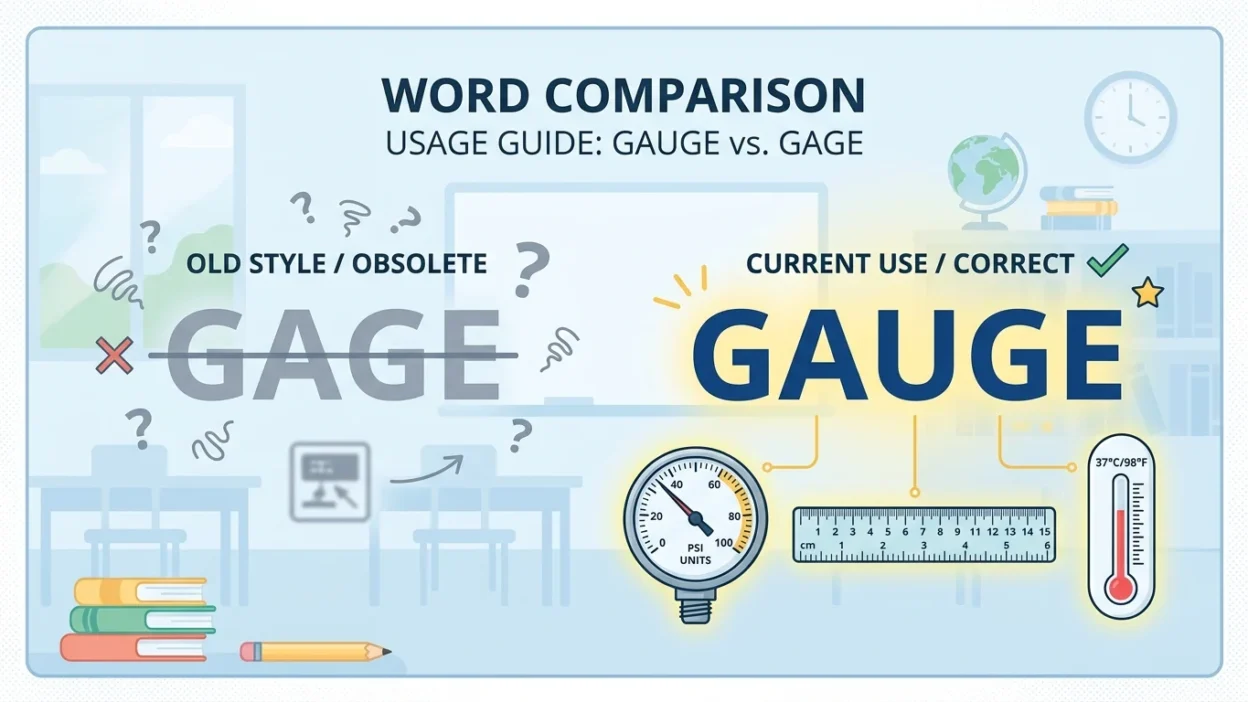
When I first came across Gauge and Gage, it felt like one of those small English traps that even experienced writers fall into. In American English, people often treat them as homophones, meaning they sound the same, which creates constant confusion spelling in language learning and English grammar. The word Gauge is the modern spelling preference used in professional writing, formal writing, and every technical document, while Gage is mostly an outdated spelling or obsolete, found in older writings and rare historical contexts. According to sources like Dictionary.com (September 6 2022), this difference is widely agreed in modern usage.
In real work environments like engineering, manufacturing, and heavy machinery, I usually see Gauge used as a measurement device, instrument, or measuring tool for measurement, estimation, and to measure precisely. It helps to assess, determine, and even appraise things like temperature, distance, capacity, volume, thickness, and quantity using tools such as pressure gauge, fuel gauge, rain gauge, thermometer, and tire gauge. In US industries and technical contexts, a gauge block, wire gauge, and even shotgun 12-gauge or 16-gauge wire are used for wire sizing, wire thickness, and mechanical accuracy as a standard of measure or benchmark.
Whether it is railway gauge, rail gauge, or systems like 1520 mm gauge, 2 ft gauge, 60 cm gauge, or 750 mm railway narrow gauge, everything connects back to measurement standard comparison and engineering tool usage where standardization, calibration, and precision matter in scientific writing, engineering reports, and technical specification.
Quick Answer
Here is the simplest way to understand it:
- Gauge is the correct and most common modern spelling
- It is used for measuring tools, levels, and checking things
- Gage is an old spelling or rare alternative
- It can also mean a pledge or something given as a promise (in older English)
- In everyday English, you should almost always use “gauge”
Simple Origin or Background Explanation
Both words come from old French and Middle English. Long ago, spelling was not fixed like today. People wrote words in different ways, and both gage and gauge were used in writing.
Over time, English became more organized. One spelling became standard:
- “Gauge” became the official modern form
- It was used in science, engineering, and everyday writing
- Dictionaries and schools preferred “gauge”
Meanwhile, “gage” slowly became less common, but it did not completely disappear. It stayed in a few special meanings and old style writing.
So, the confusion today comes from history. Both words were once common, but only one survived as the main spelling.
Clear Explanation of the Difference
The main difference is simple:
Gauge (Modern and Standard Word)
“Gauge” is used when talking about:
- Measuring something
- Checking size, level, or amount
- Tools that measure things (like pressure or temperature)
- Understanding or judging something
Examples:
- A fuel gauge in a car
- A pressure gauge in a machine
- To gauge someone’s mood (to understand)
Gage (Old or Rare Word)
“Gage” is not commonly used today. It appears in:
- Old legal or historical writing
- The meaning of a pledge or promise (rare now)
- Some names or special terms
Example (old style):
- A knight gave a gage as a sign of promise
In modern English, most people will never need to use “gage” unless reading old texts.
Comparison Table
Here is a simple table to make everything clearer:
| Feature | Gauge | Gage |
| Usage today | Very common | Rare |
| Meaning | Measure or check something | Old meaning: pledge or promise |
| Field | Science, daily life, tools | History, legal old texts |
| Example | Fuel gauge, temperature gauge | Old writings, historical usage |
| Recommended for learners | Yes | No (except rare cases) |
Which One to Use and When
If you are writing or speaking English today, the rule is very simple:
Use “gauge” in almost all cases
You should use it when talking about:
- Measuring tools
- Machines and instruments
- Understanding situations
- Everyday communication
Examples:
- “I need to gauge the situation.”
- “Check the water gauge.”
Use “gage” only if:
- You are reading old literature
- You are studying history
- You see it in a fixed name or legal document
For students and ESL learners, it is safest to stick with “gauge.”
Common Mistakes People Make
Many learners make small but common mistakes with these words:
Thinking they are always the same
People assume both spellings are interchangeable. This is not true in modern English.
Using “gage” in everyday writing
Some people use “gage” thinking it is just a shorter form. In modern writing, this looks incorrect.
Spelling errors in exams
Students sometimes lose marks by writing “gage” instead of “gauge.”
Confusing pronunciation
Both words sound the same, so learners think spelling does not matter. But English spelling rules do matter in writing.
Everyday Real Life Examples
Let’s see how “gauge” is used in daily life.
In emails
- “We need to gauge customer interest before launching the product.”
- “Can you check the fuel gauge before the trip?”
In news or reports
- “Experts gauge the impact of inflation on families.”
- “Scientists use tools to measure air pressure gauges.”
On social media
- “It’s hard to gauge people’s reactions online.”
- “How do you gauge if a post will go viral?”
In daily life conversations
- “I can’t gauge how long this will take.”
- “The water level gauge shows the tank is full.”
These examples show that “gauge” is part of everyday English, even in simple conversations.
Short Learning Section for Students and Beginners
Here is a simple way to remember:
Think: “Gauge = Measure”
- Gauge = measure, check, understand
- Gage = old word, rarely used
Memory trick
If you see a word related to meters, levels, or understanding, always think of “gauge.”
Practice sentences
Try using these:
- I can’t gauge the situation.
- The car’s fuel gauge is low.
- We need to gauge the risk before deciding.
The more you practice, the easier it becomes.
FAQ: Common Questions Answered
Is gage wrong spelling?
Not always wrong, but it is very old and rarely used today. “Gauge” is the correct modern spelling.
Can I use gage in exams?
It is not recommended. Most exams expect “gauge.”
Why do both words exist?
Because English spelling changed over time, and both forms survived from older language history.
Do gauge and gage sound different?
No, they sound the same in most English accents.
What does gauge mean in simple words?
It means to measure, check, or understand something.
Is gauge only for machines?
No, it can also mean understanding feelings or situations.
Which word should learners focus on?
Always focus on “gauge.”
Is gage used in modern English at all?
Only in rare or historical cases, not in everyday use.
Conclusion
The confusion between gage and gauge is very common, but the answer is actually simple.
- Gauge is the modern, correct, and widely used spelling.
- It is used in measurement, tools, and understanding situations.
- Gage is an old or rare form that appears mostly in historical writing.
If you are learning English, writing essays, or speaking in daily life, you should always use “gauge.” This will keep your English clear, correct, and natural.
Once you remember this simple rule, the confusion disappears completely.