From a scientific perspective, the Chicken or Egg question is not just a simple riddle but a deep evolutionary biology story that connects life on Earth, dinosaurs, and even reptiles through natural selection over 340 million years. Long before the modern chicken (Gallus gallus domesticus) appeared around 58,000 to 10,000 years, nature was already using amniotic eggs and hard shelled eggs for reproduction, especially in birds, ancestor birds, and early land adaptation systems.
These changes were driven by DNA mutation, genetic changes, and small shifts in genetics across generations, leading to new species formation. At one key mutation point, a proto chicken emerged through fertilization inside a fertilized egg, making the idea of a first chicken egg possible even before the first true bird existed. This is why many evolution theory explanations support the egg first concept, where bird emergence and evolutionary origin come from gradual biological processes rather than sudden creation. In my experience studying biology, this timeline always feels like reading Earth’s slow but powerful story of survival, adaptation, and constant change shaped by evolutionary steps and DNA variation.
However, from a definition shift in the scientific debate, things become more complex when we focus on the chicken egg as a product of a real female chicken role inside ovaries, where the OC 17 protein plays a critical protein role in eggshell formation and biomineralization. This introduces a narrow definition where a true egg cannot form without protein production inside a living chicken, creating a biological dependency linked to avian biology and reproductive biology. In practical poultry farming, especially in a backyard flock or poultry setup, understanding egg production, breeds, and incubation becomes essential for beginners.
The standard timeline 21 days in an incubator, with temperature 99.5°F, humidity 65–75%, careful turning eggs, and a strict lockdown day 18, ensures proper embryo development until chicks finally hatch through the delicate membrane. Proper nutrition, especially protein diet and calcium intake, supports strong laying hens. Popular breed selection like White Leghorn, ISA Brown, or Ameraucana helps improve egg production 280–320 eggs/year, offering brown eggs, blue eggs, and even green eggs. From my own observation of small scale homestead systems, the balance between egg availability, flock management, and self sufficiency often feels like a living version of the same ancient Chicken vs Egg question, now shaped by modern farming industry, livestock, and commercial poultry realities.
Quick Answer
Here is the simplest answer:
- The egg came first (based on science)
- Eggs existed millions of years before chickens
- The first true chicken came from an egg laid by a “almost chicken” bird
- So the egg that had a real chicken inside came before the first chicken
In short:
👉 Egg first, chicken later
Simple Origin or Background Explanation
To understand this question, we need to think about life in the past.
Long ago, there were birds that were not exactly chickens. They were very close to chickens, but not the same. These birds slowly changed over time through small natural changes.
This process is called evolution (simple meaning: small changes in living things over a long time).
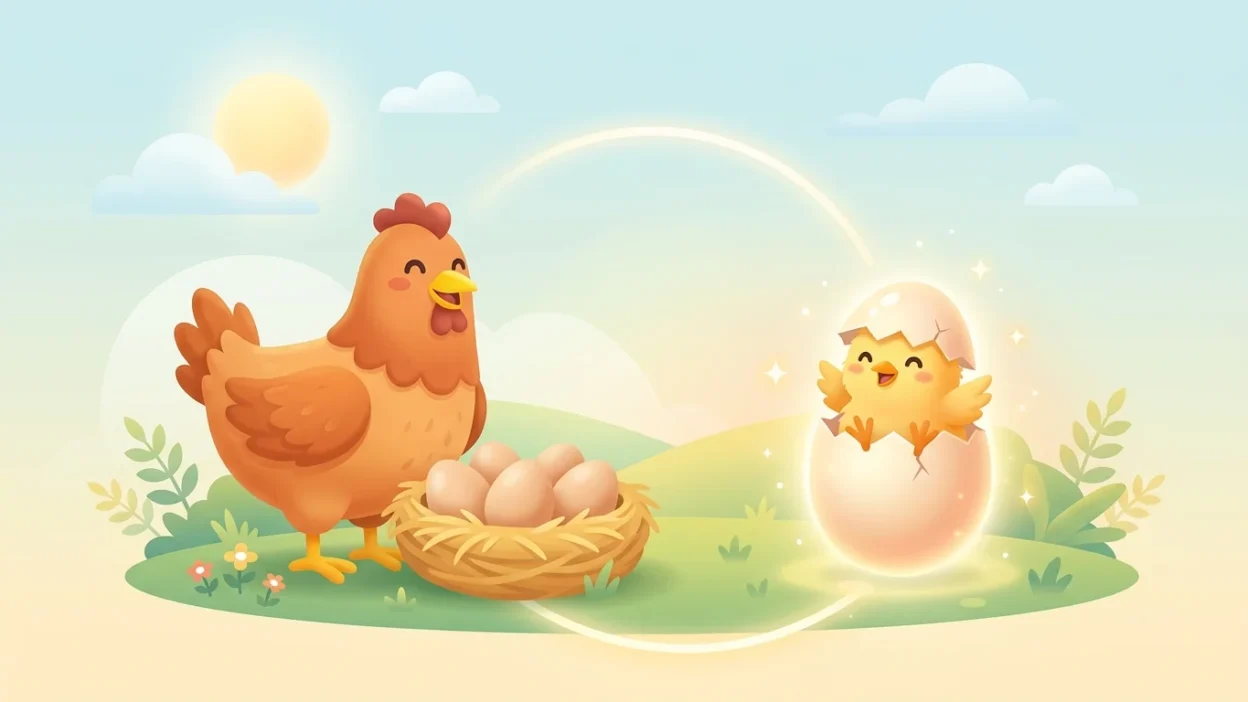
At some point, one of these “almost chickens” laid an egg. Inside that egg, a small change happened in the baby bird’s body. That baby bird became the first real chicken.
So:
- The parent was not fully a chicken
- The baby inside the egg became the first chicken
That is why the egg came first.
Clear Explanation of the Difference
Now let’s break it down in a very simple way.
What is a chicken?
A chicken is a bird that belongs to a specific group of animals we call “chickens.” It has:
- A certain body shape
- A certain type of feathers
- A specific genetic pattern (instructions inside the body)
What is an egg?
An egg is a protective shell where a baby bird grows before it hatches. Eggs existed long before chickens. Many animals lay eggs, such as:
- Fish
- Reptiles
- Other birds
The key difference
The main difference is:
- A chicken is a living animal
- An egg is a stage of early life development
So the egg is not “owned” by chickens only. Eggs existed much earlier in nature.
Comparison Table
| Feature | Chicken | Egg |
| What it is | A living bird | A protective shell for baby life |
| Life stage | After birth | Before birth |
| Exists in nature | Yes | Yes, in many animals |
| Came first in history | No | Yes |
| Depends on the other | Yes (needs egg) | Yes (needs chicken or other animals) |
Which One to Use and When
This question is not about choosing in real life, but understanding science and logic.
When talking about nature
- Use “egg came first”
- Because eggs existed before chickens evolved
When talking about daily life
- Chicken and egg are both important in food
- Chicken gives meat and eggs
- Egg gives nutrition and can become a chicken
When talking in jokes or discussions
- People often say “it’s a never ending question”
- It is used to show confusion or circular thinking
So depending on the situation:
- Science answer → egg first
- Daily life → both important
- Fun talk → both depend on each other
Common Mistakes People Make
Many people get confused because of simple thinking errors.
Thinking eggs only come from chickens
This is not true. Many animals lay eggs long before chickens existed.
Thinking chickens must exist first to make eggs
Also not true. Eggs are just a natural way for babies to grow.
Thinking the question has no answer
It actually has a scientific answer: egg came first.
Mixing logic with emotions
People sometimes think too simply: “If chicken lays egg, chicken must come first.” But evolution shows a longer story.
Everyday Real Life Examples
Emails, News, and Communication
People often use “chicken or egg problem” in writing like:
- “We don’t know what caused the delay first, it is a chicken or egg situation.”
This means:
👉 Two things depend on each other, and it is hard to know which started first.
Social Media
On social media, people use this phrase when:
- Two problems are linked
- It is unclear what caused what
Example:
- “No jobs because no experience, no experience because no jobs — chicken or egg problem.”
Daily Life Situations
You may hear it in normal talks like:
- “You are tired because you sleep late, or you sleep late because you are tired?”
- This shows a loop of cause and effect.
Short Learning Section for Students and Beginners
Let’s make it super simple:
Key ideas to remember
- Eggs existed before chickens in history
- A chicken came from an egg
- Evolution means slow changes over time
- The first chicken was born from a non chicken bird egg
Easy memory trick
👉 “Eggs are older than chickens in nature”
One line summary
👉 The first chicken hatched from an egg laid by a bird that was almost a chicken
FAQ Section
Did the chicken or egg come first in science?
Science says the egg came first because eggs existed before chickens evolved.
Can a chicken exist without an egg?
No. Every chicken starts life inside an egg.
Do only chickens lay eggs?
No. Many animals like birds, reptiles, and fish lay eggs.
Why is this question so famous?
Because it is simple but confusing, and it makes people think deeply about cause and effect.
Is there a wrong answer?
No. There are different ways to think about it, but science gives a clear explanation.
What is evolution in simple words?
It means small changes in living things over a very long time.
Why do people still argue about it?
Because it feels like a loop where each depends on the other.
Conclusion
The “chicken or egg” question is famous because it looks simple but creates confusion. When we think only in daily life, it feels like both depend on each other. But when we look at science and evolution, the answer becomes clear.
Eggs existed long before chickens. At some point in history, a bird that was almost a chicken laid an egg, and that egg hatched into the first real chicken.
So the simple and clear answer is:
👉 The egg came first.
This question teaches us an important lesson: sometimes the answer is not obvious, but looking at history and science helps us understand things better.

Anthony Charles is the founder and lead content creator at Meanefy.com, a platform dedicated to exploring word meanings, language nuances, and everyday curiosities. With a passion for language and a keen eye for detail, Anthony aims to make complex words and concepts simple and accessible for readers around the world.