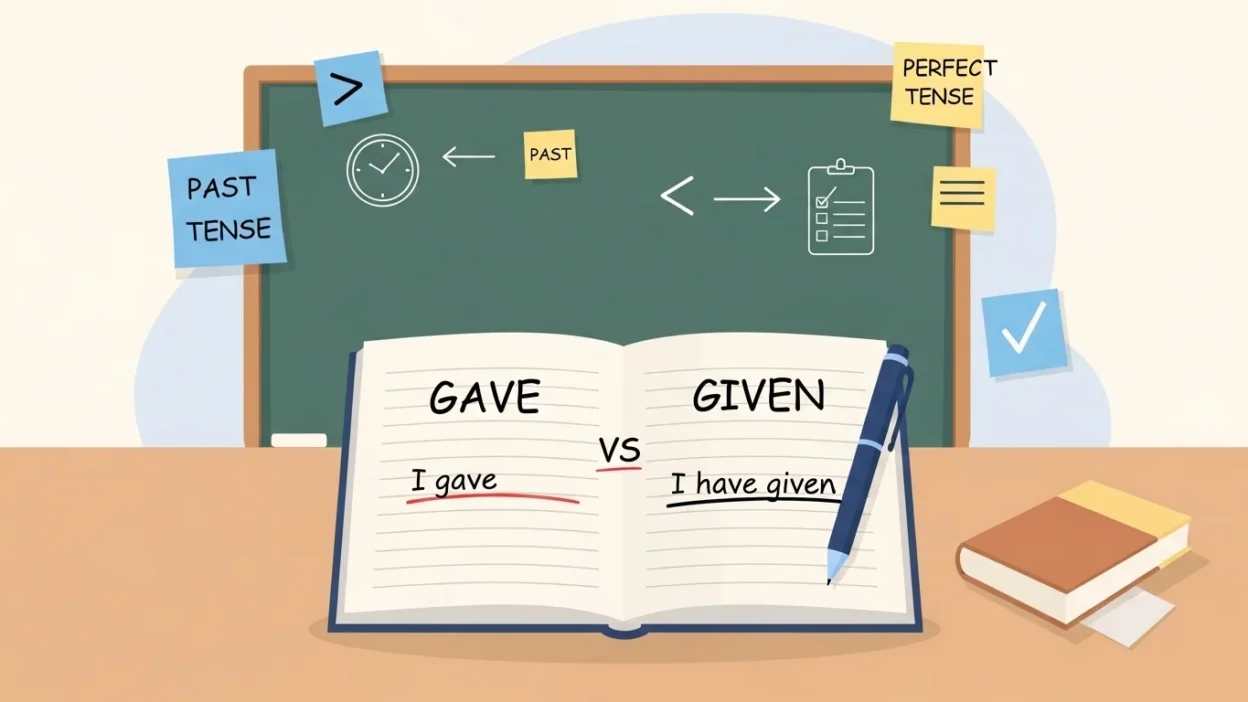
Many English learners get confused between “gave” and “given.” They look connected, and both come from the same verb “give.” But they are used in different situations.
The confusion happens because English changes verbs depending on time and sentence type. Sometimes we talk about the past directly.
Sometimes we talk about actions that connect to another verb like “have” or “has.” This small change makes a big difference in meaning.
This article will explain everything in very simple English so you can understand it clearly and never mix them up again.
Quick Answer
Here is the easiest way to understand the difference:
- Gave is simple past tense
- Used when something happened in the past
- Example: I gave him a book yesterday
- Given is past participle
- Used with helping verbs like “have,” “has,” or “had”
- Example: I have given him a book
- Both come from the verb give
- They are not interchangeable
- The sentence structure decides which one is correct
Simple Background of “Give”
The verb give is one of the most common verbs in English. It has three main forms:
- Base form: give
- Past form: gave
- Past participle: given
English verbs often change form to show time. These forms are called verb forms.
In simple words:
- “give” is present or basic form
- “gave” is used for the past
- “given” is used for perfect tenses or passive sentences
This system helps English show when and how something happens.
Clear Difference Between Gave and Given
Let’s break it down in the simplest way.
Gave
- Used for a finished action in the past
- No helper verb is needed
- Tells a simple story about something that already happened
Examples:
- I gave her my pen.
- He gave me a gift.
- They gave us food yesterday.
In all these sentences, the action is complete and in the past.
Given
- Used with helper verbs:
- have
- has
- had
- Used in perfect tense
- Also used in passive voice
Examples:
- I have given her my pen.
- He has given me a gift.
- They had given us food before we arrived.
Here, the action is connected to another time or situation.
Comparison
| Feature | Gave | Given |
| Verb form | Past simple | Past participle |
| Helping verb needed | No | Yes (have/has/had) |
| Time | Simple past | Connected past or perfect tense |
| Sentence type | Direct action | Perfect or passive sentences |
| Example | I gave him money | I have given him money |
This table shows the difference in a very clear way.
When to Use Gave and When to Use Given
Use “Gave” when:
- You talk about a simple past action
- There is no helper verb
- You are telling a story or event
Examples:
- I gave him my phone yesterday.
- She gave me tea in the morning.
- We gave them directions.
Think of “gave” as a straight past action.
Use “Given” when:
- You use have, has, or had
- You want to show connection with present or past time
- You are using passive voice
Examples:
- I have given him my answer.
- She has given me permission.
- The book was given to me by my teacher.
Think of “given” as a linked or completed action with help words.
Common Mistakes People Make
Many learners mix these two forms. Here are the most common mistakes:
Using “gave” with have/has
❌ I have gave him the book
✔ I have given him the book
Using “given” without helper verb
❌ I given him the book yesterday
✔ I gave him the book yesterday
Mixing past and present
❌ She has gave me advice
✔ She has given me advice
Forgetting verb structure
Some learners think both are just past forms. But English needs correct structure, not just meaning.
Everyday Real Life Examples
Let’s see how native speakers use these words in daily life.
Emails
- I gave you the report yesterday.
- I have given you the updated report.
School or Study
- The teacher gave us homework.
- The teacher has given us extra practice sheets.
Social Media
- My friend gave me a great idea.
- I have given my opinion in the comments.
Daily Conversations
- She gave me a ride home.
- They have given us good service at the restaurant.
News Style Examples
- The government gave support to farmers.
- The government has given new support programs this year.
These examples show how both forms are used naturally in real life.
Simple Learning Section for Beginners
If you are a beginner, remember this easy trick:
Step rule
- If the sentence is just past time → use gave
- If the sentence uses have/has/had → use given
Memory trick
Think like this:
- “Gave” = alone action in the past
- “Given” = action with help words
Practice tip
Try making your own sentences:
- I gave…
- I have given…
- She gave…
- She has given…
Practice makes the difference very clear.
FAQ Section
What is the main difference between gave and given?
“Gave” is simple past tense. “Given” is past participle used with helper verbs like have, has, or had.
Can I say “I have gave”?
No. The correct form is “I have given.”
Is given present or past?
“Given” is not a simple past form. It is a past participle used in perfect tense and passive voice.
When do I use gave in a sentence?
Use “gave” when talking about a finished action in the past without helper verbs.
Why do English verbs change form?
English verbs change form to show time and structure. This helps show when something happened.
Can both words be used in the same meaning?
They are related but not interchangeable. You must choose based on sentence structure.
Is “given” always correct with have or has?
Yes. When using “have,” “has,” or “had,” you should use “given.”
What is the easiest way to remember both?
Remember: “gave” is simple past, and “given” needs helper verbs.
Conclusion
The difference between gave and given is very simple once you understand the rule.
- Use gave for direct past actions
- Use given with helper verbs like have, has, or had
Both come from the same verb “give,” but they are used in different sentence structures.
If you remember the basic rule gave is simple past, given needs help words you will never be confused again.
With practice and daily use, choosing between these two will become natural and easy.

Daniel Matthew is a language enthusiast, writer, and contributor at Meanefy.com, where he explores the meanings, origins, and nuances of words and phrases. With a deep passion for language, Daniel aims to make complex concepts simple, engaging, and easy to understand for readers of all ages.