
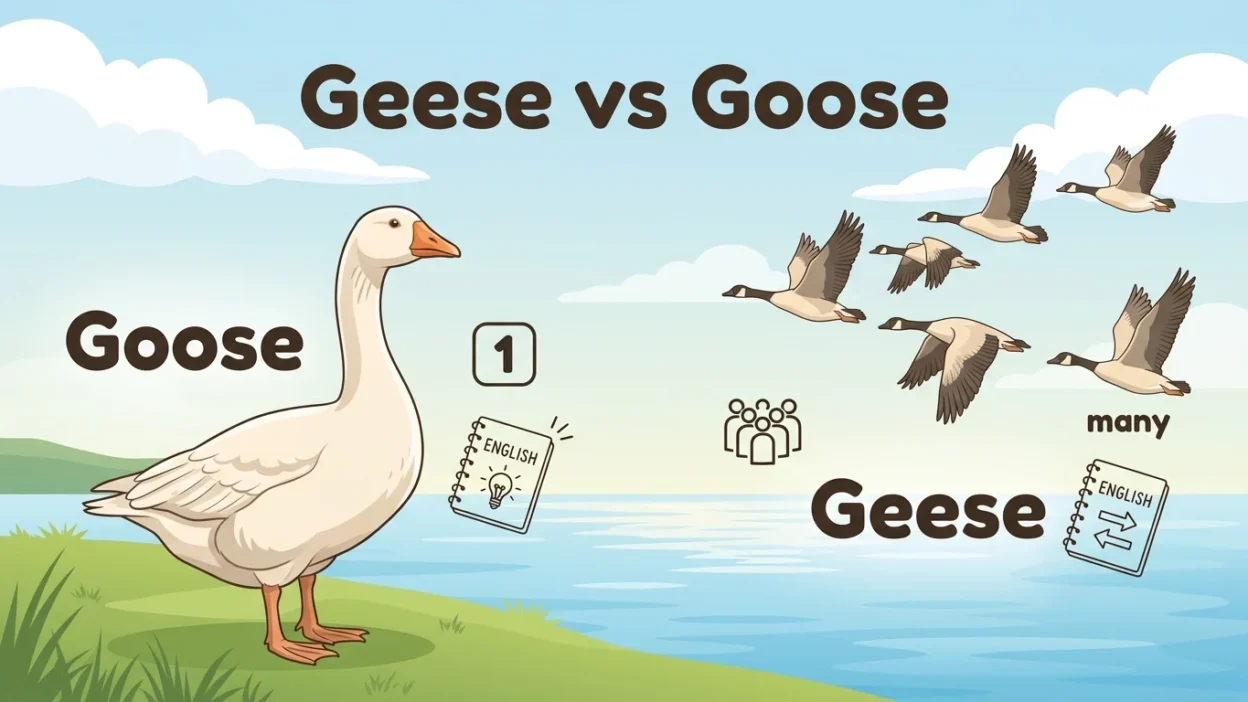
Many English learners feel confused about “geese” and “goose.” The two words look very different, even though they talk about the same animal. Because English has many unusual plural words, beginners often do not know which one to use in a sentence.
Some people say:
- “I saw a geese.”
- “There were many gooses.”
Both sentences are incorrect, but this mistake is very common.
The good news is that the rule is actually very easy. Once you understand the difference between singular and plural nouns, you will never confuse these two words again.
In this guide, you will learn:
- the meaning of goose and geese
- the difference between them
- when to use each word
- common grammar mistakes
- easy examples from daily life
- simple learning tips for students and ESL learners
Quick Answer
Here is the simple answer:
- Goose = one bird
- Geese = more than one bird
Examples:
- I saw a goose near the lake.
- We saw many geese flying in the sky.
Easy memory trick:
- Goose = singular
- Geese = plural
Never use “gooses” in standard English.
What Does Goose Mean?
A goose is a large bird that usually lives near water. Geese are often seen around:
- lakes
- ponds
- rivers
- farms
- parks
A goose has:
- a long neck
- feathers
- webbed feet
- a loud honking sound
When you are talking about one bird only, you must use goose.
Examples of Goose in Sentences
- A goose is standing near the pond.
- The goose walked across the road.
- I heard a goose outside my window.
- That goose looks angry.
- One goose was swimming alone.
What Does Geese Mean?
Geese is the plural form of goose.
We use geese when talking about two or more birds.
Examples of Geese in Sentences
- The geese are flying south.
- Several geese are in the park.
- We fed the geese yesterday.
- Two geese crossed the street.
- The geese were very noisy this morning.
Remember:
- ❌ gooses
- ✅ geese
Why Do People Get Confused?
Many English nouns become plural by adding -s or -es.
Examples:
- cat → cats
- dog → dogs
- bus → buses
But some English words change completely when they become plural.
Examples:
- man → men
- tooth → teeth
- mouse → mice
- goose → geese
These words are called irregular plural nouns.
Because “geese” does not look similar to “goose,” learners often think the correct plural should be “gooses.” However, standard English uses “geese.”
Simple Origin of Goose and Geese
The words “goose” and “geese” come from very old English.
Hundreds of years ago, English speakers changed vowel sounds to make plural words. That is why some modern English words still change their spelling completely.
For example:
- foot → feet
- tooth → teeth
- goose → geese
Even though these spellings look unusual today, they are the correct forms in modern English.
Main Difference Between Geese and Goose
The difference is very simple:
| Word | Meaning | Number |
| Goose | One bird | Singular |
| Geese | More than one bird | Plural |
Simple Rule
- Use goose for one
- Use geese for many
Goose vs Geese Comparison
| Feature | Goose | Geese |
| Type | Singular noun | Plural noun |
| Meaning | One bird | Two or more birds |
| Used With | a, one, this, that | many, several, these, those |
| Verb Type | Singular verb | Plural verb |
| Example | The goose is loud. | The geese are loud. |
When Should You Use Goose?
Use goose when talking about:
- one bird
- a single animal
- one goose in a group
Words Commonly Used With Goose
- a goose
- one goose
- this goose
- that goose
Examples
- One goose is near the water.
- This goose is very large.
- A goose followed us in the park.
- That goose belongs to the farmer.
When Should You Use Geese?
Use geese when talking about:
- two or more birds
- a group of geese
- many birds together
Words Commonly Used With Geese
- many geese
- several geese
- these geese
- those geese
Examples
- Many geese fly south in winter.
- These geese are very noisy.
- Several geese are swimming together.
- The geese crossed the road slowly.
Grammar Rules You Should Know
Goose Takes a Singular Verb
Because “goose” is singular, use singular verbs.
Examples:
- The goose is hungry.
- One goose was in the yard.
- A goose has white feathers.
Geese Takes a Plural Verb
Because “geese” is plural, use plural verbs.
Examples:
- The geese are loud.
- Several geese were flying.
- The geese have returned.
Common Mistakes People Make
Mistake 1: Saying “Gooses”
This is the most common mistake.
❌ Incorrect:
- I saw three gooses.
✅ Correct:
- I saw three geese.
Mistake 2: Using the Wrong Verb
❌ Incorrect:
- The geese is swimming.
✅ Correct:
- The geese are swimming.
Because “geese” is plural, it needs a plural verb.
Mistake 3: Mixing Singular and Plural
❌ Incorrect:
- One geese is standing there.
✅ Correct:
- One goose is standing there.
Use “goose” after words like:
- one
- a
- this
- that
Everyday Real Life Examples
In Daily Conversation
- Did you see that goose near the lake?
- The geese are making so much noise.
In Social Media Posts
- “A goose chased me at the park today!”
- “The geese looked beautiful flying together.”
In News or Nature Reports
- “Hundreds of geese migrated south this winter.”
- “A goose was rescued near the river.”
In School Writing
- The goose has orange feet.
- The geese are swimming in the pond.
In Emails or Messages
- “We saw a goose during our trip.”
- “The geese outside the hotel were very loud.”
Easy Learning Tips for Students and Beginners
Tip 1: Remember “One vs Many”
- one = goose
- many = geese
This is the easiest way to remember the difference.
Tip 2: Think of Similar Words
These words follow the same pattern:
| Singular | Plural |
| tooth | teeth |
| foot | feet |
| goose | geese |
Seeing the pattern can help you remember faster.
Tip 3: Practice With Simple Sentences
Practice these:
- I saw one goose.
- I saw many geese.
- The goose is eating.
- The geese are flying.
Short practice sentences help beginners learn quickly.
Frequently Asked Questions (FAQ)
Is “gooses” a real word?
In standard English, no. The correct plural of goose is “geese.”
What is the singular form of geese?
The singular form is “goose.”
Can I say “one geese”?
No. Use “one goose.”
Correct:
- One goose
Incorrect:
- One geese
Why does goose become geese?
It comes from old English grammar rules where some words changed vowels to make plurals.
Is geese singular or plural?
“Geese” is plural.
It means more than one goose.
Which is correct: “the geese is” or “the geese are”?
“The geese are” is correct because geese is plural.
What type of animal is a goose?
A goose is a large water bird with a long neck and webbed feet.
Are goose and geese used in American and British English?
Yes. Both American English and British English use:
- goose = singular
- geese = plural
Conclusion
The difference between goose and geese is simple once you learn the rule.
- Goose means one bird.
- Geese means more than one bird.
Remember:
- one goose
- two geese
Do not use “gooses” in normal English.
If you practice with short daily sentences, these words will quickly become easy to remember. English has many irregular plural nouns, but “goose” and “geese” are among the easiest once you understand the singular and plural pattern clearly.

Anthony Charles is the founder and lead content creator at Meanefy.com, a platform dedicated to exploring word meanings, language nuances, and everyday curiosities. With a passion for language and a keen eye for detail, Anthony aims to make complex words and concepts simple and accessible for readers around the world.