Many English learners get confused between “send” and “sent.”
They look similar, and both are connected to the same action. But they are used at different times.
The good news is that the difference is actually very simple.
In this guide, you will learn:
- What “send” means
- What “sent” means
- When to use each word
- Common mistakes to avoid
- Easy examples from daily life
By the end, you will understand the difference clearly and use both words correctly with confidence.
Quick Answer
Here is the simple difference:
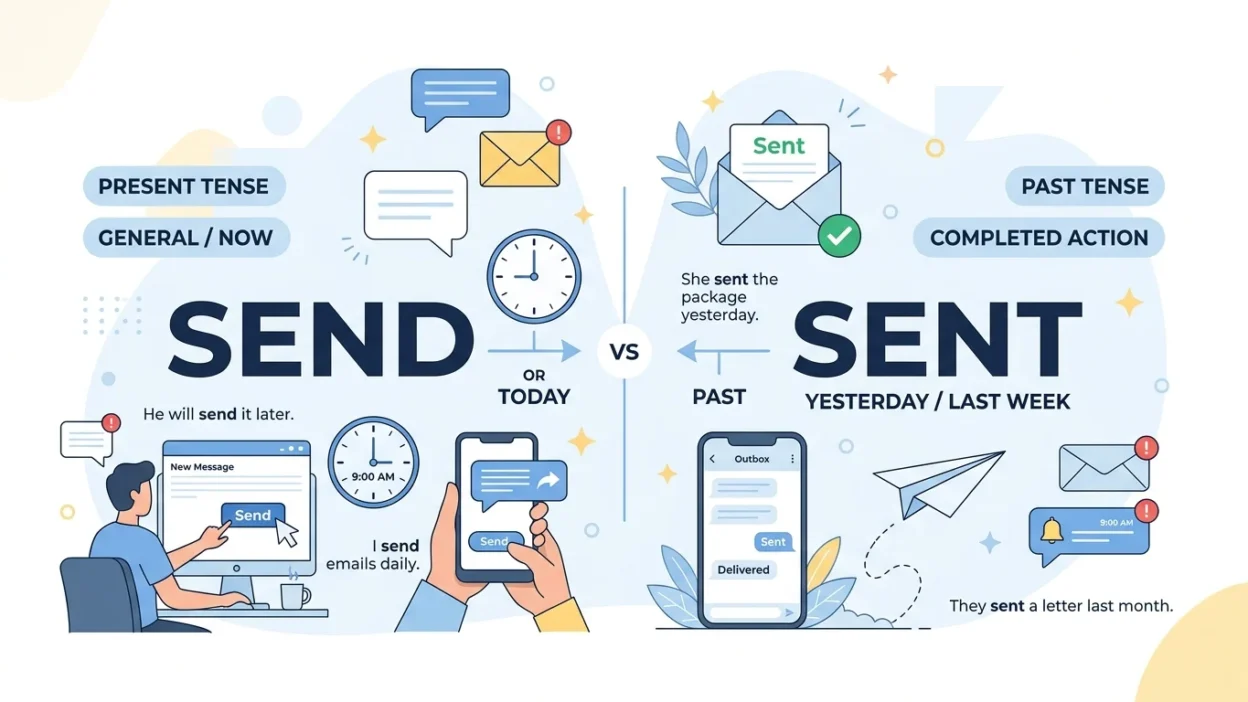
- Send = present tense or future tense
- Sent = past tense
Easy Examples
- I send emails every day.
- She will send the package tomorrow.
- I sent the email yesterday.
- They sent the message last night.
Simple Rule
If the action is happening:
- now → use send
- in the future → use send
- already finished in the past → use sent
Simple Background of the Words
The word “send” is the main form of the verb.
English verbs often change form when talking about the past.
Examples:
| Base Verb | Past Form |
| walk | walked |
| play | played |
| send | sent |
So:
- Send = base form
- Sent = past form of “send”
Unlike regular verbs, “send” changes differently in the past tense. That is why learners sometimes make mistakes.
What Does “Send” Mean?
“Send” means to make something go from one person or place to another.
You can send:
- emails
- messages
- letters
- gifts
- photos
- money
- files
Examples with “Send”
- I send homework to my teacher online.
- Please send me the photo.
- We send reports every Monday.
- Can you send the address?
“Send” in Present Tense
Use “send” for:
- habits
- routines
- facts
- present actions
Examples:
- He sends emails every morning.
- I send text messages often.
Notice:
- “I/We/They” → send
- “He/She/It” → sends
What Does “Sent” Mean?
“Sent” is the past form of “send.”
Use it when the action already happened and finished.
Examples with “Sent”
- I sent the email yesterday.
- She sent me a birthday card.
- They sent the package last week.
- We sent the wrong file by mistake.
These actions are complete and already happened in the past.
Clear Explanation of the Difference
The biggest difference is time.
Use “Send” for:
- present actions
- future actions
- repeated actions
Use “Sent” for:
- finished past actions
Comparison
| Word | Verb Type | Time | Example |
| send | base verb | present/future | I send messages daily. |
| sends | present tense | present | She sends emails fast. |
| sent | past tense | past | He sent the document yesterday. |
Which One Should You Use?
Here is an easy way to choose.
Use “Send” When:
1. Talking About Habits
- I send reports every Friday.
- They send updates regularly.
2. Giving Instructions
- Please send the file today.
- Do not send private information.
3. Talking About the Future
- I will send the email later.
- She is going to send a message tonight.
Use “Sent” When:
1. The Action Already Happened
- I sent the message this morning.
- He sent the money yesterday.
2. Talking About Completed Actions
- We sent invitations to everyone.
- They sent the package already.
Common Mistakes People Make
Many learners use the wrong form because both words are related.
Here are the most common mistakes.
Mistake 1: Using “Send” for the Past
❌ I send the email yesterday.
✅ I sent the email yesterday.
Why?
Because “yesterday” shows past time.
Mistake 2: Using “Sent” After “Will”
❌ I will sent the file.
✅ I will send the file.
After “will,” always use the base verb.
Examples:
- will go
- will eat
- will send
Mistake 3: Forgetting “Sends”
❌ She send messages daily.
✅ She sends messages daily.
For he/she/it in present tense, add “s.”
Mistake 4: Confusing Present and Past
❌ They sent emails every day.
✅ They send emails every day.
Use “send” for regular habits happening now.
Everyday Real Life Examples
Learning with real life examples makes grammar easier.
Emails
- Please send the report before noon.
- I already sent the report.
Text Messages
- Can you send me your number?
- She sent me a funny meme.
Social Media
- People send photos on social apps every day.
- He sent the video last night.
School
- Students send homework online.
- My teacher sent feedback yesterday.
Work
- We send invoices every month.
- The company sent an important notice.
Family and Friends
- I will send you a gift.
- My friend sent me birthday wishes.
Easy Grammar Patterns
These patterns can help you remember faster.
Present Tense
| Subject | Correct Form |
| I | send |
| You | send |
| We | send |
| They | send |
| He | sends |
| She | sends |
| It | sends |
Past Tense
| Subject | Correct Form |
| I | sent |
| You | sent |
| He | sent |
| She | sent |
| We | sent |
| They | sent |
Notice that “sent” stays the same for all subjects.
Short Learning Section for Students and Beginners
Here is a simple trick to remember the difference.
Think About Time
Ask yourself:
Did the action already happen?
- Yes → use sent
- No → use send
Memory Tip
- Send = now or later
- Sent = already finished
Mini Practice
Choose the correct word.
- I _____ the email yesterday.
- Please _____ me the photo.
- She _____ messages every morning.
- We already _____ the package.
Answers
- sent
- send
- sends
- sent
FAQ Section
1. Is “sent” the past tense of “send”?
Yes.
“Sent” is the past tense and past participle of “send.”
Example:
- I sent the message yesterday.
2. Can I say “I have sent”?
Yes.
This is present perfect tense.
Example:
- I have sent the email already.
It means the action happened in the past, but it is still important now.
3. Why is it “will send” and not “will sent”?
After “will,” English uses the base verb.
Correct:
- I will send it.
Incorrect:
- I will sent it.
4. What is the difference between “send” and “sends”?
“Send” is used with:
- I
- you
- we
- they
“Sends” is used with:
- he
- she
- it
Examples:
- They send messages.
- She sends messages.
5. Is “sent” used only for messages?
No.
You can use “sent” for many things:
- emails
- packages
- money
- invitations
- files
- gifts
Example:
- He sent flowers to his mother.
6. Can “send” be used for future actions?
Yes.
Examples:
- I will send the document tonight.
- She is going to send a reply soon.
7. Which is correct: “send me” or “sent me”?
Both can be correct depending on time.
Examples:
- Please send me the file. (now/future)
- She sent me the file yesterday. (past)
8. Is “sended” a real word?
No.
“Sended” is incorrect.
- send
- sends
- sent
Simple Practice Sentences
Try reading these aloud.
- I send emails every day.
- She sends homework online.
- We sent the package yesterday.
- They will send a reply soon.
- He sent me a photo last night.
This kind of practice helps you remember naturally.
Conclusion
The difference between “send” and “sent” is mainly about time.
- Use send for present or future actions.
- Use sent for actions that already happened in the past.
Final Simple Reminder
- I send messages every day.
- I sent a message yesterday.
Once you focus on the time of the action, choosing the correct word becomes much easier.
Keep practicing with real life sentences, and soon the difference between “send” and “sent” will feel natural.

Anthony Charles is the founder and lead content creator at Meanefy.com, a platform dedicated to exploring word meanings, language nuances, and everyday curiosities. With a passion for language and a keen eye for detail, Anthony aims to make complex words and concepts simple and accessible for readers around the world.