Many English learners and even native speakers sometimes get confused between the words “sence” and “sense.” The confusion happens because they sound almost the same when spoken. When two words sound similar, it is easy to mix their spelling.
Another reason is typing mistakes. On keyboards or mobile phones, people often type quickly. Because of this, “sense” is sometimes misspelled as “sence.” Over time, this mistake becomes very common in chats, comments, and social media posts.
Also, English spelling is not always phonetic (spelled the way it sounds). So learners may try to spell words based on sound, which leads to errors like “sence.”
This article will clearly explain the difference so you never get confused again.
Quick Answer
Here is the simple truth:
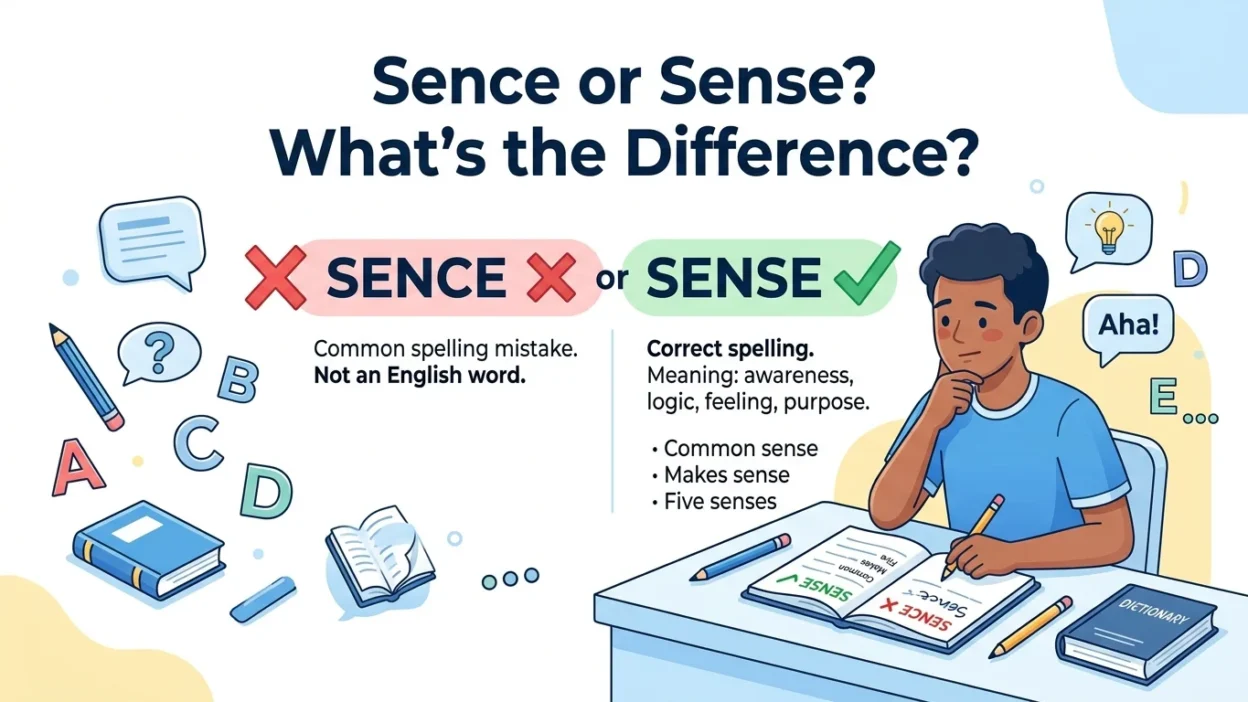
- “Sense” is the correct word in English.
- “Sence” is NOT a correct English word. It is a spelling mistake.
- “Sense” means meaning, feeling, understanding, or ability to notice something.
- If you write “sence,” most readers will think it is an error.
So, the only word you should use is sense.
Simple Origin or Background
The word “sense” comes from old languages like Latin and French. It has been used in English for hundreds of years.
Originally, it was connected to the idea of “feeling” or “perception.” Over time, its meaning expanded to include understanding, judgment, and awareness.
On the other hand, “sence” does not have a real history in English. It is not a true English word. It only appears because of spelling mistakes or confusion while typing.
So in simple terms:
- “Sense” = real English word with history and meaning
- “Sence” = incorrect spelling with no official meaning
Clear Explanation of the Difference
The difference is very simple but very important.
Sense (Correct Word)
“Sense” is a noun and sometimes a verb. It has many meanings:
- The ability to feel or notice something
Example: She has a strong sense of smell. - Understanding or meaning
Example: This sentence makes sense. - Common understanding or good judgment
Example: It makes sense to study before exams. - Feeling or emotion
Example: I had a sense of fear.
Sence (Incorrect Word)
“Sence” is not a real word in standard English. It has:
- No official meaning
- No grammar use
- No correct usage in writing
If you see “sence” in text, it is almost always a typing or spelling error.
Comparison Table
| Feature | Sense | Sence |
| Correct spelling | Yes | No |
| Meaning | Yes (many meanings) | None |
| Used in English | Yes | No |
| Found in dictionary | Yes | No |
| Acceptable in writing | Yes | No |
| Common usage | Very common | Only mistakes |
Which One to Use and When
The answer is very easy:
- Always use sense
- Never use sence in formal or informal writing
You should use “sense” when you talk about:
- Understanding something
- Feelings or awareness
- Logic or reason
- Human perception (seeing, hearing, smelling, etc.)
If you are unsure while writing, just remember this simple rule:
👉 If it is English and has meaning, it is “sense.”
👉 If it looks like “sence,” it is likely a mistake.
Common Mistakes People Make
Many learners make small mistakes with this word. Here are the most common ones:
- Writing “sence” instead of “sense”
- Auto correct not fixing the mistake
- Thinking both spellings are correct
- Confusing pronunciation with spelling
- Copying wrong spelling from social media posts
Another common issue is overthinking. Some learners try to spell words exactly how they sound, but English spelling often does not work that way.
Everyday Real Life Examples
In Daily Conversation
- Correct: This decision makes sense.
- Incorrect: This decision makes sence.
In Social Media
- Correct: Your post doesn’t make sense.
- Incorrect: Your post doesn’t make sence.
In School or Study
- Correct: I understand the sense of this paragraph.
- Incorrect: I understand the sence of this paragraph.
In News or Writing
- Correct: The plan makes sense for the economy.
- Incorrect: The plan makes sence for the economy.
In Emails
- Correct: Does this schedule make sense to you?
- Incorrect: Does this schedule make sence to you?
These examples show that “sense” is used everywhere in real life, while “sence” should be avoided completely.
Short Learning Section for Students and Beginners
To remember the correct word easily, follow these simple tips:
- Always remember: Sense = Correct
- Think of the word “science sense” (both use correct spelling patterns)
- Read sentences out loud to check if they sound natural
- Use spell check tools, but also learn the correct form
- Practice writing simple sentences with “sense” daily
Quick practice:
Try completing these sentences:
- It does not make ______.
- I can sense danger.
- She has a good sense of humor.
Answers: sense, sense, sense
FAQ
Is “sence” ever correct in English?
No, “sence” is never correct. It is always a spelling mistake.
Why do people write “sence” instead of “sense”?
Because both words sound similar when spoken, so people guess the spelling wrong.
What does “sense” mean?
It can mean understanding, feeling, awareness, or logic.
Can “sense” be used in different ways?
Yes, it can be used for emotions, judgment, and physical perception.
Is “sense” a noun or verb?
It can be both. As a noun it means understanding or feeling, and as a verb it means to notice something.
How can I avoid writing “sence” by mistake?
Practice spelling “sense” correctly, use it in sentences, and double check your writing.
Is “sense” used in formal English?
Yes, it is used in both formal and informal English.
What is the easiest way to remember the correct spelling?
Just remember: “sense” has “se” at the end, like “see + n + se.”
Conclusion
The confusion between “sence” and “sense” is very common, but the answer is simple. Only “sense” is the correct English word. It is used to express understanding, feelings, and logic in everyday communication.
“Sence” is not a real word and should always be avoided. It appears only because of spelling mistakes or typing errors.
If you remember just one thing, let it be this:
If it makes meaning, it is sense. If it is written as sence, it is wrong.
With practice and attention, you will never confuse these two again.

Daniel Matthew is a language enthusiast, writer, and contributor at Meanefy.com, where he explores the meanings, origins, and nuances of words and phrases. With a deep passion for language, Daniel aims to make complex concepts simple, engaging, and easy to understand for readers of all ages.