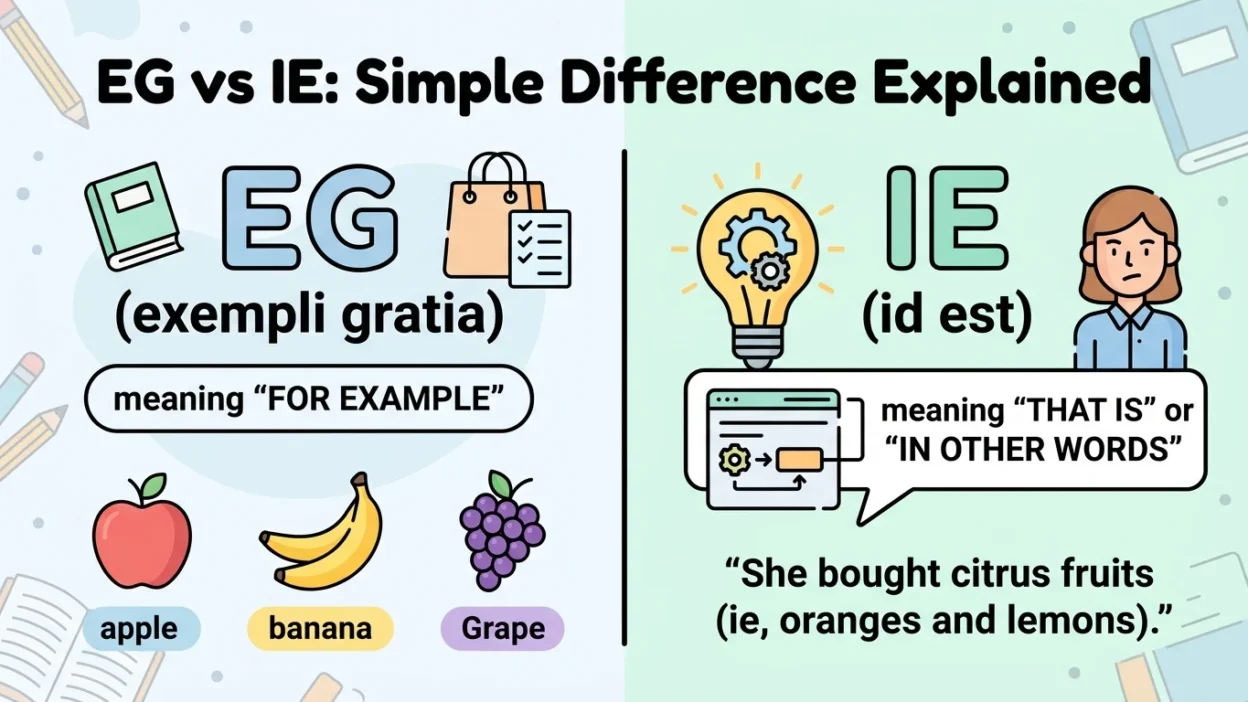
Many people confuse e.g. and i.e. because both are Latin abbreviation forms that appear in emails, essays, and formal writing, often creating confusion, misunderstanding, and writing errors. The core difference is simple: e.g. comes from exempli gratia and is used “for example,” while i.e. comes from id est and means “that is” or “in other words,” giving a clear restatement or clarification of a sentence meaning. This small rule is the base of correct usage, and once you understand it, your writing clarity, grammar, and communication improve naturally.
In real usage context, I often notice learners and ESL writers mix them due to similarity, punctuation style, and lack of memory tricks in writing rules. For example, in American English and British English, both use the same abbreviation history, but punctuation usage, commas, and style variation can differ slightly, affecting punctuation consistency in academic writing, technical writing, reports, and social media.
A simple learning aid I use is: think of e.g. as expansion (open-ended listing, examples, options, like apples, oranges, Python, JavaScript) and i.e. as definition (narrow meaning, precise restating, like remote work, online, or STEM). This improves writing confidence, avoids meaning swap, and strengthens overall writing improvement, clarity, and correctness.
Quick Answer: Simple Difference
Here is the easiest way to understand the difference:
- eg = for example
- Used when you want to give one or more examples
- You are not listing everything, just showing samples
- ie = that is / in other words
- Used when you want to explain something in a clearer way
- You are not giving examples, you are giving the exact meaning
Simple trick:
- eg = example
- ie = explain
Origin and Background of EG and IE
Both eg and ie come from Latin language.
- eg comes from “exempli gratia”
- Meaning: “for the sake of example”
- ie comes from “id est”
- Meaning: “that is”
Even though English has changed a lot over time, these short forms stayed in writing because they are very useful. They are mostly used in formal writing, notes, articles, and sometimes everyday communication.
Today, people use them in a simplified way, usually with a comma after them in modern English style:
- eg,
- ie,
Clear Explanation of the Difference
Let’s understand the real difference in a simple way.
EG (For Example)
Use eg when you want to show examples of something. You are not listing everything, just a few items to help understanding.
Example:
- I like soft drinks, eg, cola, lemon soda, and orange juice.
Here, the list is not complete. There are many soft drinks, but only a few are shown.
Think of eg as:
- “Here are some examples, but not all.”
IE (That Is / In Other Words)
Use ie when you want to explain or make something more clear. You are not giving examples—you are repeating the same idea in a different way.
Example:
- I live in a bilingual country, ie, a country where people speak two languages.
Here, the second part explains exactly what “bilingual country” means.
Think of ie as:
- “Let me explain this more clearly.”
Comparison Table
| Feature | EG | IE |
| Meaning | For example | That is / in other words |
| Purpose | Give examples | Give explanation |
| Type of information | Partial list | Exact meaning |
| Can be replaced with | “for example” | “that is” |
| Usage style | Flexible examples | Clear definition |
| Common mistake | Used when explanation is needed | Used when giving examples |
Which One to Use and When
To choose correctly, ask yourself one simple question:
Are you giving examples?
- Use eg
Example:
- You should eat healthy fruits, eg, apples, bananas, and grapes.
Are you explaining something more clearly?
- Use ie
Example:
- He is a vegetarian, ie, he does not eat meat.
Simple rule:
- If you can replace it with “for example”, use eg
- If you can replace it with “that is”, use ie
Common Mistakes People Make
Many learners mix these two in daily writing. Here are the most common mistakes:
Using EG for explanations
Wrong:
- She is a doctor, eg, she treats patients.
Correct:
- She is a doctor, ie, she treats patients.
Because “doctor” is being explained, not listed as an example.
Using IE for examples
Wrong:
- I like sports, ie, football, cricket, tennis.
Correct:
- I like sports, eg, football, cricket, tennis.
Because these are examples, not explanations.
Forgetting punctuation
Many people forget commas or spaces.
Correct style:
- eg, apples, bananas
- ie, a type of fruit
Using them too much in casual writing
In daily speech or informal chats, using them too often can feel unnatural.
Better casual version:
- “for example”
- “that is”
Everyday Real Life Examples
Emails
- Please bring stationery items, eg, pens, notebooks, and markers.
- Our meeting is rescheduled, ie, moved to another time.
Social Media Posts
- I love warm places, eg, beaches and sunny cities.
- I am on a detox, ie, no sugar for a month.
Daily Conversation Writing
- He enjoys outdoor games, eg, football and badminton.
- She is very tired, ie, she did not sleep well last night.
News or Informal Articles
- The city has many industries, eg, textile, agriculture, and food processing.
- The road is blocked, ie, no vehicles can pass through it.
Short Learning Section for Students and Beginners
Here is a very simple way to remember:
EG = Example Giving
- Think: “E for Example”
- Use when listing samples
IE = In Explanation
- Think: “I for In other words”
- Use when explaining meaning
Practice Tip:
Try replacing them in sentences:
- If “for example” fits → use eg
- If “that is” fits → use ie
Practice 5–10 sentences daily and it becomes automatic.
FAQ
What does EG mean in simple words?
EG means “for example.” It is used when you give sample items or examples.
What does IE mean in simple words?
IE means “that is” or “in other words.” It is used to explain something more clearly.
Can I use EG and IE in spoken English?
Yes, but people usually say “for example” and “that is” when speaking.
Do I need commas after EG and IE?
Yes, modern writing often uses a comma:
- eg, apples
- ie, a fruit
Can EG and IE be used in formal writing?
Yes, they are commonly used in formal and academic writing.
What is the easiest way to remember the difference?
- EG = Example
- IE = Explain
Are EG and IE the same?
No. EG gives examples, IE gives explanations. They are completely different.
Which one is more common?
“eg” is slightly more common because examples are used very often in writing.
Conclusion
The difference between eg and ie is simple once you understand the basic idea.
- eg is used when you want to give examples.
- ie is used when you want to explain something clearly.
Many learners confuse them at first, but with a little practice, it becomes easy to use correctly. Just remember this simple rule: example or explanation and you will never mix them up again.
Using them correctly will make your writing clearer, more natural, and easier to understand for readers.

Daniel Matthew is a language enthusiast, writer, and contributor at Meanefy.com, where he explores the meanings, origins, and nuances of words and phrases. With a deep passion for language, Daniel aims to make complex concepts simple, engaging, and easy to understand for readers of all ages.