Many learners feel confused when they see the words “catched” and “caught.” Both seem related to the verb “catch,” so it feels natural to think both might be correct.
The problem is simple: English has many irregular verbs, and “catch” is one of them. That means it does not follow the usual pattern like play → played or walk → walked. Because of this, people often guess the wrong form.
Don’t worry after reading this article, you will understand the difference clearly and never feel confused again.
Quick Answer
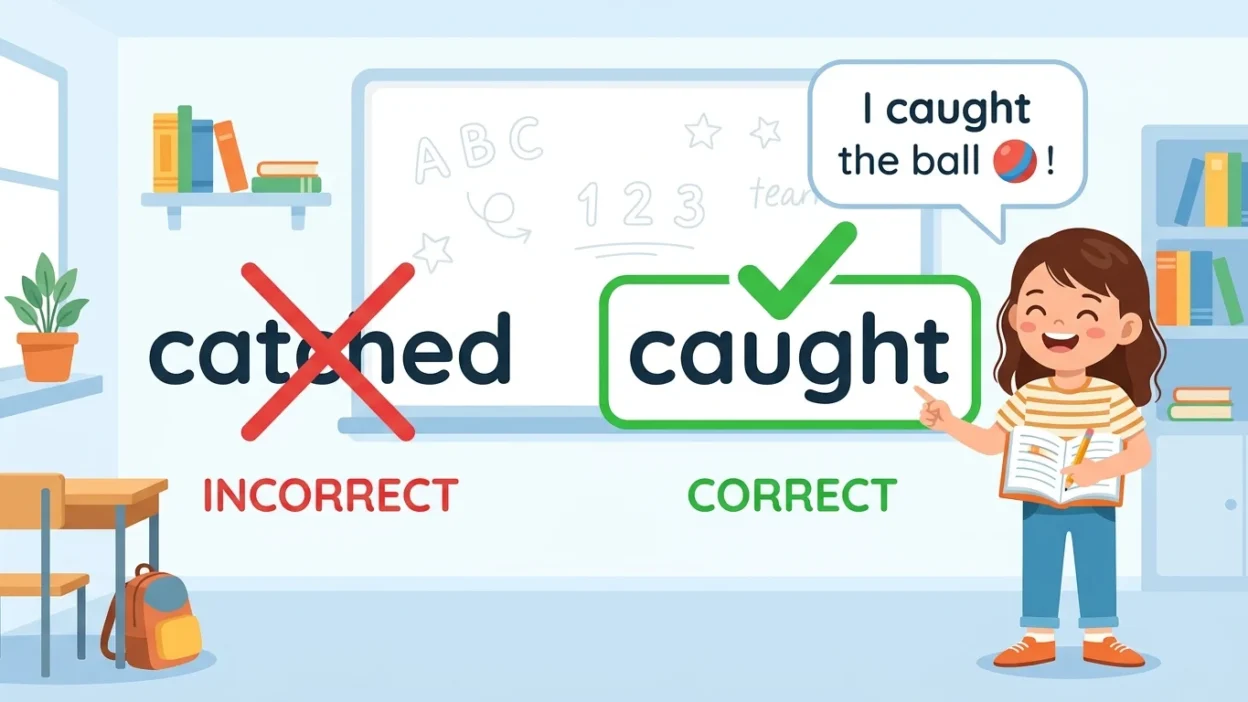
- “Caught” is correct ✔
- “Catched” is incorrect ✘
- “Caught” is the past form and past participle of “catch”
- Use “caught” for past actions and perfect tenses
Example:
- Correct: I caught the ball.
- Incorrect: I catched the ball.
Simple Background: Why “Caught” Is Used
In English, some verbs are irregular. This means they change in a special way.
For example:
- go → went
- take → took
- catch → caught
These verbs do not add -ed in the past.
The word “catched” looks logical because many verbs use “-ed,” but English does not use “catched.” It is not part of standard grammar.
Clear Explanation of the Difference
Let’s make this very simple.
Catch (Present)
This is the base form.
- I catch the bus every day.
- She catches the ball easily.
Caught (Past)
This is the correct past form.
- I caught the bus yesterday.
- He caught a fish last weekend.
Catched (Incorrect Form)
- This word is not correct in standard English
- It may be used by beginners or children by mistake
So, the real difference is:
- “Caught” = correct
- “Catched” = wrong
Easy Comparison
| Form | Is it correct? | When to use it | Example |
| Catch | ✔ Yes | Present | I catch the ball. |
| Caught | ✔ Yes | Past / Perfect | I caught the ball. |
| Catched | ✘ No | Never use | ❌ I catched the ball. |
Which One Should You Use and When?
Always follow this simple rule:
- Use “catch” for present
- Use “caught” for past
- Never use “catched”
Examples:
Present:
- I catch mistakes quickly.
- She catches butterflies.
Past:
- I caught a cold last week.
- They caught the thief.
Perfect tense:
- I have caught the ball many times.
- She has caught every mistake.
Common Mistakes People Make
Here are some common errors learners make:
Adding “-ed” to all verbs
Many students think:
- catch → catched ❌
But this rule does not work for irregular verbs.
Mixing forms in one sentence
- Wrong: I have catched the ball ❌
- Correct: I have caught the ball ✔
Using “catched” in writing
Sometimes learners write:
- “He catched the train.” ❌
This is incorrect and should be avoided.
Overthinking the rule
Some people try to create patterns, but for irregular verbs, it is best to memorize the correct form.
Everyday Real Life Examples
Let’s look at how “caught” is used in daily life.
In Emails
- I caught your message late, sorry for the delay.
- She caught an error in the report.
In News
- Police caught the suspect yesterday.
- The player caught the ball in the final seconds.
On Social Media
- I finally caught the sunset today 🌅
- He got caught in the rain!
In Daily Conversations
- I caught a cold.
- Did you catch what he said?
- We caught the last bus home.
Simple Learning Tips for Students
If you want to remember this easily, try these tips:
Think of it as a pair
- catch → caught
Just like:
- teach → taught
- buy → bought
Practice with sentences
Say these aloud:
- I caught it.
- She caught the ball.
Avoid guessing
If you are not sure, never add -ed automatically.
Use small repetition
Repeat 5–10 sentences daily using “caught.” This builds strong memory.
FAQ: Simple Questions and Answers
Is “catched” ever correct?
No, “catched” is not correct in standard English.
Why do people say “catched”?
Because they follow the regular verb rule (add -ed), but “catch” is irregular.
What is the past tense of “catch”?
The correct past tense is “caught.”
Can I use “catched” in informal speech?
No, it is still considered incorrect, even in casual use.
What is the past participle of “catch”?
It is also “caught.”
Example:
- I have caught the ball.
Is “caughted” correct?
No, “caughted” is also incorrect.
How can I remember “caught” easily?
Think of similar words:
- bought
- taught
These help you remember the pattern.
Do native speakers use “catched”?
No, native speakers use “caught.”
Conclusion: Keep It Simple
The confusion between “catched” and “caught” is very common, but the answer is simple:
- Always use “caught”
- Never use “catched”
English has many irregular verbs, and “catch” is one of them. Once you accept this, everything becomes easy.
With a little practice, “caught” will feel natural to you. Keep using it in sentences, and soon you won’t even think about the mistake again.

Anthony Charles is the founder and lead content creator at Meanefy.com, a platform dedicated to exploring word meanings, language nuances, and everyday curiosities. With a passion for language and a keen eye for detail, Anthony aims to make complex words and concepts simple and accessible for readers around the world.