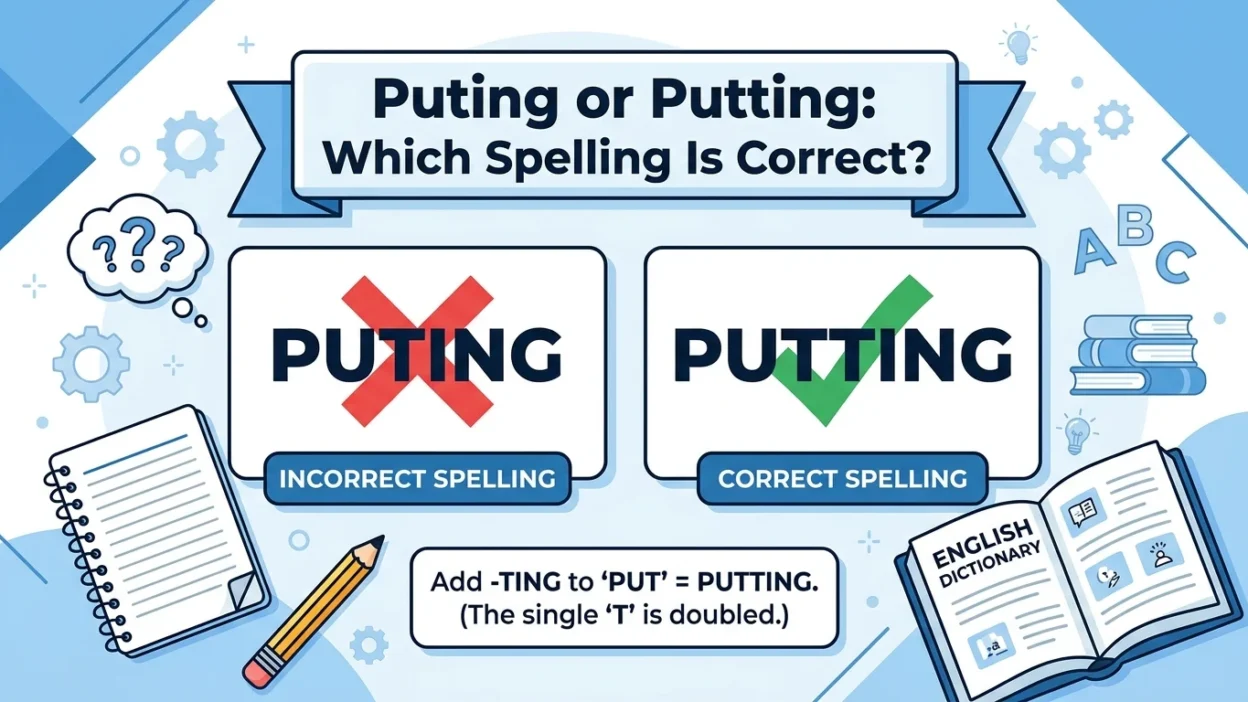
Many English learners and even native speakers sometimes write puting instead of putting. At first glance, both words may look possible because they come from the verb put.
The confusion happens because English spelling rules are not always simple. When people add -ing to a verb, they are often unsure whether they should double the final letter or not.
The good news is that this confusion is easy to fix.
Once you understand the spelling rule, you will know exactly which form is correct and why.
Quick Answer
- Putting is the correct spelling.
- Puting is incorrect in standard English.
- The verb put becomes putting when adding -ing.
- The final t is doubled before adding -ing.
- Always use putting in writing, speaking, schoolwork, emails, and everyday communication.
Correct Examples
- I am putting my books on the table.
- She is putting her phone in her bag.
- They are putting up a new sign.
Incorrect Examples
- I am puting my books on the table.
- She is puting her phone in her bag.
Simple Origin or Background Explanation
The word put is a very old English verb. It means to place something somewhere.
Examples:
- Put the keys on the desk.
- Put the milk in the refrigerator.
- Put your shoes by the door.
When we want to show that the action is happening right now, we add -ing to the verb.
For many short verbs that end with one vowel and one consonant, English often doubles the final consonant before adding -ing.
That is why:
- put → putting
- sit → sitting
- run → running
The same rule applies to the word put.
Clear Explanation of the Difference
The difference is very simple.
Putting
Putting is the correct present participle and continuous form of the verb put.
Examples:
- I am putting the dishes away.
- He is putting on his jacket.
- We are putting together a plan.
This spelling follows standard English grammar rules.
Puting
Puting is not considered correct English spelling.
You may occasionally see it because:
- Someone made a typing mistake.
- Someone did not know the spelling rule.
- A learner was guessing how to spell the word.
In formal and informal English, puting should be avoided.
Easy Rule to Remember
If you start with put, double the t before adding -ing.
- put + ing = putting ✅
- put + ing = puting ❌
Comparison Table
| Feature | Putting | Puting |
| Correct spelling | Yes | No |
| Used in standard English | Yes | No |
| Found in dictionaries | Yes | No |
| Accepted in school writing | Yes | No |
| Accepted in business writing | Yes | No |
| Present participle of “put” | Yes | No |
| Recommended for everyday use | Yes | No |
Which One to Use and When
You should use putting every time you want to describe the action of placing something somewhere.
Use Putting in Present Continuous Tense
Examples:
- I am putting the groceries away.
- She is putting on her shoes.
- They are putting the chairs in the room.
Use Putting in Descriptions
Examples:
- Putting effort into your work is important.
- Putting others first can be kind.
- Putting money aside helps with savings.
Use Putting in Instructions
Examples:
- Start by putting the paper on the desk.
- Finish by putting the tools away.
- Keep putting practice into your daily routine.
Never Use Puting
No matter the situation, puting is not the correct spelling in standard English.
Common Mistakes People Make
Many learners make the same spelling mistakes when using putting.
Forgetting to Double the T
Incorrect:
- She is puting her bag on the chair.
Correct:
- She is putting her bag on the chair.
Assuming All Verbs Follow the Same Pattern
Some people think they should simply add -ing to every verb.
While this works for many verbs, some short verbs require a doubled consonant.
Examples:
| Base Verb | Correct -ing Form |
| put | putting |
| run | running |
| sit | sitting |
| stop | stopping |
Writing Too Quickly
Sometimes people know the correct spelling but accidentally type:
- puting
instead of:
- putting
A quick proofread can help catch this mistake.
Mixing Speaking and Writing
When speaking, the doubled t is not obvious. Because of this, some learners write the word incorrectly even though they say it correctly.
Everyday Real Life Examples
Emails
- I am putting the report in the shared folder.
- We are putting the final details together.
- Thank you for putting your ideas into the document.
News
- The city is putting more money into public services.
- Officials are putting safety measures in place.
- The company is putting new rules into effect.
Social Media
- I am putting together my travel photos.
- She is putting a new video online today.
- We are putting our favorite memories in one album.
Daily Use
- Dad is putting the groceries away.
- The teacher is putting books on the shelf.
- I am putting my phone on the charger.
- They are putting decorations around the room.
Short Learning Section for Students and Beginners
A simple way to remember the correct spelling is to learn this pattern:
Step One
Start with the base verb:
put
Step Two
Look at the ending.
The word ends with:
- one vowel (u)
- one consonant (t)
Step Three
Double the final consonant.
put → putt
Step Four
Add -ing.
putt + ing = putting
Practice Sentences
Choose the correct word:
- I am _____ my books away.
- She is _____ on her coat.
- They are _____ up a tent.
Answers:
- putting
- putting
- putting
Memory Tip
Think of these words together:
- run → running
- sit → sitting
- put → putting
They all double the last consonant before adding -ing.
FAQ
Is putting the correct spelling?
Yes. Putting is the correct spelling in standard English.
Is puting a real English word?
No. Puting is considered a spelling mistake in standard English.
Why does putting have two t’s?
The final t is doubled before adding -ing, following a common English spelling rule for short verbs.
How do I use putting in a sentence?
Example:
- She is putting her notebook in her backpack.
Is putting a verb?
Yes. It is the -ing form of the verb put.
Can I use puting in informal writing?
No. Even in casual writing, putting is the correct form.
What tense uses putting?
It is often used in continuous tenses.
Example:
- I am putting the dishes away.
How can I remember the correct spelling?
Remember that short verbs like put, run, and sit usually double the final consonant before adding -ing.
Conclusion
The answer is simple: putting is correct, and puting is incorrect.
The word putting comes from the verb put, and English spelling rules require the final t to be doubled before adding -ing. Whether you are writing an email, completing schoolwork, posting on social media, or having a conversation, putting is always the form you should use.
If you remember the pattern put → putting, you will avoid this common mistake and write with more confidence every time.