Many English learners and even native speakers get confused between reoccurring and recurring because both words seem to have the same meaning. They are often used when talking about something that happens again and again.
When people see these two words, they naturally wonder:
- Are they interchangeable?
- Is one more correct than the other?
- Which word should I use in writing?
The confusion exists because both words are related to repetition. However, there is a small difference in how they are commonly used. Understanding that difference can make your writing clearer and more natural.
This guide explains everything in simple English so you can confidently choose the right word every time.
Quick Answer
- Recurring is the more common and preferred word.
- Reoccurring is a real word and is not wrong.
- Both words can describe something that happens more than once.
- Recurring usually means something happens repeatedly or regularly.
- Reoccurring often focuses on something happening again after stopping.
- In most situations, use recurring because it sounds more natural.
Simple rule:
- If you are unsure, choose recurring.
Origin and Background
To understand these words better, it helps to look at where they come from.
Meaning of Recurring
The word recurring comes from the verb recur.
Recur means:
- To happen again
- To return repeatedly
- To appear over and over
Examples:
- A recurring problem
- A recurring payment
- A recurring dream
Meaning of Reoccurring
The word reoccurring comes from the verb reoccur.
Reoccur means:
- To occur again
- To happen another time after it happened before
Examples:
- The symptoms reoccurred.
- The event reoccurred after several years.
Both words involve repetition, which is why people often mix them up.
The Difference Between Reoccurring and Recurring
The difference is small, but it exists.
Recurring Means Repeated or Regular
When something is recurring, it happens again and again.
It may happen:
- Daily
- Weekly
- Monthly
- Frequently
- In a repeating pattern
Examples:
- A recurring meeting every Monday.
- A recurring charge on your credit card.
- A recurring headache.
The focus is on repetition.
Reoccurring Means Happening Again
When something is reoccurring, the focus is simply that it happened again.
There is not always a sense of a regular pattern.
Examples:
- The issue reoccurred after several months.
- The storm reoccurred the following year.
The focus is on a repeat event rather than a repeated pattern.
Easy Way to Remember
Think of it like this:
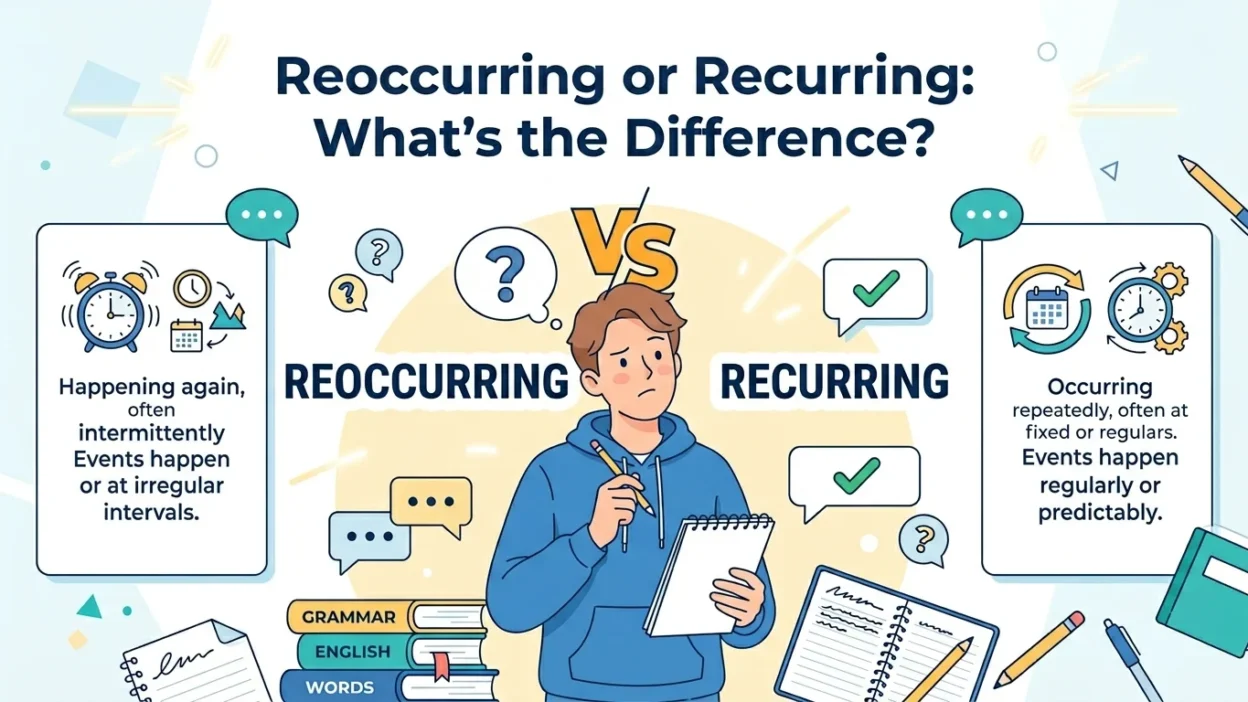
- Recurring = repeating regularly
- Reoccurring = occurring again
In modern English, many people use recurring even when they could technically use reoccurring.
Comparison Table
| Feature | Recurring | Reoccurring |
| Is it a real word? | Yes | Yes |
| More common? | Yes | No |
| Preferred in most writing? | Yes | Usually no |
| Means happens again? | Yes | Yes |
| Suggests a repeated pattern? | Often | Not always |
| Used in business writing? | Very common | Rare |
| Sounds more natural? | Usually yes | Sometimes less natural |
| Safe choice in most situations? | Yes | Not always |
Which One to Use and When
Use Recurring When Talking About Regular Repetition
This is the best choice for most situations.
Examples:
- Recurring payments
- Recurring meetings
- Recurring expenses
- Recurring dreams
- Recurring issues
Sentences:
- We have a recurring team meeting every Friday.
- The company noticed recurring customer complaints.
- She experiences recurring migraines.
Use Reoccurring When Emphasizing That Something Happened Again
This word works when you want to stress that an event returned.
Examples:
- A disease that reoccurred
- A problem that came back
- A situation that happened again
Sentences:
- The infection reoccurred after treatment.
- The same error reoccurred last month.
- The issue reoccurred despite several fixes.
In Everyday Writing
Most writers simply choose recurring.
It is more familiar, more common, and easier for readers to understand.
Common Mistakes People Make
Using Reoccurring Everywhere
Some people think adding “occur” makes the word more correct.
Example:
❌ The company has a reoccurring monthly meeting.
Better:
✅ The company has a recurring monthly meeting.
Thinking Recurring Is Wrong
Some learners believe recurring is an informal version.
That is not true.
Recurring is completely correct and widely accepted.
Mixing the Words Without Understanding Context
Consider these examples:
- A recurring monthly bill.
- A problem that reoccurred after six months.
Both are correct because they fit the situation.
Using Both Words in the Same Sentence
This can make writing confusing.
Example:
❌ The recurring issue reoccurred again.
Better:
✅ The issue reoccurred.
or
✅ The issue is recurring.
Everyday Real Life Examples
Emails
- We are reviewing recurring expenses this quarter.
- The recurring payment has been processed.
- The problem has reoccurred since the last update.
News
- Experts are concerned about recurring flooding in the area.
- The disease has reoccurred in several regions.
- Officials are working to prevent recurring accidents.
Social Media
- I keep having the same recurring dream.
- This bug is recurring after every update.
- The issue reoccurred again today.
Daily Conversations
- We have a recurring family dinner every Sunday.
- My back pain is recurring.
- The problem reoccurred after a few weeks.
- The noise keeps recurring every night.
Learning Section for Students and Beginners
The Simplest Rule
If you are unsure, use recurring.
It is:
- More common
- More natural
- More widely accepted
Quick Practice
Choose the best word.
The company has a ______ monthly subscription.
Answer: recurring
The problem ______ after several months.
Answer: reoccurred
She has ______ headaches every week.
Answer: recurring
The symptoms ______ after treatment.
Answer: reoccurred
Memory Trick
Remember this simple idea:
- Recurring = repeating pattern
- Reoccurring = happening again
This trick helps many learners choose the right word quickly.
FAQ
Is reoccurring a real word?
Yes. Reoccurring is a correct English word. It means something occurs again.
Is recurring more common than reoccurring?
Yes. Recurring is much more common in everyday English and professional writing.
Which word should I use in most situations?
Use recurring in most situations because it sounds more natural and is widely accepted.
Are recurring and reoccurring exactly the same?
Not completely. Both involve repetition, but recurring often suggests a repeated pattern, while reoccurring focuses on something happening again.
Is recurring correct for monthly payments?
Yes. Recurring is the standard word for monthly payments, subscriptions, charges, and scheduled events.
Can I say a reoccurring problem?
Yes, you can. However, many writers would prefer recurring problem because it sounds more natural.
Which word is better in business writing?
Recurring is generally preferred in business, academic, and professional writing.
Do native English speakers use both words?
Yes. However, native speakers use recurring much more often than reoccurring.
Conclusion
The confusion between reoccurring and recurring comes from the fact that both words describe something happening again. While both are correct, they are not used equally.
Recurring is the more common, natural, and widely preferred choice. It is usually used for things that repeat regularly, such as meetings, payments, expenses, dreams, or problems.
Reoccurring is also correct, but it is less common. It is often used when the focus is on something happening again after it happened before.
The easiest rule to remember is simple:
- Recurring = repeated regularly
- Reoccurring = occurring again
If you ever feel unsure, choose recurring. In most situations, it will be the best and most natural choice.

Daniel Matthew is a language enthusiast, writer, and contributor at Meanefy.com, where he explores the meanings, origins, and nuances of words and phrases. With a deep passion for language, Daniel aims to make complex concepts simple, engaging, and easy to understand for readers of all ages.