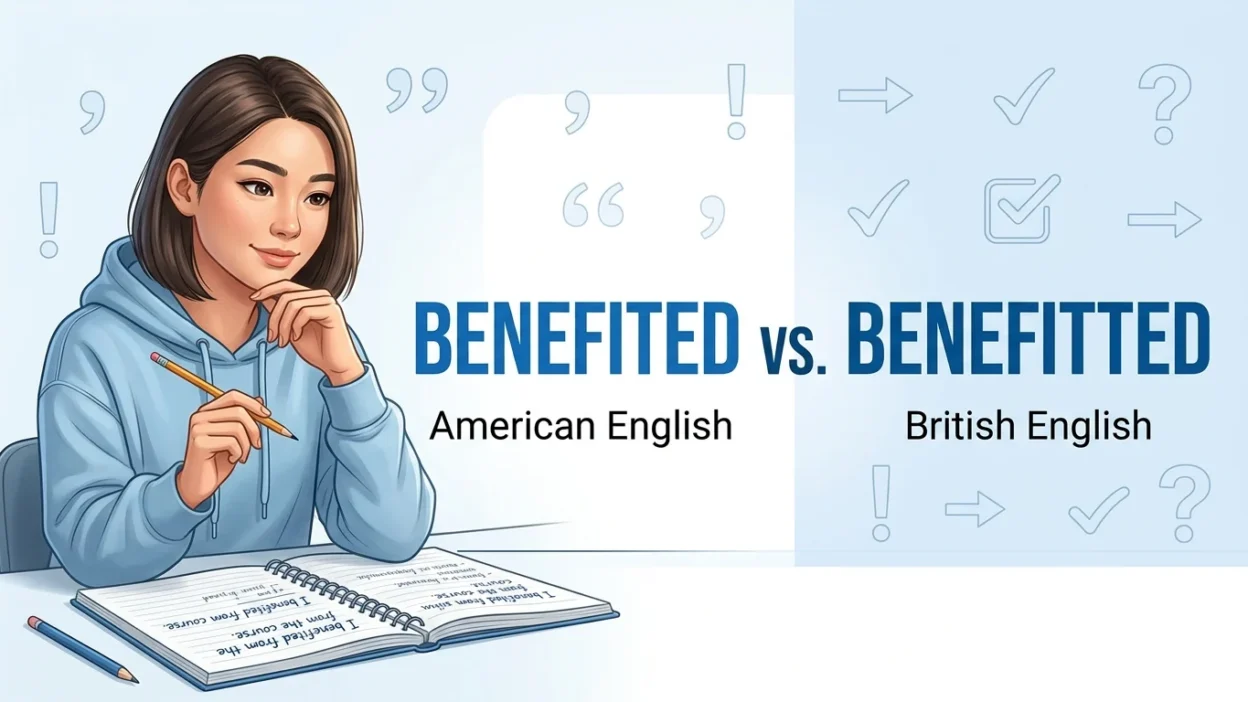
Many English learners and even native speakers get confused about benefited and benefitted because both spellings appear in books, articles, websites, and everyday writing.
When people see two different spellings of the same word, they naturally wonder:
- Which one is correct?
- Are they different in meaning?
- Is one British and the other American?
- Should I use both?
The good news is that the confusion is easy to clear up. Both words come from the same verb, benefit, and both can be correct. The difference is mainly about spelling style.
Quick Answer
- Benefited and benefitted have the same meaning.
- Both are past tense and past participle forms of benefit.
- Benefited is more common in American English.
- Benefitted is more common in British English, although benefited is also widely accepted there.
- There is no difference in meaning.
- If you are writing for an American audience, use benefited.
- If you are writing for a British audience, benefitted may appear more often.
Examples
- The students benefited from the extra lessons.
- The students benefitted from the extra lessons.
Both sentences mean exactly the same thing.
Simple Origin or Background Explanation
The word benefit comes from an older word that meant something good, helpful, or useful.
Today, benefit can be used as:
A Noun
A benefit is an advantage or something helpful.
Examples:
- Exercise has many health benefits.
- One benefit of online learning is flexibility.
A Verb
To benefit means to help someone or improve something.
Examples:
- The new program will benefit students.
- Regular reading benefits language skills.
When we change the verb into the past tense, we get either:
- benefited
- benefitted
This is where the spelling question begins.
Clear Explanation of the Difference
The most important thing to know is that there is no difference in meaning.
Both words mean:
- helped
- improved
- gained an advantage
- received something useful
Benefited
This spelling uses one t before -ed.
Example:
- She benefited from the training.
This form is the preferred spelling in American English.
Benefitted
This spelling doubles the final t before adding -ed.
Example:
- She benefitted from the training.
This form is seen more often in British English.
Why Does the Double T Appear?
English spelling sometimes doubles a final consonant before adding endings such as:
- -ed
- -ing
For example:
- admit → admitted
- travel → travelled (British English)
Some writers apply a similar pattern to benefit, creating benefitted.
Because English spelling rules are not always perfectly consistent, both versions became accepted over time.
Comparison Table
| Feature | Benefited | Benefitted |
| Meaning | Helped or gained an advantage | Helped or gained an advantage |
| Correct spelling | Yes | Yes |
| American English | More common | Less common |
| British English | Accepted | More common |
| Pronunciation | Same | Same |
| Grammar | Past tense and past participle | Past tense and past participle |
| Meaning difference | None | None |
Which One to Use and When
Choosing the right spelling depends mostly on your audience.
Use Benefited When
- Writing in American English
- Writing school assignments using American spelling
- Writing for international readers
- You want the most widely used version
Examples:
- The company benefited from the new policy.
- We benefited from your advice.
- Many people benefited from the project.
Use Benefitted When
- Following British English spelling rules
- Writing for a British audience
- Matching a style guide that prefers double consonants
Examples:
- The community benefitted from the improvements.
- Local businesses benefitted from tourism.
- Students benefitted from additional support.
Be Consistent
The most important rule is consistency.
If you choose benefited, use it throughout your writing.
If you choose benefitted, use that version throughout your writing.
Avoid mixing both spellings in the same piece unless there is a specific reason.
Common Mistakes People Make
Thinking One Is Wrong
Many people believe one spelling must be incorrect.
In reality, both spellings are accepted.
Thinking They Have Different Meanings
Some learners think:
- benefited = helped
- benefitted = earned money
This is not true.
Both words have the same meaning.
Mixing American and British Spellings
For example:
- The organisation benefited from the program.
In this sentence:
- organisation = British spelling
- program = American spelling
- benefited = American preference
Mixing styles can make writing look inconsistent.
Forgetting the Base Word
The base word is:
- benefit
Some learners accidentally write forms that do not follow standard spelling patterns.
Always start with the verb benefit and then choose either:
- benefited
- benefitted
Using the Wrong Tense
Incorrect:
- Yesterday we benefit from the meeting.
Correct:
- Yesterday we benefited from the meeting.
- Yesterday we benefitted from the meeting.
Everyday Real Life Examples
Emails
- Our team benefited from your suggestions.
- We greatly benefited from your support.
- Everyone benefited from the training session.
News
- Farmers benefited from the government program.
- Local businesses benefited from increased tourism.
- Residents benefited from improved public services.
Social Media
- I really benefited from this course.
- Thousands of users benefited from the update.
- We all benefited from sharing ideas.
Daily Conversations
- I benefited from practicing every day.
- She benefited from the experience.
- They benefited from working together.
School and Education
- Students benefited from extra tutoring.
- The class benefited from smaller group activities.
- Children benefited from better learning materials.
Short Learning Section for Students and Beginners
Here is a simple trick to remember.
Step One
Ask yourself:
Am I writing in American English?
If yes, use:
- benefited
Step Two
Ask yourself:
Am I writing in British English?
If yes, you may use:
- benefitted
Easy Memory Tip
Think of it this way:
- American English usually prefers benefited
- British English often accepts benefitted
Quick Practice
Choose the correct word.
- The workers _____ from the new system.
- She _____ from the extra practice.
- We _____ from your advice.
Answers:
- benefited or benefitted
- benefited or benefitted
- benefited or benefitted
Both spellings work as long as you stay consistent.
FAQ
Is benefited correct?
Yes. Benefited is completely correct and is the more common spelling in American English.
Is benefitted correct?
Yes. Benefitted is also correct and is often used in British English.
Do benefited and benefitted mean the same thing?
Yes. They have exactly the same meaning.
Which spelling is more common?
Generally, benefited is more common worldwide, especially in American English.
Is benefitted a spelling mistake?
No. It is a recognized and accepted spelling.
How do I know which one to use?
Choose the version that matches the English style you are using and stay consistent throughout your writing.
Can I use both spellings in one document?
It is usually better not to. Pick one spelling and use it consistently.
Which spelling should students learn first?
Most learners should start with benefited because it is the more widely used form and is commonly taught in international English materials.
Conclusion
The confusion between benefited and benefitted is easier to understand than many people think. Both spellings are correct, both come from the verb benefit, and both mean that someone received help or gained an advantage.
The main difference is spelling preference:
- Benefited is the preferred form in American English.
- Benefitted is more common in British English.
There is no difference in meaning, pronunciation, or grammar. The best approach is to choose the spelling that matches your writing style and use it consistently. Once you remember that both forms are correct, you can write with confidence and avoid unnecessary confusion.

Anthony Charles is the founder and lead content creator at Meanefy.com, a platform dedicated to exploring word meanings, language nuances, and everyday curiosities. With a passion for language and a keen eye for detail, Anthony aims to make complex words and concepts simple and accessible for readers around the world.