Many learners feel confused about “stick” and “stuck.” They look similar, and they both come from the same word family. Because of this, people often use them in the wrong place.
You may have seen sentences like “I am stick here” or “The paper stucks to the wall.” These are very common mistakes.
The good news is that the difference is simple. Once you understand one small idea, you will never mix them up again.
Quick Answer
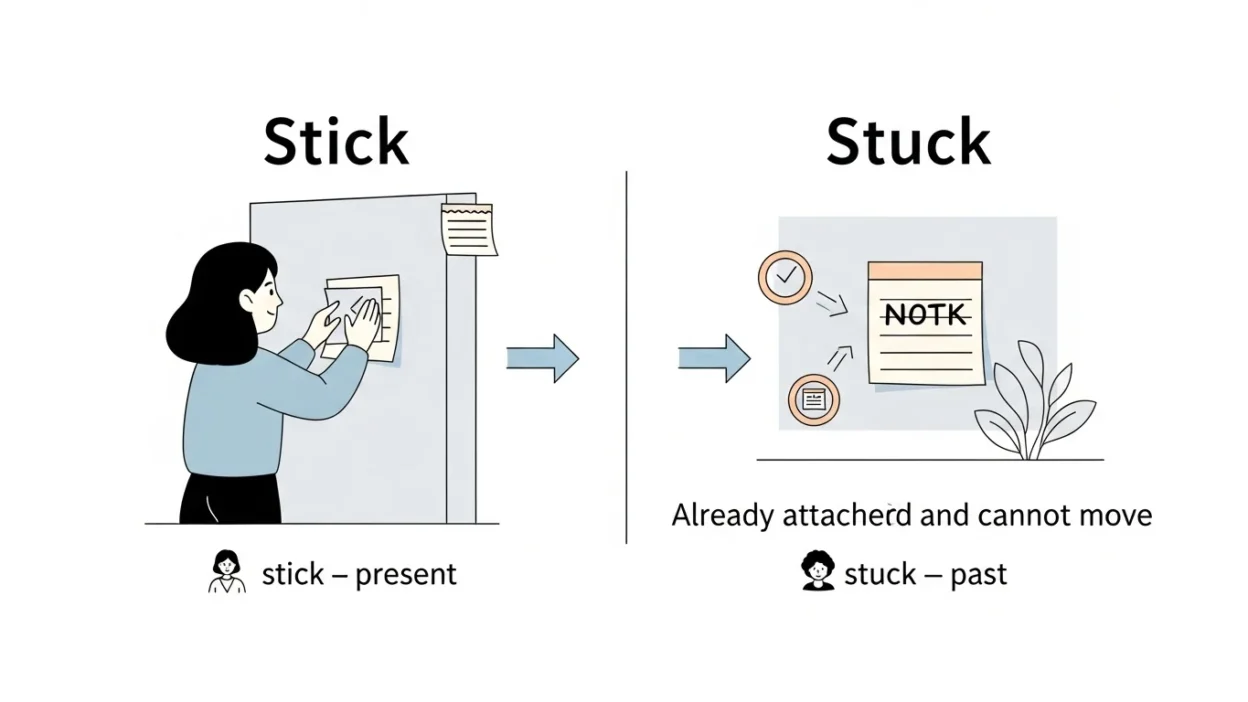
- Stick = base form (present or future)
- Example: I stick the note on the board.
- Stuck = past form or past participle
- Example: I stuck the note on the board yesterday.
- Example: The note is stuck on the board.
- Easy rule:
- Use stick for now or general actions
- Use stuck for past or already finished actions
Simple Background of the Words
The word “stick” is a verb. It means:
- to attach something
- to stay fixed
- to not move easily
Over time, English changed the past form of “stick” into “stuck.” This is not a regular verb. That means we do not say “sticked.” Instead, we say “stuck.”
So:
- Present: stick
- Past: stuck
- Past participle: stuck
Clear Explanation of the Difference
Let’s break it down in a very simple way.
What “stick” means
“Stick” is used when:
- you talk about the present
- you talk about something that happens regularly
- you give instructions
Examples:
- I stick posters on my wall.
- Glue helps things stick together.
- Stick the label here.
What “stuck” means
“Stuck” is used when:
- something already happened
- something cannot move
- something is trapped or fixed
Examples:
- I stuck the poster yesterday.
- My car is stuck in the mud.
- The door is stuck.
The key idea
Think of it like time:
- Stick = now or always
- Stuck = before or already happened
Comparison
| Feature | Stick | Stuck |
| Type | Base verb | Past form / past participle |
| Time | Present or future | Past or completed action |
| Usage | Action happening now | Action already done |
| Example | I stick notes on my desk | I stuck notes yesterday |
| With “is/are” | Not common | Very common |
| Example sentence | Stick the paper here | The paper is stuck |
Which One to Use and When
Here is a simple guide you can follow.
Use “stick” when:
- You talk about habits
- I stick reminders on my phone.
- You give instructions
- Stick this label on the box.
- You describe general facts
- Magnets stick to metal.
Use “stuck” when:
- Something already happened
- I stuck the photo in my notebook.
- Something cannot move
- My shoe is stuck in the mud.
- Something is fixed in place
- The sticker is stuck on the wall.
Helpful trick
If your sentence has:
- yesterday, last night, earlier → use stuck
- now, always, usually → use stick
Common Mistakes People Make
Let’s look at mistakes and correct them.
Mistake one: using “stick” for past
❌ I stick the paper yesterday.
✔ I stuck the paper yesterday.
Mistake two: saying “sticked”
❌ He sticked the note.
✔ He stuck the note.
Mistake three: wrong form with “is”
❌ The paper is stick on the wall.
✔ The paper is stuck on the wall.
Mistake four: confusion with meaning
❌ I am stick in traffic.
✔ I am stuck in traffic.
Simple reminder
- Never say sticked
- Always use stuck for past
Everyday Real Life Examples
Let’s see how people use these words in daily life.
In emails
- Please stick the label on the package.
- The label is already stuck on the box.
In news or reports
- Cars are stuck due to heavy rain.
- Rescue teams helped people who were stuck.
On social media
- I’m stuck at home today.
- Stick with your goals!
In daily conversation
- My phone button is stuck.
- Stick this note on the fridge.
- I got stuck in traffic.
At school
- Stick your chart on the wall.
- My page is stuck together.
Learning Section for Students and Beginners
Here are easy steps to help you remember.
Step one: remember the base form
- Stick = basic form
Step two: remember the past
- Stuck = past and finished
Step three: practice simple sentences
Try these:
- I stick photos in my album.
- I stuck photos in my album yesterday.
Step four: use “is stuck”
This is very common:
- The door is stuck.
- My pen is stuck.
Mini practice
Fill in the blanks:
- I ___ the paper on the wall. (stick/stuck)
- Yesterday, I ___ the paper. (stick/stuck)
- The paper is ___ now. (stick/stuck)
Answers:
- stick
- stuck
- stuck
FAQ Section
What is the main difference between stick and stuck?
“Stick” is present. “Stuck” is past or already done.
Can I say “sticked”?
No. This is wrong. Always use “stuck.”
Is “stuck” always past?
Mostly yes. It can also describe a condition:
- I am stuck.
Can “stuck” mean trapped?
Yes. It often means something cannot move.
When do I use “stick”?
Use it for present actions, habits, or instructions.
Is “stick” only a verb?
No. It can also be a noun (like a wooden stick), but here we are talking about the verb.
Why is it not “sticked”?
Because “stick” is an irregular verb in English.
Is “I am stuck” correct?
Yes. It means you cannot move or leave.
Conclusion
The difference between stick and stuck is simple once you see it clearly.
- Stick is for now or general actions
- Stuck is for past or something already fixed or trapped
If you remember just one idea, remember this:
Stick = present, Stuck = past
Practice a few sentences every day, and soon it will feel natural. With a little time, you will use both words correctly without thinking.

Anthony Charles is the founder and lead content creator at Meanefy.com, a platform dedicated to exploring word meanings, language nuances, and everyday curiosities. With a passion for language and a keen eye for detail, Anthony aims to make complex words and concepts simple and accessible for readers around the world.