Many learners feel confused when they see the words “win” and “won.” They look almost the same, and both are about success. Because of this, people often use them in the wrong way, especially in speaking and writing English.
The good news is that the difference is very simple. Once you understand it, you will not mix them again.
Let’s break it down step by step in easy English.
Quick Answer
Here is the main difference:
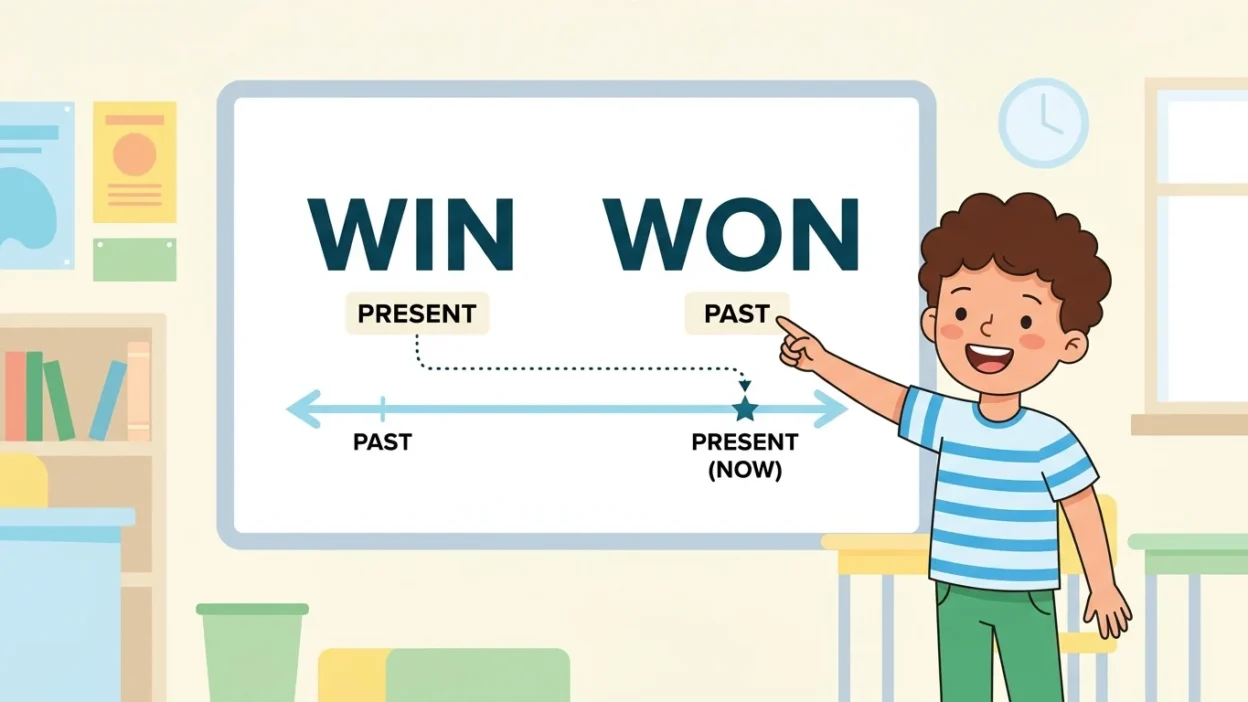
- Win = present form (happening now or in general)
- Won = past form (already happened)
Examples:
- I win the game. (now or usually)
- I won the game. (in the past)
That’s the core idea. Now let’s understand it better.
Simple Background
Both “win” and “won” come from the same base word: win.
English verbs often change their form to show time:
- Present (now)
- Past (before)
- Future (later)
“Win” is an irregular verb, which means it does not follow the usual “-ed” rule.
Instead of:
- win → wined ❌
It changes like this:
- win → won ✔
This is why learners get confused.
Clear Explanation of the Difference
Let’s look at each word in a very simple way.
What does “win” mean?
“Win” means to get success, victory, or a prize.
It is used for:
- Present time
- Habits or general facts
- Future (with helping words)
Examples:
- I win when I play chess.
- They win many matches.
- She will win the race.
What does “won” mean?
“Won” is the past form of “win.”
It means the action already happened and is finished.
Examples:
- I won the game yesterday.
- They won the match last night.
- She won a prize last year.
Simple Way to Remember
- If the action is now or regular → use win
- If the action is already finished → use won
Comparison
| Feature | Win | Won |
| Verb type | Base form | Past form |
| Time | Present / future | Past |
| Use | Now or general truth | Completed action |
| Example | I win games | I won the game yesterday |
| Helping verbs | can, will, do | did, have, had |
Which One to Use and When
Choosing between “win” and “won” is easy if you think about time.
Use “win” when:
- Talking about now
- Talking about habits
- Talking about the future
Examples:
- I win most of my matches.
- We win when we work together.
- He will win the competition.
Use “won” when:
- Talking about the past
- Talking about something finished
Examples:
- I won the match yesterday.
- She won first place last week.
- They won the championship in 2020.
Common Mistakes People Make
Here are some mistakes learners often make:
Using “win” for past
❌ I win the match yesterday.
✔ I won the match yesterday.
Using “won” for present
❌ I won every time I play.
✔ I win every time I play.
Mixing time words
Words like:
- yesterday
- last night
- last year
These always need won, not win.
Forgetting verb tense
Learners sometimes forget that English verbs change with time. Always ask:
Is this now or in the past?
Everyday Real Life Examples
Let’s see how people use “win” and “won” in daily life.
In conversations
- I always win when I practice a lot.
- I won the game yesterday!
In emails
- I hope our team will win the next match.
- Our team won the competition last week.
On social media
- Feeling happy! I won a prize today!
- I believe we can win this game!
In news
- The team won the championship last night.
- Experts say the team can win again this year.
In school
- I win when I study hard.
- I won the quiz competition yesterday.
Learning Tips for Students and Beginners
Here are some easy tips to remember the difference:
Think about time
Ask yourself:
- Is it now? → use win
- Is it past? → use won
Practice with sentences
Make simple sentences every day:
- I win…
- I won…
This helps your brain learn faster.
Use time words
Time words help you choose:
- yesterday → won
- today → win
- every day → win
Speak out loud
Say sentences like:
- I win games.
- I won a game.
Speaking helps you remember better.
Keep it simple
Do not try to make long sentences at first. Start with short and clear ones.
FAQ
What is the main difference between win and won?
“Win” is present. “Won” is past.
Is “won” the past of “win”?
Yes, “won” is the past form of “win.”
Can I say “I win yesterday”?
No. You should say: ✔ I won yesterday.
Can I say “I won every day”?
No. Use present for habits: ✔ I win every day.
Is “win” used for the future?
Yes, with helping words:
- I will win
Why is it “won” and not “wined”?
Because “win” is an irregular verb. It does not follow normal rules.
Can both words mean success?
Yes. Both mean success, but they show different times.
Which one is more common?
Both are common. It depends on the sentence and time.
Conclusion
The difference between “win” and “won” is simple once you focus on time.
- Win is for now, habits, and future
- Won is for the past
Whenever you feel confused, just ask:
Did this happen already, or is it happening now?
If it already happened → use won
If it is now or regular → use win
With a little practice, you will use both words correctly and naturally.

Daniel Matthew is a language enthusiast, writer, and contributor at Meanefy.com, where he explores the meanings, origins, and nuances of words and phrases. With a deep passion for language, Daniel aims to make complex concepts simple, engaging, and easy to understand for readers of all ages.