Many learners of English feel confused about “bended” and “bent.” Both words come from the verb “bend,” which means to curve or change shape. Because English has many irregular verbs, it is not always clear which form is correct.
Some people think “bended” sounds right because many verbs add -ed in the past. Others hear “bent” more often but are not sure why. This article will remove all confusion and help you understand the difference in a very simple way.
Quick Answer
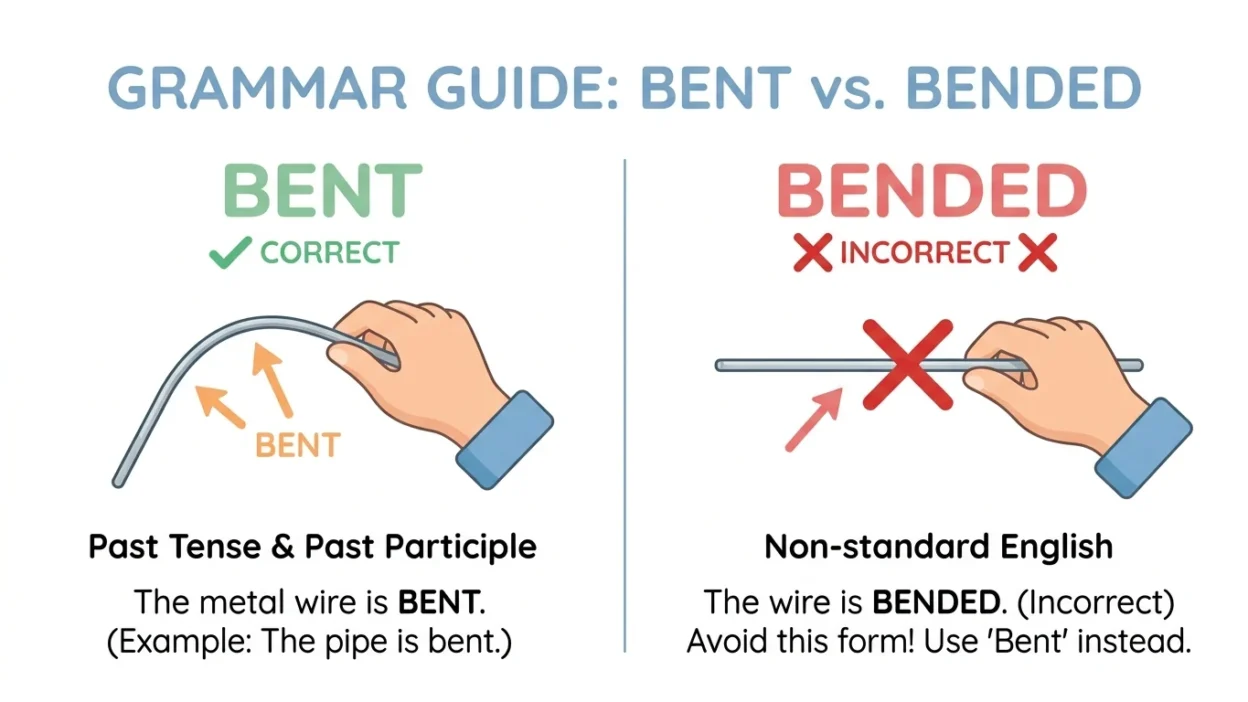
- “Bent” is the correct past tense and past participle of “bend.”
- “Bended” is very rare and usually not used in modern English.
- In almost all situations, you should use “bent.”
Simple rule:
- Yesterday → “I bent the wire.”
- Now perfect → “I have bent the wire.”
Simple Origin and Background
English verbs have two main types:
- Regular verbs → add -ed (like walk → walked)
- Irregular verbs → change in different ways (like go → went)
The verb “bend” is an irregular verb.
Its correct forms are:
- Base form: bend
- Past tense: bent
- Past participle: bent
In older or very rare English, “bended” sometimes appeared, but today it is almost never used in normal conversation or writing.
Clear Explanation of the Difference
What is “Bent”?
“Bent” is the correct and standard form. It is used in both:
- Past tense
- Past participle
Examples:
- She bent the metal rod.
- The tree has bent in the wind.
It is also used as an adjective:
- a bent nail
- a bent pipe
What is “Bended”?
“Bended” is not commonly used today. It may appear in:
- Old texts
- Poetry
- Very rare or special expressions
Example (rare/poetic style):
- He bended his knee in respect.
But in modern English, even this sentence would normally be:
- He bent his knee.
Comparison
| Feature | Bent | Bended |
| Correct today | Yes | No (very rare) |
| Past tense | Yes | Not used |
| Past participle | Yes | Not used |
| Common in speech | Very common | Almost never |
| Used in writing | Yes | Rare or old style |
| Example | I bent the stick | (rare) He bended his knee |
Which One to Use and When
Use “Bent” in all normal situations
You should use “bent” when:
- Talking about the past
- Writing emails or messages
- Speaking in daily life
- Doing school or exam writing
Examples:
- I accidentally bent my glasses.
- She has bent the rules before.
- The road bent to the left.
Avoid “Bended” in modern English
You should not use “bended” unless:
- You are reading or studying old texts
- You are writing poetry or creative work
Even in creative writing, most people still prefer “bent.”
Common Mistakes People Make
Mistake: Using “bended” like a regular verb
❌ I bended the wire.
✔ I bent the wire.
Mistake: Thinking both forms are equal
Some learners think both words are correct. This is not true in modern English.
✔ Always choose “bent.”
Mistake: Mixing verb forms
❌ I have bended it already.
✔ I have bent it already.
Mistake: Overthinking the rule
You do not need to memorize many forms. Just remember:
👉 “bend → bent → bent”
Everyday Real Life Examples
In Emails
- I accidentally bent the document corner.
- The metal frame got bent during delivery.
In News or Reports
- The strong wind bent trees across the city.
- The bridge structure has slightly bent over time.
On Social Media
- Oops, I bent my phone charger again 😅
- This spoon is completely bent!
In Daily Conversations
- Did you bend this key?
- Be careful you’ll bend it.
- The branch has bent under the weight.
Learning Section for Students and Beginners
Here is an easy way to remember:
Step One: Learn the pattern
- bend → bent → bent
Say it out loud a few times.
Step Two: Practice with simple sentences
- I bent it.
- It is bent.
- I have bent it.
Step Three: Compare with other irregular verbs
- send → sent
- spend → spent
- lend → lent
These are similar to “bend → bent.”
Step Four: Avoid “bended”
Whenever you feel like saying “bended,” stop and replace it with “bent.”
FAQ Section
Is “bended” ever correct?
It is not correct in modern everyday English. It may appear in very old or poetic writing.
Why do people say “bended”?
Because many verbs use “-ed,” learners think “bend” should follow the same rule.
What is the past tense of “bend”?
The correct past tense is “bent.”
What is the past participle of “bend”?
It is also “bent.”
Can “bent” be used as an adjective?
Yes. For example:
- a bent wire
- a bent pipe
Is “bended knee” correct?
It is an old or poetic phrase. Today, people usually say “bent knee.”
Which one should I use in exams?
Always use “bent.” It is the correct answer.
Is “bent” formal or informal?
It works in both formal and informal English.
Conclusion
The difference between “bended” and “bent” is actually very simple:
- “Bent” is correct and used everywhere.
- “Bended” is rare and mostly outdated.
If you remember just one thing, remember this:
👉 Always use “bent.”
This small rule will help you speak and write English more clearly and confidently.

Anthony Charles is the founder and lead content creator at Meanefy.com, a platform dedicated to exploring word meanings, language nuances, and everyday curiosities. With a passion for language and a keen eye for detail, Anthony aims to make complex words and concepts simple and accessible for readers around the world.