Many learners feel confused about “blew” and “blown.” Both words come from the same verb, “blow,” but they are used in different ways. The confusion usually happens because both words talk about past actions, but they do not work the same in a sentence.
If you have ever asked yourself, “Should I say blew or blown here?” you are not alone. The good news is that the difference is simple once you see it clearly. This guide will explain everything in very easy English so you can understand it right away.
Quick Answer
Here is the simplest way to remember:
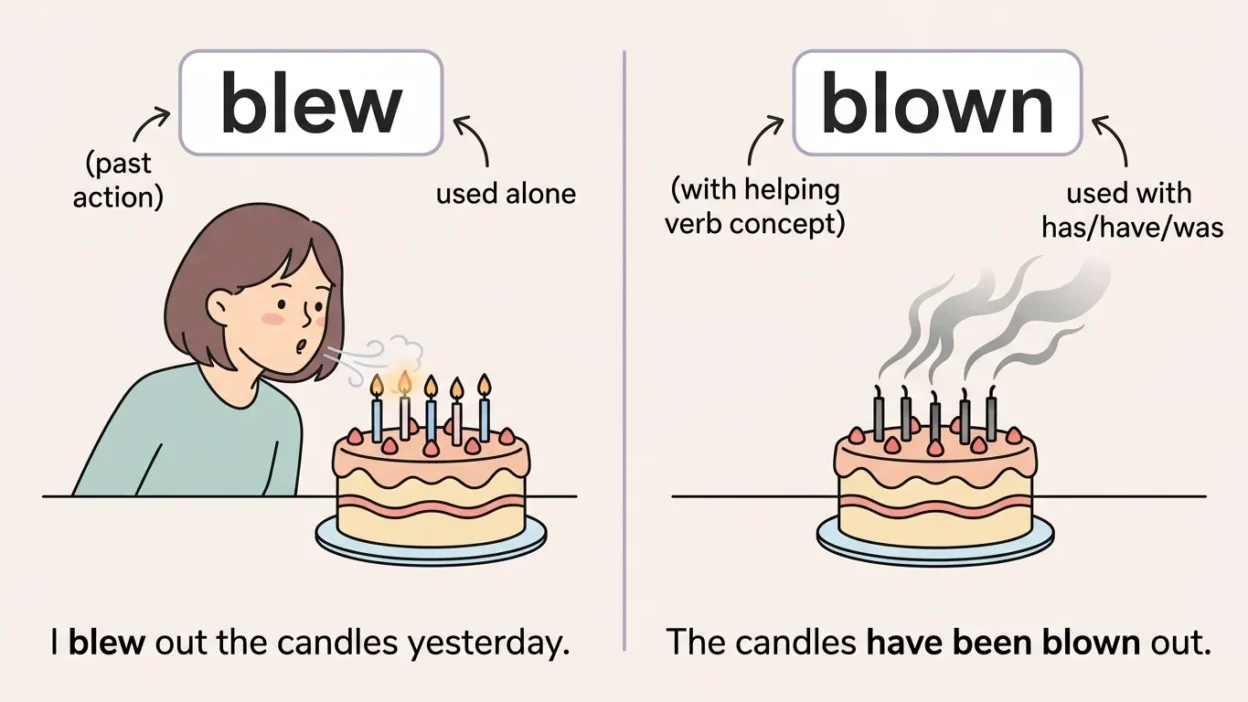
- Blew = past simple (used alone)
- Blown = past participle (used with helping verbs like has, have, had, is, was)
Examples:
- I blew out the candles. ✅
- The candles were blown out. ✅
Simple Background
The verb “blow” means to move air or to move something using air.
For example:
- The wind blows.
- You blow air with your mouth.
Like many English verbs, “blow” changes form when we talk about the past:
- Present: blow
- Past: blew
- Past participle: blown
This is why we have two different words — they are part of the same verb but used in different grammar situations.
The Clear Difference
Let’s understand the difference in the easiest way.
Blew
“Blew” is used when you talk about something that already happened in the past. It does not need any helping verb.
Examples:
- She blew the whistle.
- The wind blew all night.
- He blew out the candle.
👉 You can use “blew” alone in a sentence.
Blown
“Blown” cannot be used alone. It always needs a helping verb like:
- has
- have
- had
- was
- were
- is
- been
Examples:
- She has blown the whistle.
- The leaves were blown away.
- He had blown the candles out before we arrived.
👉 “Blown” always works with another verb.
Comparison
| Feature | Blew | Blown |
| Type | Past simple | Past participle |
| Used alone | Yes | No |
| Needs helping verb | No | Yes |
| Example | He blew the horn. | The horn was blown. |
| Common helpers | Not needed | has, have, had, was, were |
Which One to Use and When
Here is a simple trick to choose the correct word.
Use “blew” when:
- You are talking about a completed past action
- You do not use a helping verb
Examples:
- The wind blew very hard yesterday.
- She blew bubbles in the air.
Use “blown” when:
- You use words like has, have, had, is, was
- The sentence is in passive voice
- You want to show a completed action with a helper
Examples:
- The balloons have blown away.
- The papers were blown off the table.
Common Mistakes People Make
Here are mistakes learners often make:
Using “blown” without a helper
❌ I blown the candles.
✅ I blew the candles.
Using “blew” with a helper
❌ She has blew the whistle.
✅ She has blown the whistle.
Mixing the forms
❌ The leaves have blew away.
✅ The leaves have blown away.
Forgetting passive voice rules
❌ The door was blew open.
✅ The door was blown open.
Everyday Real Life Examples
In Emails
- I blew the budget last month.
- The deadline has been blown already.
In News
- Strong winds blew roofs off houses.
- Many trees were blown down in the storm.
On Social Media
- I accidentally blew out all the candles at once 😂
- My hair got completely blown in the wind!
In Daily Conversation
- He blew the whistle to stop the game.
- The papers were blown everywhere.
Learning Section for Students and Beginners
Here is an easy way to practice:
Step One: Remember the forms
- Blow → Blew → Blown
Step Two: Ask yourself a question
Before choosing the word, ask:
👉 “Do I have a helping verb?”
- If no → use blew
- If yes → use blown
Step Three: Practice simple sentences
Try these:
- Yesterday, the wind ______ very hard.
→ blew - The leaves have ______ away.
→ blown - She ______ out the candles.
→ blew - The candles were ______ out.
→ blown
FAQ Section
What is the main difference between blew and blown?
“Blew” is past simple and used alone. “Blown” is past participle and needs a helping verb.
Can I use “blown” without has or have?
No. “Blown” always needs a helping verb like has, have, had, was, or were.
Is “blew” present or past?
“Blew” is past tense.
Is “blown” past or present?
“Blown” is also related to the past, but it is used with helping verbs.
Which is correct: “has blew” or “has blown”?
“Has blown” is correct.
Can I say “was blew”?
No. You should say “was blown.”
Why are there two forms?
English verbs often have different forms for different grammar uses. “Blew” and “blown” are part of this pattern.
How can I remember this easily?
Think:
- Blew = alone
- Blown = needs a helper
Conclusion
Understanding “blew” and “blown” becomes very easy once you know their roles.
- Use blew for simple past actions without helpers
- Use blown with helping verbs like has, have, had, was, were
The key idea is simple:
👉 If there is a helping verb, use blown
👉 If there is no helping verb, use blew
With a little practice, you will start using both words correctly without thinking twice. Keep practicing with simple sentences, and soon this confusion will completely disappear.