Many English learners feel confused when they see “bit” and “bitten.” They look similar, and both come from the same verb: “bite.” Because of this, people often mix them up in speaking and writing.
The good news is that the difference is simple once you understand it clearly. In this article, you will learn the meaning of each word, when to use them, and how to avoid common mistakes.
Quick Answer
- Bit = past simple form of bite
→ Used for something that happened in the past
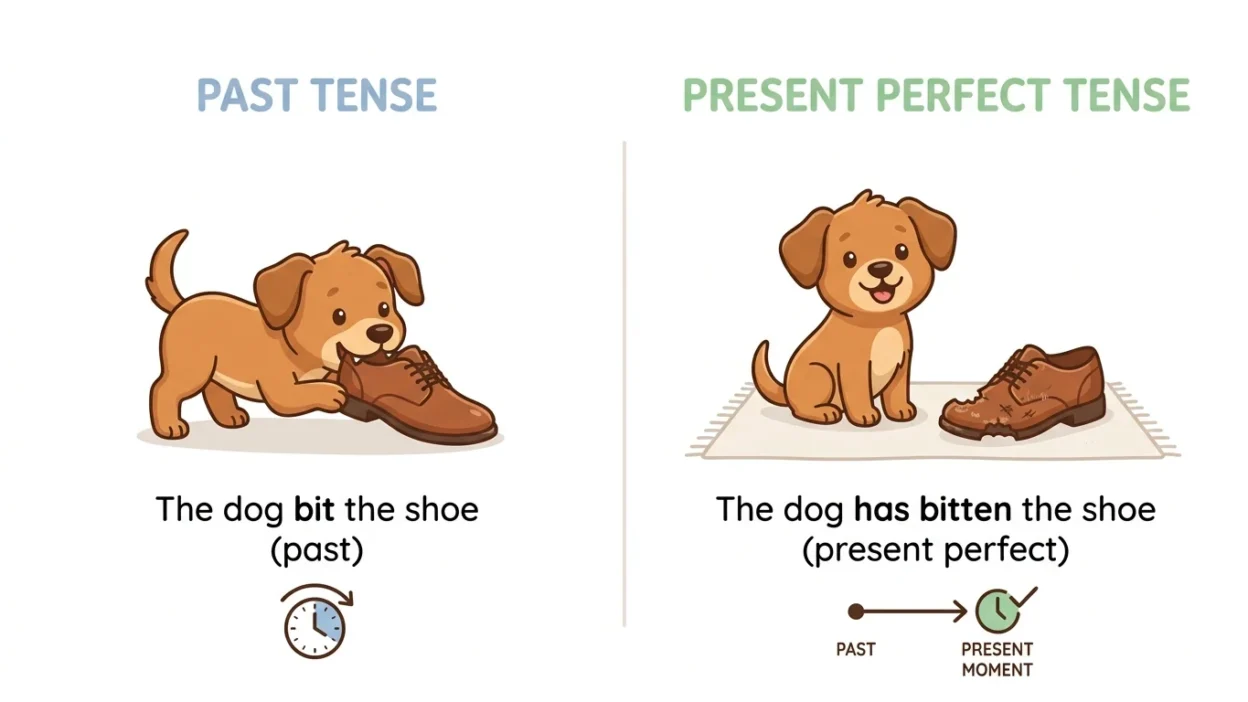
→ Example: The dog bit me. - Bitten = past participle form of bite
→ Used with helping verbs like has, have, had
→ Example: The dog has bitten me.
Origin and Background
Both bit and bitten come from the base verb “bite.”
Here are the three main forms of the verb:
- Base form: bite
- Past simple: bit
- Past participle: bitten
This pattern is called an irregular verb, which means it does not follow the usual “-ed” rule like walk → walked.
Because the forms are different, it is important to learn each one carefully.
The Difference Explained Simply
Let’s break it down in the easiest way.
Bit
- “Bit” is used when talking about a finished action in the past.
- It does not need a helping verb.
Example:
- The snake bit him yesterday.
- She bit her lip.
Here, the action is complete and clear.
Bitten
- “Bitten” is used with helping verbs such as:
- has
- have
- had
- It is part of perfect tenses.
Example:
- The snake has bitten him.
- She had bitten her lip before speaking.
Here, the action connects to another time or result.
Comparison
| Form | Type | Use | Example |
| Bite | Base verb | Present or general use | I don’t bite. |
| Bit | Past simple | Finished past action | The dog bit me. |
| Bitten | Past participle | With has/have/had | The dog has bitten me. |
Which One to Use and When
Use bit when:
- You talk about a past action
- You do not use a helping verb
Examples:
- The insect bit me last night.
- He bit into the apple.
Use bitten when:
- You use helping verbs like has, have, had
- You want to connect the past action to now or another event
Examples:
- I have been bitten by a mosquito.
- She had bitten her nails before the exam.
Simple Tip
- No helping verb → use bit
- With helping verb → use bitten
Common Mistakes People Make
Here are some mistakes learners often make:
Using “bit” instead of “bitten”
Incorrect:
- I have bit my tongue.
Correct:
- I have bitten my tongue.
Using “bitten” without a helping verb
Incorrect:
- The dog bitten me.
Correct:
- The dog bit me.
Forgetting the tense
Incorrect:
- Yesterday, the cat has bitten me.
Correct:
- Yesterday, the cat bit me.
Mixing forms in one sentence
Incorrect:
- He bit and has bitten the apple.
Correct:
- He bit the apple.
or - He has bitten the apple.
Everyday Real Life Examples
In Emails
- I accidentally bit my lip during lunch.
- I have bitten my tongue while eating.
In News
- A dog bit a man in the park.
- Several people have been bitten by stray dogs.
On Social Media
- Ouch! I just bit my cheek while chewing 😅
- I’ve been bitten by a mosquito again!
In Daily Conversations
- Did the dog bite you?
- Yes, it bit me yesterday.
- Have you ever been bitten by a snake?
- No, I haven’t.
Learning Section for Students and Beginners
If you are learning English, here is a simple way to remember:
Step One: Learn the verb forms
- Bite → Bit → Bitten
Say them aloud:
- bite, bit, bitten
Step Two: Practice with sentences
Try these:
- The dog bit the boy.
- The dog has bitten the boy.
Step Three: Use time clues
- Words like yesterday, last night, ago → use bit
- Words like has, have, had → use bitten
Step Four: Make your own examples
Write your own sentences:
- I bit into a sandwich.
- I have bitten into a sandwich.
This helps your brain remember better.
FAQ
What is the difference between “bit” and “bitten”?
“Bit” is the past simple form. “Bitten” is the past participle used with helping verbs.
Can I say “I have bit”?
No. You should say:
- I have bitten.
Is “bitten” always used with has/have/had?
Yes, almost always. It needs a helping verb.
Which is correct: “The dog bit me” or “The dog bitten me”?
Correct:
- The dog bit me.
Can “bitten” be used alone?
No. It usually needs a helping verb like:
- has bitten
- have bitten
Why is it confusing?
Because both words come from the same verb and look similar, but they are used in different grammar forms.
Is “bite” regular or irregular?
It is an irregular verb, so it does not follow the “-ed” rule.
How can I remember the difference easily?
Think:
- Bit = simple past
- Bitten = with has/have/had
Conclusion
The difference between bit and bitten is simple once you understand the pattern.
- Bit is for past actions without helping verbs
- Bitten is used with helping verbs like has, have, had
If you remember this one rule, you will avoid most mistakes.
Keep practicing with small sentences, and soon it will feel natural. English becomes much easier when you learn one clear rule at a time.

Daniel Matthew is a language enthusiast, writer, and contributor at Meanefy.com, where he explores the meanings, origins, and nuances of words and phrases. With a deep passion for language, Daniel aims to make complex concepts simple, engaging, and easy to understand for readers of all ages.