Many learners feel confused when they see the words rose and risen. Both come from the verb rise, and both talk about something going up. But they are not used in the same way. This can make it hard to know which one to choose.
If you have ever asked yourself, “Should I say the sun has rose or the sun has risen?” — you are not alone. This article will explain everything in very simple English so you can understand it clearly on your first read.
Quick Answer
Here is the simple difference:
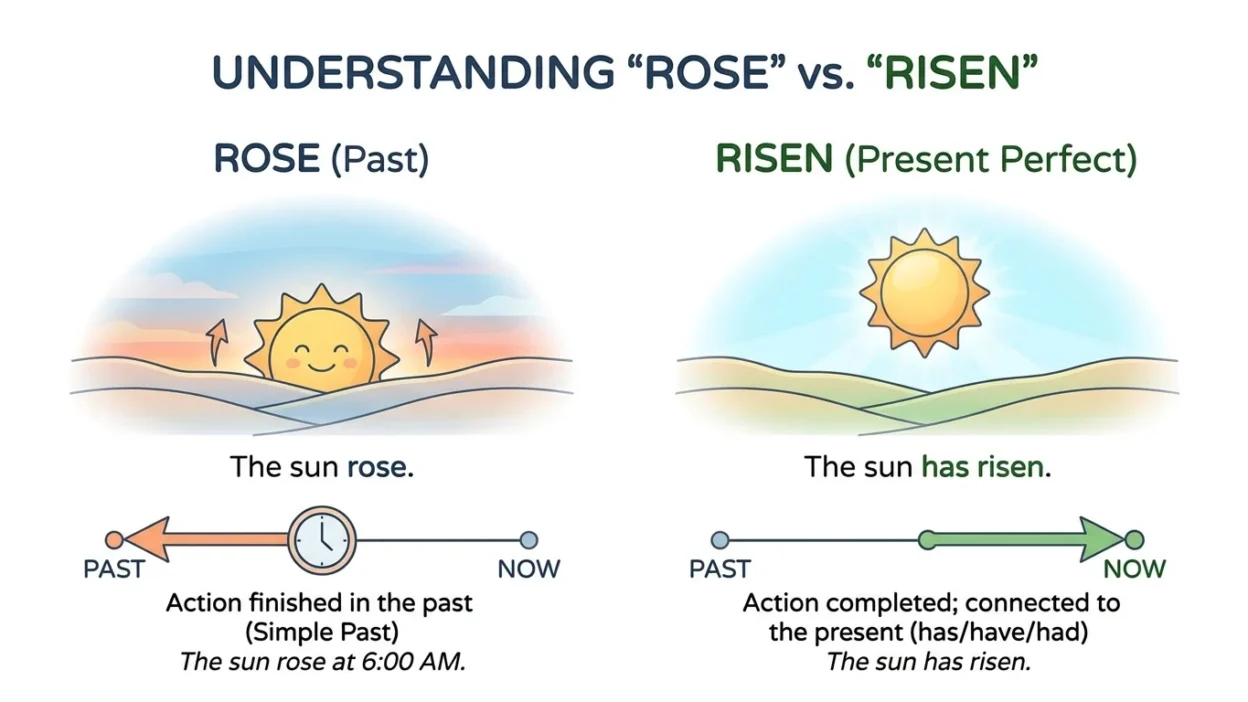
- Rose = past simple form of rise
→ Used for actions that happened in the past
→ Example: The sun rose at 6 a.m. - Risen = past participle form of rise
→ Used with helping verbs like has, have, or had
→ Example: The sun has risen.
👉 Easy tip:
- Use rose alone
- Use risen with has / have / had
Background of the Words
The verb rise is an irregular verb. This means it does not follow the usual pattern like play → played → played.
Instead, it changes like this:
- Base form: rise
- Past simple: rose
- Past participle: risen
These forms come from very old English. Many common verbs are irregular, like:
- go → went → gone
- see → saw → seen
- take → took → taken
So, rose and risen are simply two different forms of the same verb.
Clear Explanation of the Difference
Let’s understand this in the easiest way.
What is “rose”?
Rose is used when you talk about something that happened in the past and is finished.
👉 Structure:
- Subject + rose
👉 Examples:
- The sun rose early today.
- Prices rose last year.
- She rose from her chair.
No helping verb is needed.
What is “risen”?
Risen is used with a helping verb. It cannot stand alone.
👉 Structure:
- Subject + has/have/had + risen
👉 Examples:
- The sun has risen.
- Prices have risen again.
- He had risen before everyone else woke up.
Very Simple Way to Remember
- If there is no helping verb, use rose
- If there is has / have / had, use risen
Comparison
| Feature | Rose | Risen |
| Type | Past simple | Past participle |
| Used alone? | Yes | No |
| Needs helping verb? | No | Yes |
| Example | The sun rose | The sun has risen |
| Time | Finished past action | Connected to present or past |
Which One to Use and When
Here is how to choose the correct word.
Use “rose” when:
- You talk about a completed past action
- There is no helping verb
👉 Examples:
- The water level rose quickly.
- He rose to speak.
- The crowd rose during the speech.
Use “risen” when:
- You use has, have, or had
- You want to connect the past action to now
👉 Examples:
- The water level has risen.
- He has risen to fame.
- The crowd had risen before the music started.
Common Mistakes People Make
Many learners make these small but important mistakes.
Using “risen” without a helping verb
❌ The sun risen early.
✔ The sun rose early.
Using “rose” with a helping verb
❌ The sun has rose.
✔ The sun has risen.
Mixing both forms
❌ Prices have rose.
✔ Prices have risen.
Forgetting the verb form
Sometimes learners use the base form by mistake.
❌ Yesterday, the sun rise at 6 a.m.
✔ Yesterday, the sun rose at 6 a.m.
Everyday Real Life Examples
Let’s see how these words are used in daily life.
In emails
- The issue rose during the meeting.
- The problem has risen again this week.
In news
- Oil prices rose sharply yesterday.
- Oil prices have risen in recent months.
On social media
- My stress level rose during exams 😅
- My confidence has risen after practice 💪
In daily conversation
- The sun rose before we woke up.
- The temperature has risen today.
- He rose from his seat.
- She has risen to a higher position.
Learning Section for Students and Beginners
Here are some simple tips to help you remember:
Easy Memory Trick
Think of this pattern:
- Yesterday → rose
- Has / have → risen
Practice Sentences
Try to fill in the blanks:
- The sun ______ early today.
- Prices have ______ again.
- He ______ from his chair quickly.
- The river has ______ after the rain.
👉 Answers:
- rose
- risen
- rose
- risen
Simple Rule to Keep in Mind
👉 “Risen needs a helper. Rose stands alone.”
FAQ Section
What is the main difference between rose and risen?
Rose is past simple. Risen is past participle and needs a helping verb.
Can I say “has rose”?
No. This is incorrect.
You should say: has risen
Can “risen” be used alone?
No. It always needs has, have, or had.
Is “rose” always about the past?
Yes. It talks about a completed action in the past.
Why is this confusing?
Because both words come from the same verb and look similar, but they follow different grammar rules.
What helping verbs are used with “risen”?
- has
- have
- had
Is “rise” a regular verb?
No. It is an irregular verb.
Can I replace “rose” with “risen”?
No. You must follow the correct structure.
Conclusion
Understanding rose and risen becomes easy when you focus on one simple idea:
- Rose = past action, used alone
- Risen = used with has / have / had
Once you remember this rule, you will stop making mistakes and feel more confident in your writing and speaking.
Take your time, practice with real sentences, and soon it will feel natural.

Anthony Charles is the founder and lead content creator at Meanefy.com, a platform dedicated to exploring word meanings, language nuances, and everyday curiosities. With a passion for language and a keen eye for detail, Anthony aims to make complex words and concepts simple and accessible for readers around the world.