Many English learners get confused about “swam” and “swum.” Both words come from the verb “swim,” so they look very similar. Because of this, people often use the wrong one in speaking and writing.
You may hear sentences like:
- “I have swam before.”
- “She swum across the lake.”
These sentences sound close to correct, but they are not right in standard English.
The good news is that the difference is actually very simple once you understand how these words work. In this article, you will learn when to use swam and when to use swum in easy everyday English.
Quick Answer
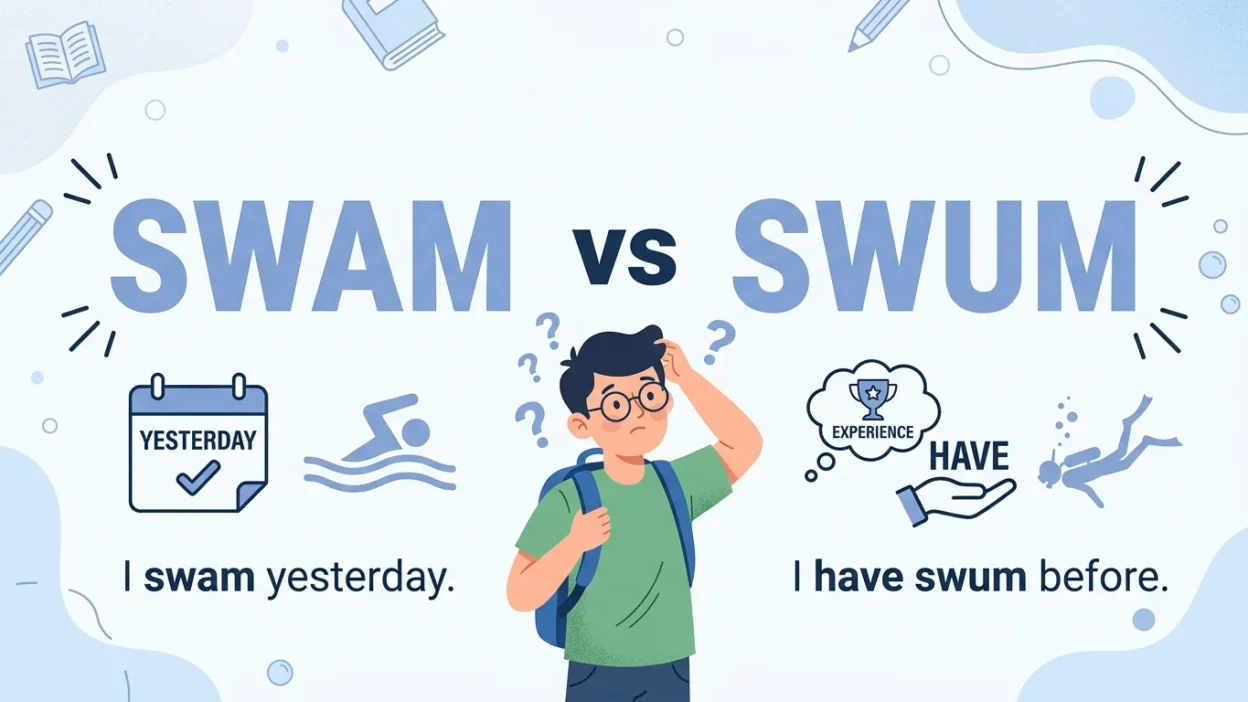
- Swam = simple past tense
- Example: “I swam yesterday.”
- Swum = past participle
- Example: “I have swum before.”
- Use swam without helping verbs.
- Use swum with helping verbs like:
- have
- has
- had
Easy Rule
- “Yesterday I swam.”
- “I have swum many times.”
Background of the Words
The verb “swim” is an irregular verb in English. That means it does not follow the normal “-ed” rule.
Many regular verbs work like this:
- walk → walked
- jump → jumped
But “swim” changes differently:
- swim
- swam
- swum
English has many irregular verbs like:
- sing → sang → sung
- drink → drank → drunk
- begin → began → begun
The pattern is similar, which can help you remember it.
Understanding the Difference
What Does “Swam” Mean?
“Swam” is the simple past tense of “swim.”
Use it when talking about an action that happened in the past.
Examples
- I swam in the pool yesterday.
- She swam very fast.
- They swam across the river last summer.
In all these examples, the action is finished.
Simple Formula
Subject + swam
Examples:
- He swam.
- We swam.
- The dog swam.
What Does “Swum” Mean?
“Swum” is the past participle form of “swim.”
You usually use it with helping verbs such as:
- have
- has
- had
Examples
- I have swum in the ocean before.
- She has swum since childhood.
- They had swum for hours.
“Swum” almost never stands alone in normal grammar.
Simple Formula
Subject + helping verb + swum
Examples:
- I have swum.
- He has swum.
- They had swum.
Comparison
| Word | Type | Used With Helping Verb? | Example |
| Swam | Simple past tense | No | I swam yesterday. |
| Swum | Past participle | Yes | I have swum before. |
Which One Should You Use?
Use “Swam” When Talking About a Finished Past Action
Choose “swam” when the sentence talks about something that happened before and is already finished.
Examples
- We swam at the beach last weekend.
- My brother swam in cold water.
- She swam after school.
Look for time words like:
- yesterday
- last night
- last year
- earlier
- ago
These often signal that “swam” is correct.
Use “Swum” With Helping Verbs
Choose “swum” when the sentence includes:
- have
- has
- had
Examples
- I have swum in many lakes.
- He has swum competitively for years.
- They had swum before the rain started.
If there is a helping verb, “swum” is usually the correct choice.
Common Mistakes People Make
Mistake: “I Have Swam”
This is one of the most common grammar mistakes.
❌ Incorrect:
- I have swam there before.
✅ Correct:
- I have swum there before.
Why?
Because “have” needs the past participle form, and the past participle is “swum.”
Mistake: Using “Swum” Alone
❌ Incorrect:
- Yesterday I swum in the river.
✅ Correct:
- Yesterday I swam in the river.
Why?
Because there is no helping verb.
Mistake: Forgetting the Verb Pattern
Some learners remember:
- swim → swam
But forget the third form:
- swum
Try to remember all three together:
- swim
- swam
- swum
Easy Trick to Remember
Think about these similar verb patterns:
| Base Verb | Past | Past Participle |
| sing | sang | sung |
| drink | drank | drunk |
| swim | swam | swum |
Notice how the last word changes again.
This makes “swum” easier to remember.
Everyday Real Life Examples
In Daily Conversation
- We swam all afternoon.
- Have you ever swum in the sea?
- She has swum since she was five years old.
In Text Messages
- I swam today and I’m tired.
- Have you ever swum in deep water?
In Social Media Posts
- We swam at the beach today!
- I have never swum in such clear water before.
In School Writing
- The athletes swam very well during the competition.
- The students had swum for practice every morning.
In News or Sports
- The swimmer swam a record-breaking race.
- She has swum internationally for many years.
Practice Sentences
Choose the correct word.
Answers Included
- Yesterday we ___ in the lake.
- ✅ swam
- I have never ___ that far before.
- ✅ swum
- She ___ very quickly during the race.
- ✅ swam
- They had ___ for hours.
- ✅ swum
Short Learning Section for Students and Beginners
Step One: Look for a Helping Verb
Check if the sentence has:
- have
- has
- had
If yes, use swum.
Example:
- I have swum there before.
Step Two: No Helping Verb?
Use swam.
Example:
- I swam there yesterday.
Step Three: Practice Speaking
Say these aloud:
- I swam yesterday.
- I have swum before.
Speaking helps your memory.
Mini Quiz
Choose the correct answer.
Question
- She has ___ in this pool many times.
- swam
- swum
✅ Correct answer: swum
Question
- Last summer we ___ every day.
- swam
- swum
✅ Correct answer: swam
Question
- They had ___ before dinner.
- swam
- swum
✅ Correct answer: swum
FAQ
Is “I have swam” correct?
No. The correct sentence is:
- “I have swum.”
Is “swum” a real word?
Yes. “Swum” is the past participle form of “swim.”
Can I say “Yesterday I swum”?
No. The correct sentence is:
- “Yesterday I swam.”
Why do people confuse swam and swum?
Because both words come from “swim,” and they sound similar.
Which word is more common?
Both are common, but they are used in different grammar situations.
- “Swam” is common in simple past sentences.
- “Swum” is common after helping verbs.
Do native English speakers make this mistake?
Yes. Some native speakers also say “have swam” in casual speech, but standard grammar uses “have swum.”
How can I remember the difference easily?
Remember this simple pattern:
- swim
- swam
- swum
And remember:
- no helping verb = swam
- helping verb = swum
Is “swimmed” correct?
No. “Swimmed” is not correct English because “swim” is an irregular verb.
- swim
- swam
- swum
Conclusion
The difference between swam and swum becomes simple once you know the grammar rule.
- Use swam for a finished action in the past.
- “I swam yesterday.”
- Use swum with helping verbs like:
- have
- has
- had
- Example:
- “I have swum before.”
A good way to remember is:
- swim
- swam
- swum
With practice, these words will start to feel natural in everyday English.

Anthony Charles is the founder and lead content creator at Meanefy.com, a platform dedicated to exploring word meanings, language nuances, and everyday curiosities. With a passion for language and a keen eye for detail, Anthony aims to make complex words and concepts simple and accessible for readers around the world.